

32 Sociology Research Topics for High School Students (2026 Guide)

32 Sociology Research Topics for High School Students (2026 Guide)
You want to write a sociology research paper that stands out to university admissions officers, but a quick search for sociology topics yields a mess of overly broad questions. Asking "What causes poverty?" or "How do we stop bullying?" is not a viable high school research project—it is an entire academic discipline. To get published and make a genuine impact, you need a narrow, feasible research question that you can actually answer using accessible data in a reasonable timeframe.
Here is your complete guide to selecting and executing a sociology research project, including 32 realistic topics, data collection methodologies, and actionable publication pathways.
At a Glance: High School Sociology Research
Best methodologies: Secondary data analysis, anonymized surveys, and observational studies.
Time commitment: 10 to 14 weeks from topic selection to final draft.
Key constraint: Avoid protected groups or sensitive topics (e.g., mental health trauma, illegal behavior) to bypass complex Institutional Review Board (IRB) restrictions.
Standard format: APA citation style is the default for sociological research.
On this page:
Most high school students read a list of popular sociology survey topics and immediately try to poll their classmates about sensitive issues like clinical depression, family trauma, or substance use. This is a critical procedural mistake.
Conducting primary research on human subjects requires strict ethical oversight. At the university level, this is handled by an Institutional Review Board (IRB), which ensures the safety, informed consent, and privacy of the participants. High schoolers researching sensitive topics on minors rarely have the institutional backing to secure IRB approval. If you cannot prove your research was conducted ethically, reputable journals will refuse to publish it.
The solution is to pivot your methodology. You must either conduct completely anonymous, low-risk surveys on benign subjects (such as study habits or media consumption), or bypass surveys entirely by utilizing secondary data. Leveraging massive, pre-vetted datasets from established organizations allows you to ask complex questions without navigating the ethical minefield of primary human subject research.
Rather than attempting to solve global socioeconomic crises, focus on localized, measurable sociological phenomena. A good research question identifies two specific variables and asks how they relate. Here are 32 highly focused sociology topics categorized by theme, designed specifically for high school researchers.
Social Media and Digital Identity
How algorithm-driven video feeds influence political polarization among first-time teen voters.
The effect of "studygram" (study Instagram) culture on high school academic anxiety and perfectionism.
Differences in digital privacy expectations between Generation Z and Millennials on public forums.
How anonymous posting applications affect the prevalence and reporting of cyberbullying in suburban high schools.
The role of Discord communities in forming primary social bonds for socially anxious teenagers.
Does screen-time monitoring by parents increase or decrease long-term digital literacy in adolescents?
The correlation between TikTok trend participation and perceived peer acceptance in middle school environments.
How online gaming voice chats replicate or challenge traditional gender norms among teenage players.
Education and Peer Dynamics
How classroom seating arrangements (clusters vs. rows) impact student verbal participation in STEM classes.
The sociological function of school dress codes: promoting conformity versus minimizing socioeconomic distractions.
How participation in varsity sports alters perceived social mobility and status within the high school hierarchy.
The impact of standardized testing culture on peer collaboration versus competitive isolation.
How commuter students experience school belonging compared to local students living near campus.
The effect of part-time after-school employment on a student’s social capital and peer relationships.
Do school-mandated anti-bullying assemblies change actual student behavior, or merely increase policy awareness?
How bilingual students navigate social integration and code-switching in English-dominant classrooms.
Family Structure and Cultural Shifts
How birth order correlates with assumed domestic responsibilities in first-generation immigrant households.
The impact of remote work policies on weekday family dinner frequency and household communication.
How different generations within the same extended family define and measure "financial success."
The sociological impact of multigenerational living on teenage independence and eldercare expectations.
How dual-income households divide emotional labor and scheduling compared to single-income households.
The role of household pets as surrogate siblings in single-child families.
How parental education levels influence a student's choice of, and access to, specialized extracurricular activities.
The shift in stigma regarding mental health discussions across two distinct family generations.
Consumerism and Community
How the rapid gentrification of a local neighborhood affects adolescent hangout spaces and social mobility.
The impact of fast-fashion environmental awareness on the actual shopping habits of high school students.
How local independent coffee shops function as vital "third places" for teenagers outside of home and school.
The sociology of brand loyalty: Why students stratify socially based on technology ecosystems (e.g., Apple vs. Android).
How public transportation access dictates social inclusion and employment opportunities for non-driving teenagers.
The correlation between neighborhood walkability (urban design) and community trust among local residents.
How mandatory volunteer requirements for high school graduation affect genuine, long-term civic engagement.
The influence of global pop culture (such as K-pop) on the formation of local high school subcultures.
Need more inspiration to narrow down your focus? Explore other research project ideas to see the exact frameworks successful students are investigating right now.
Once you have defined your topic, you must determine how to gather your evidence. High school researchers generally choose between two distinct data pathways.
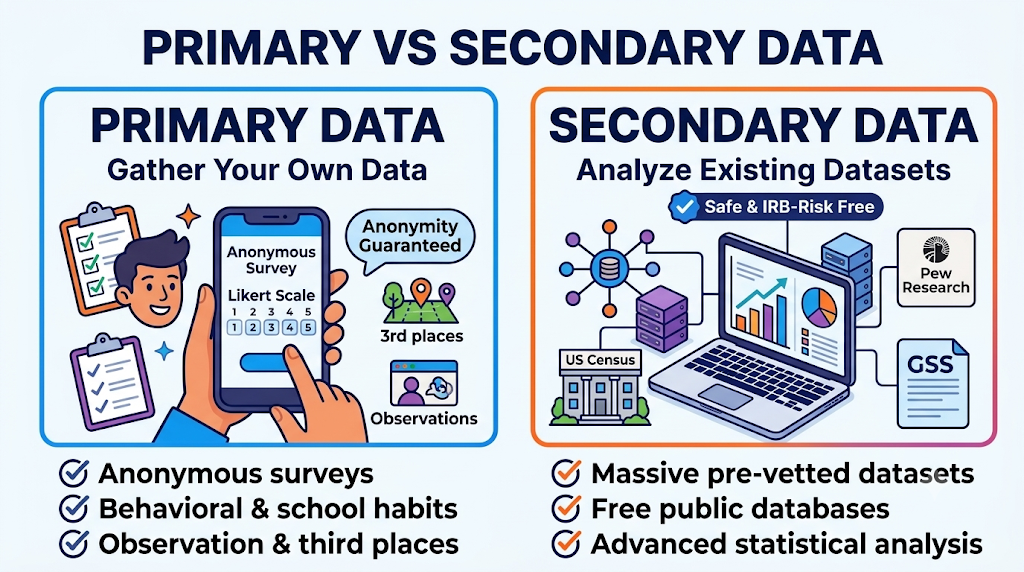
Primary Data (Surveys and Observations) Primary data involves collecting your own original information. For a high school project, surveys are the most accessible tool, but they must be designed with strict limitations. You cannot simply build a Google Form and ask invasive questions.
Keep it anonymous: Never collect names, emails, or identifying demographic intersections that could out a participant.
Minimize risk: Stick to behavioral habits rather than psychological trauma.
Use Likert scales: Frame your questions to yield quantitative data (e.g., asking participants to rate their agreement from 1 to 5) rather than sorting through hundreds of open-ended paragraph responses.
Secondary Data (Existing Datasets) This is often the smarter, more rigorous route for ambitious students. Professional sociologists frequently analyze existing datasets rather than running their own local surveys. You can access massive, statistically significant datasets for free from the US Census Bureau, the Pew Research Center, or the General Social Survey (GSS). Analyzing secondary data allows you to tackle larger sociological questions, run advanced statistical analyses, and completely bypass the ethical hurdles of primary human subject research.
A common misconception among high schoolers is that a research paper can be cranked out in a single weekend. True academic research is a procedural marathon, not a sprint. A standard timeline looks like this:
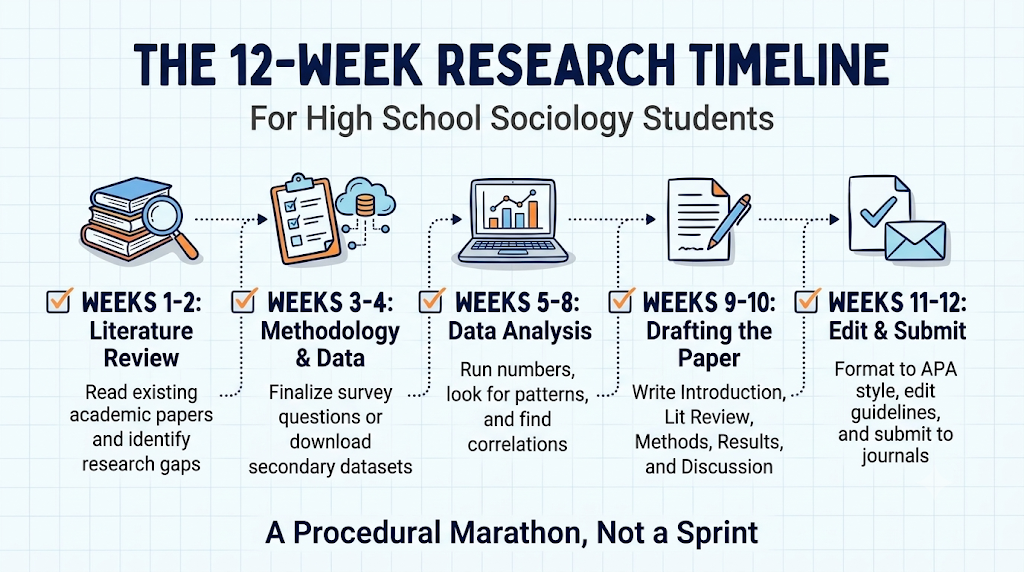
Weeks 1-2: Literature Review. Read existing academic papers on your topic. You must understand what has already been discovered before you can add something new.
Weeks 3-4: Methodology & Data Collection. Finalize your survey questions and distribute them, or download and clean your chosen secondary dataset.
Weeks 5-8: Data Analysis. Run your numbers. Look for correlations, patterns, and anomalies that answer your core research question.
Weeks 9-10: Drafting. Write the academic manuscript, breaking it into standard sections: Introduction, Literature Review, Methodology, Results, and Discussion.
Weeks 11-12: Formatting and Submission. Edit the paper to match specific journal guidelines and format all citations.
Navigating this rigorous process alone can be overwhelming. If you want structured, step-by-step guidance through this exact timeline, the High School Scholar Program pairs students with expert academic mentors to navigate everything from topic selection to final publication.
The goal of your project is not just to write a paper, but to contribute to the academic conversation. Publishing your work demonstrates rigorous academic capability to university admissions officers.
However, you must be cautious. Avoid predatory journals that charge exorbitant "processing fees" to publish anything submitted to them. Instead, look for peer-reviewed journals dedicated to young researchers. You can find a curated list of recommended journals that maintain high academic standards and are respected by university admissions panels.
Always check the journal's submission guidelines before you begin formatting your final draft. Sociology papers universally require APA (American Psychological Association) citation style, and most reputable student journals enforce strict word limits and structural requirements.
What is a good sociology topic for a high school project? A good sociology topic is specific, measurable, and low-risk. Instead of asking a broad question like "What is the impact of poverty?", ask a targeted question like "How does neighborhood walkability affect community trust among local residents?" The latter can be measured directly with a targeted survey or local geographic data.
Do I need IRB approval for a high school survey? If you are surveying human subjects about sensitive topics (illegal behavior, mental health diagnoses, trauma), yes. If you are conducting a fully anonymous survey on benign topics like study habits or media consumption for a school project, you generally do not need formal approval. When in doubt, eliminate the ethical risk entirely by using secondary datasets.
How long should a high school sociology research paper be? Most high school research papers range from 1,500 to 3,500 words, depending heavily on the target journal's specific requirements. Your focus should be on the depth of your data analysis and the clarity of your methodology, rather than artificially inflating your word count.

