

5 Laboratory Experiment Ideas for Students
How to Design a Laboratory Experiment: 5 Ideas for Student Research
Executing a rigorous laboratory experiment is the dividing line between a standard high school science fair participant and a published student researcher. When international university admissions committees review STEM applicants, they are not looking for students who can merely follow a textbook's instructions; they want to see students who can identify a gap in scientific literature, design an empirical methodology, and generate original data. Whether you are building a bio-reactor in your garage or utilizing your school’s chemistry equipment, understanding the strict architecture of experimental design is your first step toward academic publication.
At a Glance: The Architecture of an Experiment
The Goal: To isolate and test a single variable to prove or disprove a specific scientific hypothesis.
Independent Variable: The one specific factor you deliberately change (e.g., the pH level of the soil).
Dependent Variable: The measurable outcome you are recording (e.g., the growth rate of the plant in centimeters).
Control Group: The baseline sample that remains completely unaltered, used to compare against your experimental results.
Replicability: A laboratory experiment is only valid if another researcher can follow your written methodology and achieve the exact same results.
On this page:
The most common mistake students make when approaching empirical science is confusing a physical demonstration with a true laboratory experiment.
Building a model of a wind turbine that spins when you turn on a fan is a demonstration. It shows a known scientific principle in action, but it does not generate any new information. It is observational.
To turn that demonstration into a laboratory experiment, you must introduce variables. If you design three different wind turbine blade shapes (the independent variable), expose them to the exact same wind speed (the controlled variable), and measure the electrical voltage produced by each using a multimeter (the dependent variable), you are conducting an experiment. You are asking a question whose answer is not entirely known until the data is collected and analyzed.
If your project does not generate a spreadsheet of measurable, numerical data that can be graphed and statistically analyzed, you are not conducting a college-level experiment.
Before you touch a beaker or a microscope, you must write a formal experimental design. If your methodology is flawed from the beginning, your resulting data will be scientifically invalid and rejected by peer-reviewed journals.
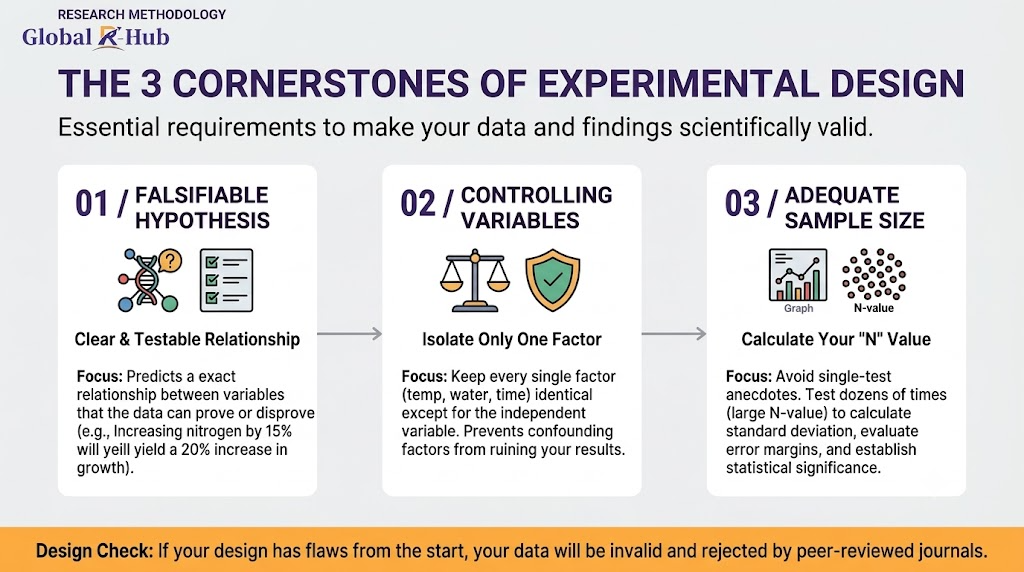
1. The Falsifiable Hypothesis A hypothesis is not a guess; it is a testable statement predicting the relationship between your variables. It must be "falsifiable," meaning it can be proven wrong by the data.
Weak: "I think fertilizer makes plants grow faster."
Falsifiable: "If the concentration of nitrogen in the soil is increased by 15%, then the Phaseolus vulgaris (bean plant) will exhibit a 20% increase in vertical growth over a 14-day period."
2. Controlling Confounding Variables In a laboratory experiment, you only want to test one changing factor. Everything else must remain identical across all your test subjects. If you are testing the effect of light on plant growth, but you accidentally water the plants in the dark room more than the plants in the light room, water becomes a "confounding variable." You no longer know if the light or the water caused the growth difference, rendering your data useless.
3. Sample Size and Statistical Significance (The 'N' Value) Testing a chemical reaction once is an anecdote. Testing it fifty times provides statistical weight. In scientific research, your sample size is denoted by 'N'. An experiment with N=3 is easily dismissed as random chance. An experiment with N=100 allows you to calculate the standard deviation and definitively prove that your results represent a consistent scientific reality.
If you are looking to move beyond basic demonstrations, here are five advanced frameworks. Each can be scaled down for middle school students or scaled up with advanced statistical modeling for high school and undergraduate researchers.
1. Biology: Phytoremediation Rates in Heavy Metal Soil
The Concept: Phytoremediation uses living plants to clean up contaminated soil and water.
The Experiment: Spike soil samples with a safe, measured amount of a heavy metal substitute (like zinc). Plant a fast-growing accumulator species (like mustard grass) in both the contaminated soil and a clean control group.
The Measurement: After four weeks, harvest the plants, dry the biomass, and use your school's chemistry lab to measure the concentration of zinc absorbed into the plant tissue compared to what remains in the soil.
2. Chemistry: Titration of Vitamin C in Degraded Produce
The Concept: Nutritional value in organic matter degrades over time based on environmental exposure.
The Experiment: Expose identical batches of citrus juice to different environmental stressors: extreme UV light, boiling temperatures, and ambient room temperature.
The Measurement: Perform an iodine titration on each batch every 24 hours for a week. By measuring how much iodine solution is required to neutralize the ascorbic acid, you can graph the exact degradation rate of Vitamin C under different storage conditions.
3. Physics: Aerodynamic Drag on 3D Printed Airfoils
The Concept: Modifying the surface texture of an object changes how fluid or air flows around it.
The Experiment: Use a 3D printer to create three identical wing shapes (airfoils). Leave one smooth (the control), give one a dimpled texture (like a golf ball), and give one a ribbed texture.
The Measurement: Suspend each airfoil in a homemade wind tunnel using a force sensor or a sensitive digital scale. Measure the drag force exerted on each texture at varying wind speeds to determine which surface is the most aerodynamically efficient.
4. Environmental Science: Microplastic Filtration via Coagulation
The Concept: Removing microplastics from municipal water supplies is a pressing global engineering challenge.
The Experiment: Create a synthetic wastewater sample suspended with a known mass of fluorescent microplastic beads. Introduce varying concentrations of a natural coagulant, such as powdered Moringa oleifera seeds, which bind to impurities.
The Measurement: Filter the water after the coagulation process, dry the remaining solid mass, and weigh it to determine which concentration of the natural coagulant resulted in the highest percentage of microplastic removal.
5. Materials Science: Tensile Strength of Starch-Based Bioplastics
The Concept: Traditional petroleum plastics take centuries to degrade. Bioplastics made from organic starches offer a sustainable alternative, but often lack structural durability.
The Experiment: Synthesize a basic bioplastic using water, glycerin, vinegar, and starch. The independent variable is the source of the starch (e.g., potato starch vs. cornstarch vs. tapioca starch).
The Measurement: Cast the plastics into identical strips of uniform thickness. Once cured, clamp the strips and apply increasing weights until the material snaps. Record the exact breaking point (tensile strength) to mathematically determine which organic starch yields the most durable commercial plastic alternative.
If these specific frameworks do not align with your academic interests, you can explore a broader database of research project ideas to find a topic that fits your available lab equipment and scientific passions.
Conducting the laboratory experiment is only the first phase of the scientific process. To utilize your work for university admissions, you must transition from the lab bench to the writing desk.
Professional scientific papers follow the universally recognized IMRaD format:
Introduction: Explains the scientific background and states the hypothesis.
Methodology: Details the exact steps, equipment, and variables used in the laboratory experiment so others can replicate it.
Results: Presents the raw data, utilizing graphs, charts, and statistical calculations (like p-values and standard deviation) without subjective commentary.
Discussion: Interprets what the results actually mean, whether they proved or disproved the hypothesis, and notes any potential errors or confounding variables that occurred during testing.
Writing a 4,000-word academic manuscript requires a different skill set than running a titration. For students who want to ensure their methodology and final paper meet the strict standards of peer review, the High School Scholar Program pairs driven students directly with active university faculty mentors. Your mentor will help you design a flawless experimental methodology, guide your statistical analysis, and ensure your final manuscript is ready for submission to a vetted scientific journal.
Once your manuscript is polished, you must identify a platform that publishes student research. Review our list of recommended journals to find platforms that accept high school and undergraduate empirical research across various STEM disciplines.
What are the 3 types of variables in a laboratory experiment? The three variables are the independent variable (the one specific thing you change), the dependent variable (the result you are measuring), and the controlled variables (the environmental factors you keep exactly the same for all test subjects to ensure a fair test).
How do you write a good conclusion for a lab report? A strong conclusion directly answers your initial hypothesis using your data. Do not simply say, "My hypothesis was correct." You must say, "The data supported the hypothesis, demonstrating that the cornstarch bioplastic withstood 4.2kg of tensile force, which was 15% higher than the potato starch variant." Always acknowledge any errors or limitations in your testing setup.
Do I need a professional lab to conduct a valid experiment? No. While advanced chemical analysis requires professional equipment, many rigorous laboratory experiments can be conducted using digital sensors, open-source software, and safe household materials. The validity of an experiment relies on the strictness of your methodology and your control of variables, not the cost of your equipment.