

9 Ethical Social Experiment Ideas for Students
9 Social Experiment Ideas for High School Students (2026)
Designing a valid social experiment is one of the most effective ways for a high school student to demonstrate empirical research skills to university admissions committees. However, the line between a rigorous behavioral science project and an unethical internet prank is frequently blurred by students attempting their first study. To produce research that a university will actually respect and that a peer-reviewed journal will publish you must move beyond hidden cameras and focus on structured hypotheses, control groups, and strict ethical guidelines.
At a Glance: Designing a Behavioral Science Project
Definition: A social experiment is a research method used to test theories about human behavior by manipulating one variable (independent) to see its effect on another (dependent) within a social setting.
The Golden Rule of Ethics: High school students must never use deception, induce psychological stress, or target vulnerable populations.
Best Approach for Students: Naturalistic observation or benign interventions (e.g., changing the placement of a recycling bin to measure compliance).
Required Elements: A falsifiable hypothesis, informed consent (if interacting with subjects), a control group, and quantitative data collection.
On this page:
A common mistake high school students make is calling a survey or a public stunt a "social experiment." True experimental design in psychology and sociology requires a specific architectural framework to ensure your results are scientifically valid rather than just anecdotal.
Before you begin collecting data, your project must have these three foundational elements:
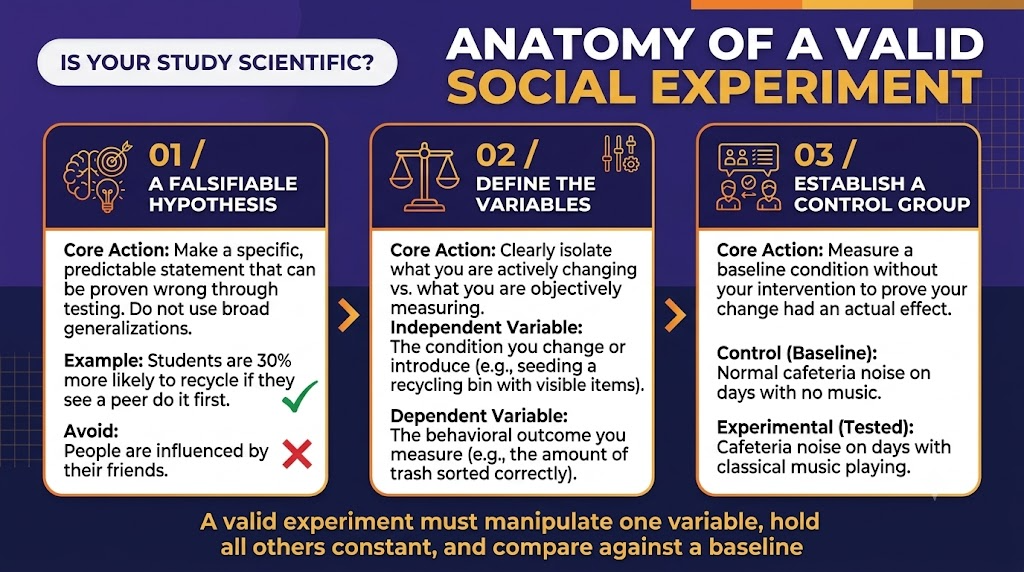
A Falsifiable Hypothesis: You must make a specific prediction that can be proven wrong. "People are influenced by their friends" is not falsifiable. "Students are 30% more likely to recycle a plastic bottle if they see a peer do it first" is falsifiable and testable.
Variables: You must clearly define your Independent Variable (the condition you change or introduce) and your Dependent Variable (the behavioral outcome you measure).
A Control Group: To prove that your intervention caused a change in behavior, you must establish a baseline. If you are testing whether classical music in the cafeteria reduces noise levels, your control is the baseline decibel level on days with no music.
When students search for social psychology experiments, they inevitably find Stanley Milgram’s obedience study, the Stanford Prison Experiment, or the Asch conformity experiments. While fascinating, you cannot replicate these for a high school project.
Today, human subject research is governed by strict ethical codes, primarily enforced by Institutional Review Boards (IRBs) or ethics committees. According to the American Psychological Association's (APA) Ethical Principles, researchers must ensure informed consent, the right to withdraw, and the protection of participants from physical and mental harm.
Classic experiments routinely used deception—lying to participants about the true nature of the study which induced severe psychological distress. If you submit a research paper to a reputable journal that involves lying to your classmates or putting them in stressful social situations, it will be immediately rejected for ethical violations. Instead, high school students should focus on benign interventions (making a harmless change to an environment) or naturalistic observation (recording behavior in a public space without interfering).
If you want to build a research portfolio for university admissions, here are five robust, highly ethical social experiments that do not require deception and can yield excellent quantitative data.
1. The Social Proof of Sustainable Behavior (Environmental Psychology)
The Hypothesis: Individuals are more likely to dispose of waste in the correct recycling bin if the bin already contains visible, correctly sorted items.
The Methodology: Set up two identical recycling bins in a school hallway. For Week 1 (Control), leave the bins empty at the start of the day. For Week 2 (Intervention), seed the bins with five clean, visible plastic bottles.
Data Collection: Count the total number of correctly sorted items versus incorrectly sorted trash at the end of each day.
2. The Halo Effect in Academic Perception (Cognitive Bias)
The Hypothesis: The visual presentation of an essay (font choice, margin formatting, and neatness) significantly impacts the grade a reader assigns to it, regardless of the written content.
The Methodology: Take a single, average-quality essay. Print 20 copies in a clean, professional format (e.g., Times New Roman, properly spaced) and 20 copies in a highly disorganized format (e.g., Comic Sans, messy margins). Ask 40 students or teachers to grade the essay on a scale of 1 to 10.
Data Collection: Calculate the mean score for the cleanly formatted essays versus the poorly formatted essays.
3. The Endowment Effect in Peer Trading (Behavioral Economics)
The Hypothesis: People ascribe more value to things merely because they own them, making them reluctant to trade equally priced items.
The Methodology: Purchase two equally priced snacks (e.g., a chocolate bar and a bag of chips). Randomly give 20 students the chocolate and 20 students the chips. After five minutes, offer every student the opportunity to trade their snack for the other option.
Data Collection: Record the percentage of students who choose to keep their initial item versus the percentage who choose to trade. Traditional economic theory suggests a 50/50 split; behavioral economics predicts a vast majority will keep what they were initially given.
4. The Impact of Digital Proximity on Memory (Cognitive Psychology)
The Hypothesis: The mere physical presence of a smartphone on a desk reduces a student's cognitive retention, even if the phone is turned off.
The Methodology: Create a simple 20-word memory recall test. Group A (Control) takes the test with their phones left in their lockers or backpacks. Group B (Intervention) takes the test with their own phones placed face-down on their desks.
Data Collection: Compare the average number of words successfully recalled by each group.
5. Choice Overload in Extracurricular Sign-Ups (Decision Fatigue)
The Hypothesis: Offering fewer choices increases the likelihood of a student making a definitive decision, while offering too many choices leads to decision paralysis.
The Methodology: Set up a mock sign-up booth for a school volunteering initiative. On Day 1, offer students only 3 specific volunteering options. On Day 2, offer students 15 different volunteering options.
Data Collection: Measure the percentage of students who stop at the booth and successfully sign up for a slot on Day 1 versus Day 2.
Students looking for more inspiration across other disciplines, such as political science or pure economics, can explore our curated directory of research project ideas to find a topic that perfectly aligns with their intended university major.
Conducting the experiment is only the first half of the process. To leverage your work for international university admissions, you must translate your raw data into a formal academic manuscript.
Manuscript Section | What You Must Include |
Literature Review | A summary of existing peer-reviewed studies related to your topic. You must explain how your high school experiment builds upon or localizes prior academic work. |
Methodology | A highly detailed explanation of your procedure, including your sample size, demographic breakdown, and how you secured informed consent or maintained ethical anonymity. |
Results | Your raw data presented in clear charts and graphs, alongside statistical analysis (e.g., calculating the mean, median, and p-value to prove statistical significance). |
Discussion | An analysis of why the results occurred, acknowledging any limitations in your study (such as a small sample size or environmental biases). |
Once your manuscript is complete, do not let it sit on a hard drive. Submit it to student-focused or undergraduate peer-reviewed platforms. You can find vetted publications in our guide to recommended journals.
Transitioning from a basic school project to a mathematically sound research paper can be incredibly difficult if you do not have experience with data analysis software or academic formatting. If you want to ensure your methodology is rigorous enough for publication, the High School Scholar Program pairs driven students with active university researchers who provide one-on-one mentorship through the entire experimental design, data analysis, and publication process.
Do I need permission to conduct a social experiment at school?
Yes. You should never conduct a behavioral study on school grounds without explicit permission from a teacher, principal, or your school's ethics committee. Even benign observational studies require administrative clearance to ensure they do not disrupt the educational environment.
What is the difference between an observational study and an experiment?
In an observational study, you simply watch and record natural behavior without interfering (e.g., counting how many people hold the door open for a stranger). In an experiment, you actively introduce a variable (e.g., having a confederate drop a stack of papers) to measure how it changes the subjects' behavior.
Are YouTube social experiments considered actual research?
No. Most YouTube social experiments are entertainment videos that rely on shock value, extreme scenarios, and deception. They do not use control groups, they do not collect statistically significant sample sizes, and they frequently violate fundamental ethical guidelines established by the American Psychological Association.

