

How NASA's DART Asteroid Impact Looks Up Close Years Later
How NASA's DART Asteroid Impact Looks Up Close Years Later
For Indian high school students building portfolios in astrophysics, physics, aerospace engineering, or data science for university admissions, planetary defense is one of the most exciting real-world applications of classical mechanics. When headlines highlight that in 2022 NASA struck an asteroid, and now we are finally seeing the massive impact up close, students and parents often ask what the European Space Agency's Hera mission has revealed at the asteroid Dimorphos and why follow-up close-up inspection matters so much. Exploring how scientists turn a spacecraft collision into precision physics gives ambitious students a clear, lab-free way to build a strong research portfolio.
At a Glance: From NASA's DART Impact to ESA's Hera Inspection
The 2022 Kinetic Impact: In September 2022, NASA's DART (Double Asteroid Redirection Test) spacecraft deliberately collided with Dimorphos, a small moonlet orbiting the larger near-Earth asteroid Didymos, shortening its orbital period by roughly 33 minutes.
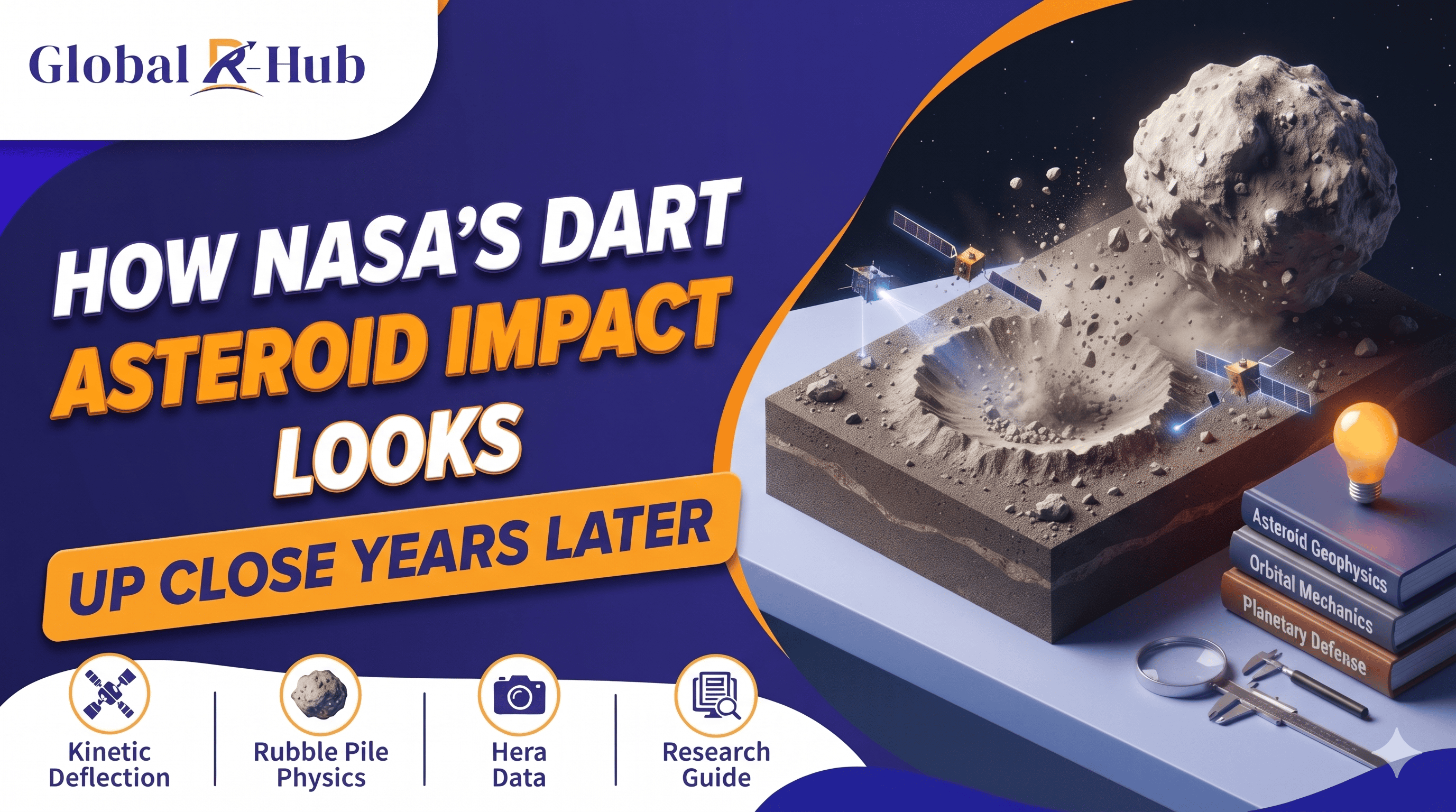
The Up-Close Reveal: ESA's Hera spacecraft has reached the binary asteroid system and captured high-resolution close-up views of Dimorphos, revealing a massive, stadium-sized impact crater and reshaped surface terrain left behind by the collision.
Why Close-Up Data Matters: Knowing a spacecraft's mass and speed is only half the equation; measuring the exact crater size, asteroid mass, and boulder distribution lets physicists calculate how much extra push came from blasting rocky debris (ejecta) into space.
High School Research Fields: Planetary Science & Planetary Defense, Orbital Mechanics & Classical Physics, Impact Cratering & Geophysics, and Computational Astrophysics (Python).
Why Seeing the Crater Up Close Completes the Experiment
When a spacecraft hits an asteroid at more than 6 kilometers per second, the collision is far more complex than two billiard balls bouncing off each other. Along with transferring its own momentum directly to the asteroid, the spacecraft blasts tons of rock and dust backward into space. That outward plume of ejecta acts like a natural rocket exhaust, giving the asteroid an extra recoil push.
Earth-based telescopes and DART's tiny companion cube satellite (LICIACube) saw the bright debris plume and measured the 33-minute change in Dimorphos's orbit around Didymos in 2022, but they could not inspect the scarred asteroid surface in detail afterward. Hera's close-range cameras, altimeters, and companion CubeSats measure Dimorphos's exact mass, crater dimensions, and internal structure allowing scientists to calibrate impact simulations for future planetary-defense scenarios.
Comparing DART's Impact Phase vs. Hera's Post-Impact Survey
Looking at both missions side by side shows how space agencies design two-part experiments to turn a single event into validated physics models.
Mission Dimension | NASA DART (2022 Impact) | ESA Hera (Up-Close Inspection) |
|---|---|---|
Primary Scientific Role | Test kinetic-impactor deflection by colliding with Dimorphos at hypervelocity | Survey the aftermath up close to measure crater geometry, mass, and surface structure |
Key Measurements | Spacecraft impact velocity, approach imagery, and Earth-based orbital-period shift | High-resolution crater mapping, gravity/mass determination, and boulder/ejecta analysis |
Physics Question Answered | Can a human-made spacecraft measurably alter an asteroid's orbit? | How did a loosely bound rubble-pile asteroid respond internally and structurally to the strike? |
What This Means for High School Students in India
Planetary defense, near-Earth asteroid tracking, and space-mission data analysis are rapidly growing areas across global space agencies, including ISRO's planetary science and space-situational-awareness programs. High school students in India do not need access to a telescope or physics laboratory to study asteroid orbits and impact mechanics.
Analyzing open NASA and ESA small-body datasets or simulating orbital deflection in grades 9–12 builds hands-on skills in classical mechanics, Python programming, and scientific writing that stand out strongly in university admissions.
How High School Students Can Research Asteroid Physics & Planetary Defense (Without a Lab)
You can build a structured, reproducible astrophysics or computational-physics research project on a standard laptop using free planetary databases and Python.
Step 1: Gather Open Asteroid and Impact Datasets
Start with verified, publicly accessible space-science repositories:
Explore near-Earth asteroid orbital catalogs from NASA's JPL Small-Body Database, planetary-defense mission archives from NASA PDS (Planetary Data System) and ESA's Planetary Science Archive, or open impact-crater catalogs.
Define a focused research question such as comparing orbital-period sensitivities across binary near-Earth asteroids, or modeling how asteroid density and porosity affect crater diameter and momentum enhancement.
Step 2: Model Momentum Transfer and Orbital Shifts in Python
Use Python (NumPy, SciPy, Astropy, Pandas, and Matplotlib) to test a clear physical relationship:
Build a computational two-body orbital simulation showing how a small change in tangential velocity alters orbital period and semi-major axis, comparing theoretical predictions against published DART–Dimorphos values.
Test parameter sensitivity such as varying the momentum enhancement factor or target density and present clean, well-labeled plots with transparent equations and assumptions.
Step 3: Turn Your Findings Into a Structured Research Paper
Selective university admissions committees and student STEM journals look for a clear physical hypothesis, clean derivations or simulation scripts, validation against real mission measurements, and an honest discussion of modeling simplifications. Browsing curated research project ideas can help you narrow a broad fascination with space missions into a focused high school study. If you want guidance from doctoral mentors to refine your methodology and prepare a manuscript for vetted recommended journals, consider applying to the High School Scholar Program.
Frequently Asked Questions
Which asteroid did NASA hit in 2022, and what are we seeing now?
In September 2022, NASA's DART spacecraft struck Dimorphos, a small moonlet orbiting the asteroid Didymos; ESA's Hera spacecraft has now reached the system and captured close-up images of the stadium-sized crater and reshaped surface.
How much did NASA's DART mission change the asteroid's orbit?
DART shortened Dimorphos's 11-hour-55-minute orbit around Didymos by roughly 33 minutes, proving that a kinetic impactor can measurably alter an asteroid's trajectory.
Why is ESA's Hera mission important after DART already hit the asteroid?
Hera measures Dimorphos's exact mass, internal structure, and crater size up close critical variables needed to turn DART's single test into reliable computer models for deflecting other asteroids.
Can high school students do a research project on asteroid deflection at home?
Yes. Students can use Python and open NASA JPL Small-Body Database catalogs to simulate momentum transfer, binary-asteroid orbits, or near-Earth asteroid distributions on a standard laptop.