

How to Maintain a Learning Log for Academic Research and Study Success

How to Maintain a Learning Log for Academic Research and Study Success
When students tackle complex academic subjects or long-term research projects, they often try to keep every milestone, citation, and conceptual breakthrough inside their heads. Within weeks, details blur, hypotheses contradict one another, and writing a research paper becomes an exercise in frustration. Keeping a disciplined learning log transforms disorganized reading and sporadic experimentation into a structured, searchable database of your own intellectual growth.
At a Glance: Learning Log Quick Facts
Core Purpose: To document intellectual progress, track experimental or analytical failures, synthesize literature, and capture metacognitive reflections.
Recommended Formats: Digital markdown notebooks (Notion, Obsidian), dedicated research binders, or encrypted cloud spreadsheets.
Best Practice Frequency: Daily entries during active research phases; weekly summaries during standard coursework.
Key Distinction: Unlike a daily planner (which tracks tasks), a learning log tracks insights, conceptual friction, and methodological evolution.
On this page:
A learning log is a chronological, written record of what you study, what questions arise, and how your understanding evolves over time. In academic research, it serves as your primary laboratory notebook for ideas.
Professional scientists, historians, and policy analysts rely on logs to prevent "selective memory." When you review a paper you read three months ago, your brain often smooths over the difficulties you had understanding it. A learning log captures your raw confusion, the specific counterarguments you debated, and the exact moment a concept clicked. This granular record becomes invaluable when you transition from passive reading to active writing, providing verified citations and organic narrative threads for your introductions and literature reviews.
Randomly jotting down random thoughts in a notebook yields messy results. A high-performing learning log uses a consistent structural framework for every entry. Whether you use digital tools or physical paper, your log should capture both objective facts and subjective analysis.
Log Component | What It Captures | Why It Matters for Research |
Metadata & Timestamp | Date, project title, primary source URL, or journal title. | Ensures seamless citation tracking and chronological auditing. |
The Core Concept | A 3-sentence summary of what you read, observed, or calculated in your own words. | Tests genuine comprehension rather than mindless copying. |
Conceptual Friction | What part of the theory or dataset did you struggle with or find contradictory? | Highlights exact gaps in current literature that turn into research questions. |
Actionable Next Steps | Specific questions to research tomorrow, formulas to test, or experts to consult. | Eliminates procrastination by giving your next study session a concrete starting point. |
Students seeking personalized mentorship to transition from structured note-taking to independent investigation often explore programs like the High School Scholar Program, where mentors emphasize rigorous documentation habits.
Many students abandon journaling because they confuse a learning log with a personal diary. Understanding the functional differences ensures your log remains an academic asset rather than an emotional outlet.
Objective: A diary records personal feelings, daily events, and subjective life experiences. A learning log focuses exclusively on cognitive development, problem-solving paths, and academic inquiry.
Tone: Diaries are narrative and reflective. Learning logs are analytical, critical, and objective.
Utility: While a diary remains private and introspective, a mature learning log can be mined for methodology sections, thesis evolution notes, and portfolio reflections for university applications.
Maintaining a learning log does not require hours of writing. A sustainable 15-minute daily workflow keeps your insights sharp without slowing down your research:
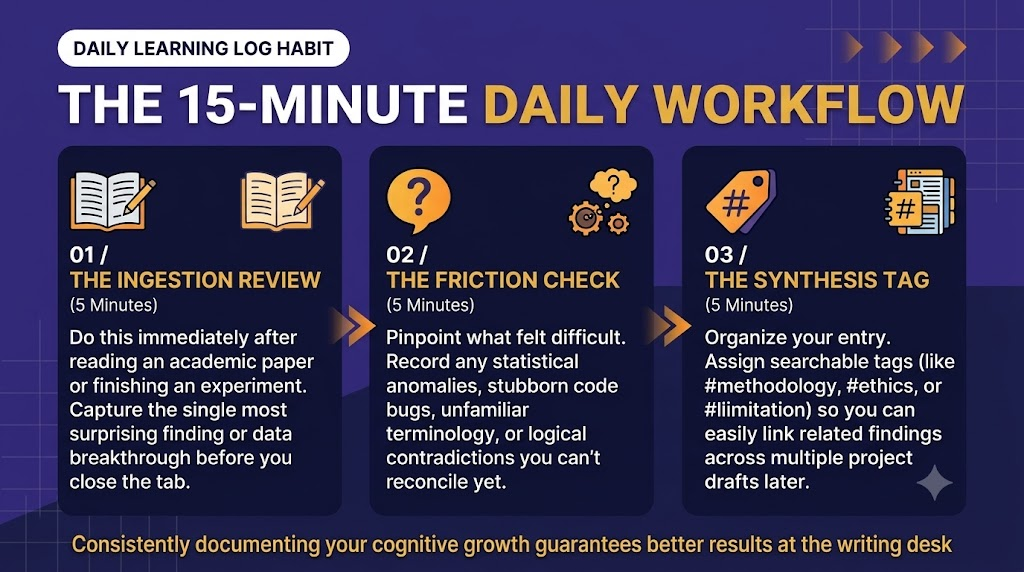
The 5-Minute Ingestion Review: Immediately after reading an academic paper or running an experiment, write down the single most surprising finding before closing the tab.
The Friction Check: Note any statistical anomalies, vocabulary terms, or philosophical contradictions you could not immediately reconcile.
The Synthesis Tag: Apply consistent tags or keywords (e.g.,
#methodology,#ethics,#dataset-limitations) so you can search your log across multiple projects.
What is the primary benefit of maintaining a learning log? The primary benefit is building a searchable, chronological archive of your conceptual breakthroughs and methodological struggles, which prevents memory loss and accelerates academic writing.
Should a learning log be digital or handwritten? Both formats have merits, but digital tools (such as Notion, Obsidian, or Markdown editors) are recommended for academic research because they allow instant keyword searching, tag filtering, and hyperlink connections between related sources.
How often should I update my learning log? During active research projects or exam preparation, you should update your log daily (even if only for 10 minutes). For general coursework, two to three detailed weekly entries are sufficient to maintain momentum.
Plaintext