

Rolling Admissions Explained: How It Works, Deadlines, and When to Apply | Global R-Hub

Rolling Admissions Explained: How It Works, Deadlines, and When to Apply | Global R-Hub
TL;DR: Rolling admissions is a first-come, first-served college application process where universities review your file as soon as you submit it and send an acceptance decision within 4 to 6 weeks. Because university seats and merit scholarships fill up quickly, applying early gives you a massive strategic advantage over waiting until winter.
Introduction
Applying to college doesn't have to be a stressful, late-night scramble in December. While most high school seniors are still stressing over their first essay drafts in the middle of winter, smart applicants already have confirmed college acceptance letters in hand before autumn even begins.
For instance, a student who submits an application to Penn State in late August can receive an acceptance decision in just five weeks—replacing months of anxiety with a secured university spot. This isn't luck; it’s rolling admissions done right.
Most students never think about college applications until December, which is exactly the wrong time to start for rolling programs. Here is a complete guide to how rolling admissions works, which top universities use it, and how to use it to secure admissions and scholarships.
What Is Rolling Admissions, Really?
Here is the simplest way to understand the difference between traditional admissions and rolling admissions:
Regular Decision Schools: Collect all student applications until a fixed deadline (usually January 1), read them all together in February and March, and release every decision at once in mid-March.
Rolling Admissions Schools: Do the exact opposite. They evaluate your application as soon as it arrives in their admissions office and send your decision back within 4 to 6 weeks, regardless of what time of year it is.
There is no single batch reveal date. Instead, admissions teams review applications continuously from August all the way through spring, until every single seat in the incoming freshman class is filled.
Why timing matters: The incoming class fills up first-come, first-served. A university that is theoretically "still accepting applications" in March may have very few seats left, and the merit scholarships will likely be gone entirely.
Which Top Universities Use Rolling Admissions?
Quite a few well-known universities—primarily large public institutions—utilize rolling admissions models. Some of the most prominent schools include:
Penn State University
University of Pittsburgh (Pitt)
Indiana University Bloomington
Michigan State University
University of Arizona
University of Mississippi
Pro Tip: Admissions policies shift from year to year. Always double-check the official admissions website of your target university to confirm their current deadlines and priority dates before finalizing your timeline.
Rolling Admissions vs. Regular Decision vs. Early Action
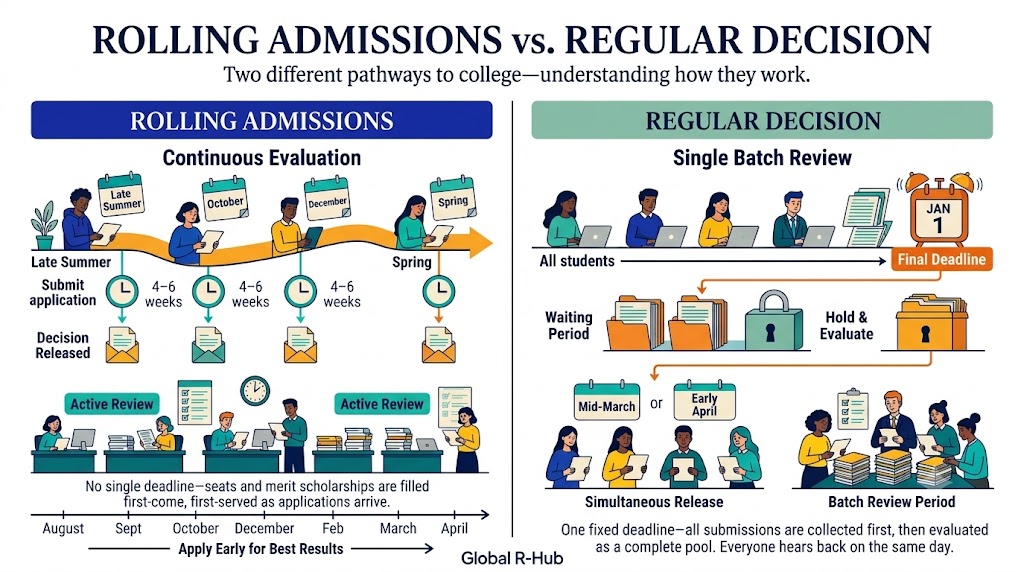
Students often ask how rolling admissions stacks up against other common application plans. Here is a clear, side-by-side comparison:
Feature | Rolling Admissions | Early Action (EA) | Regular Decision (RD) |
Application Deadline | Ongoing (Window opens in late summer/fall) | Fixed (Usually November 1) | Fixed (Usually January 1) |
When You Hear Back | 4 to 6 weeks after submitting | Mid-December | Mid-to-late March |
Is It Binding? | No (You have until May 1 to decide) | No (You have until May 1 to decide) | No (You have until May 1 to decide) |
Seats Filled First-Come? | Yes | No | No |
Scholarship Risk If You Wait? | High | Low | Low |
Important Distinction: Students sometimes confuse rolling admissions with Early Decision (ED). They are completely different. Rolling admissions is never binding. Even if you receive an acceptance letter in October, you are completely free to sit on that offer and compare other choices until the national decision day on May 1.
3 Big Reasons Why Applying Early Pays Off
Getting an admissions decision in October rather than March is comforting, but the true advantages go far beyond psychological peace of mind:
1. Less Competition and More Open Seats
In September and October, the volume of incoming applications is a fraction of what it becomes by January. When you apply early, you aren't competing against the massive flood of last-minute applicants. You compete against a much smaller group while the university still has maximum open seats available.
2. Maximum Merit Scholarships and Financial Aid
This is the single factor most students underestimate. At schools like Pitt, Penn State, and other rolling institutions, merit aid is tied to priority dates, not final deadlines. A student who applies in January might receive zero scholarship money, while a peer with an identical academic profile who applied in October secures a massive award simply because early funds were still available.
3. Complete Psychological Relief
Having at least one confirmed university acceptance in your pocket by November completely shifts how you approach the rest of your college list. You stop applying from a place of panic and start applying with authentic confidence and leverage.
3 Major Pitfalls to Watch Out For
While rolling admissions is much more flexible than fixed-deadline paths, a few traps can hurt your profile if you aren't careful:
The Procrastination Trap: Because there is no hard deadline creating immediate panic, it is easy to keep pushing your application back. Students who plan to submit "next week" for months often find themselves in February applying for leftover spots.
Program-Specific Cutoffs: A university might still accept general undergraduate applicants in March, but selective departments like Computer Science, Business, Nursing, or Engineering often close their internal applications months earlier. Always check department-level rules.
Submitting an Incomplete File: A rolling admissions school will not start your review queue until every piece of documentation arrives. Transcripts, test scores, and teacher recommendations must all be submitted together.
A Month-by-Month Timeline That Works
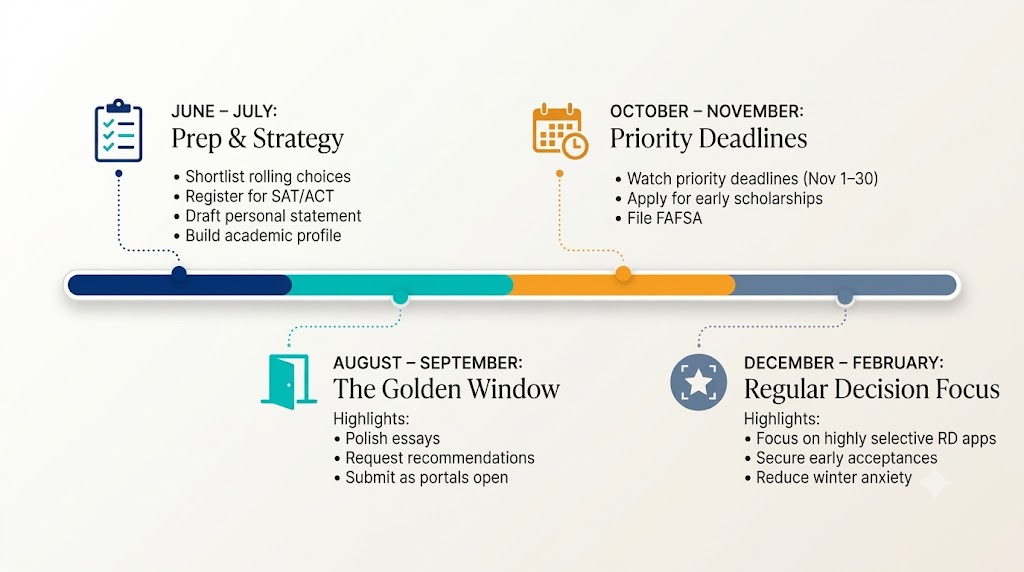
Students who achieve the best outcomes with rolling admissions treat the opening window like a fixed autumn deadline. Here is how to structure your timeline:
June – July (Strategy & Prep): Shortlist your rolling admissions choices. Register for summer or fall SAT/ACT tests if needed, begin drafting your personal statement, and build your academic profile (such as finalizing an independent research project).
August – September (The Golden Window): Polish your essays, ensure your recommendation requests are out with plenty of lead time, and submit to rolling schools as soon as their portals open.
October – November (Priority Deadlines): Most rolling schools set their priority scholarship deadlines between November 1 and November 30. Complete your applications and file your FAFSA during this window.
December – February (Regular Decision Focus): With your rolling acceptances securely in hand, use the winter months to focus on highly selective Regular Decision applications without high anxiety.
Frequently Asked Questions (FAQs)
Q: What happens if I apply late to a rolling admissions school?
A: You can still get accepted if seats remain open, but your chances drop significantly, and merit scholarship funds are almost always exhausted by late winter. Applying late is always an unnecessary gamble.
Q: Can I apply to multiple rolling admissions universities at the same time?
A: Yes, absolutely. Nothing stops you from submitting applications to several rolling institutions simultaneously, along with your Early Action and Regular Decision choices.
Q: Do I have to commit right away if I get accepted in October?
A: No. Rolling admissions is non-binding. Just like any other acceptance, you have until national decision day (May 1) to review financial aid packages and make your final commitment.
Q: Should I rush my application to submit in September?
A: Never sacrifice quality for speed. A well-crafted, rigorous application submitted in October will always outperform a rushed, mediocre application submitted in September.
Build a Standout College Application Profile with Global R-Hub!
Applying early gives you a vital timing advantage—but what goes inside your application is what truly drives acceptances and wins major merit scholarships. Top universities look for ambitious students who go beyond basic coursework and prove genuine academic capability and initiative.
At Global R-Hub (globalrhub.org), we empower middle school, high school, undergraduate, and graduate students to work 1-on-1 with PhD scholars and faculty mentors from the world's leading universities.
How Global R-Hub Gives You the Admissions Edge:
Publish Your Own Research Paper: Get step-by-step mentorship to write and publish an original research paper in reputed peer-reviewed journals before college application season peaks.
Earn an Elite Letter of Recommendation (LOR): Elevate your rolling and regular applications with a credible recommendation from a distinguished university mentor.
Explore High-Impact Disciplines: Conduct university-level research across Artificial Intelligence, Computer Science, Biology, Medicine, Economics, Business, Psychology, Law, and Physics.

