

Top Forensic Science Internships for Students
Forensic Science Internships: Reality Check and Top Programs for Students
You have watched the documentaries, studied the biology, and decided you want to work in a crime lab. Securing forensic science internships is the most direct way to transition from textbook theory to applied laboratory science. However, for international students and high schoolers, the forensic field is heavily restricted by federal laws, security clearances, and strict evidence-handling protocols. Navigating these barriers requires knowing exactly which academic and private laboratories accept student researchers.
At a Glance: The Reality of Forensic Internships
Federal Limitations: Internships at US agencies (FBI, DEA, ATF) mandate US citizenship and intense background checks. International students cannot apply.
Age Restrictions: Due to "chain of custody" laws and biohazard exposure, students under 18 are almost universally barred from active state crime labs.
The Best Alternative: University-based academic research labs and private genetic testing facilities.
Core Skills Required: Gas chromatography, mass spectrometry (GC-MS), PCR amplification, and digital data recovery (Python/C++).
On this page:
If you search for forensic opportunities online, you will immediately find prestigious programs at the Federal Bureau of Investigation (FBI) Honors Internship Program or the Central Intelligence Agency (CIA). While excellent, these programs have an unyielding rule: you must be a United States citizen. There are no exceptions for international students, regardless of academic merit, because these roles require federal security clearances.
Furthermore, state and local police departments manage active criminal cases. The legal principle known as the "chain of custody" requires that every person who handles a piece of evidence be documented and legally accountable in court. Crime labs cannot risk compromising a criminal trial by allowing a high school student or an un-cleared intern to process DNA or toxicology samples.
If you are an international student or a high schooler, you must stop looking at law enforcement agencies and start looking at academic research institutions and private laboratories. These environments study forensic methodology (improving how DNA is extracted or how digital data is recovered) without handling active, legally sensitive criminal evidence.
For college students pursuing degrees in chemistry, biology, or criminal justice, the following organizations offer rigorous, lab-based forensic science internships that frequently accept diverse applicant pools, including international students on valid visas.
1. Center for Forensic Science Research & Education (CFSRE)
The CFSRE, based in Pennsylvania, is one of the premier independent forensic research institutions in the United States. They offer highly competitive summer internship programs for undergraduate and graduate students.
Focus Areas: Forensic toxicology, forensic biology, and forensic chemistry.
The Experience: Interns do not fetch coffee; they conduct method development and validation. You might spend the summer validating a new mass spectrometry machine to detect synthetic opioids.
Eligibility: Must be enrolled in a university science program. International students studying in the US are generally eligible to apply for research roles, as it operates independently from federal law enforcement.
2. University-Specific Forensic Institutes (e.g., Penn State, Sam Houston State)
The best forensic science internships are often hidden within the universities themselves. Institutions with dedicated forensic programs such as the Penn State Department of Anthropology or Sam Houston State University’s Department of Forensic Science operate advanced research labs.
Focus Areas: Forensic anthropology (osteology and bone degradation), forensic entomology (using insect lifecycles to determine time of death), and digital forensics.
The Experience: Undergraduates can apply to work as research assistants for their professors. This involves processing non-criminal samples, running data through statistical software, and contributing to academic papers.
Eligibility: Open to all enrolled students, making this the most accessible route for international undergraduates.
3. Private DNA and Genetic Testing Laboratories
Private companies handle massive amounts of genetic processing and often contract with law enforcement for "genetic genealogy" (using commercial DNA databases to solve cold cases). Companies like Bode Technology operate as private entities rather than government agencies.
Focus Areas: DNA extraction, polymerase chain reaction (PCR) amplification, and genetic genealogy.
The Experience: Interns learn the rigid quality assurance and quality control (QA/QC) protocols required in a commercial bio-lab.
Eligibility: Standard corporate internship requirements apply. Visa sponsorship varies by company.
Because active crime labs are off-limits, high school students must demonstrate their interest in forensic science through specialized academic development. University admissions committees do not expect a 16-year-old to have processed a crime scene. They expect you to have mastered the underlying foundational sciences.
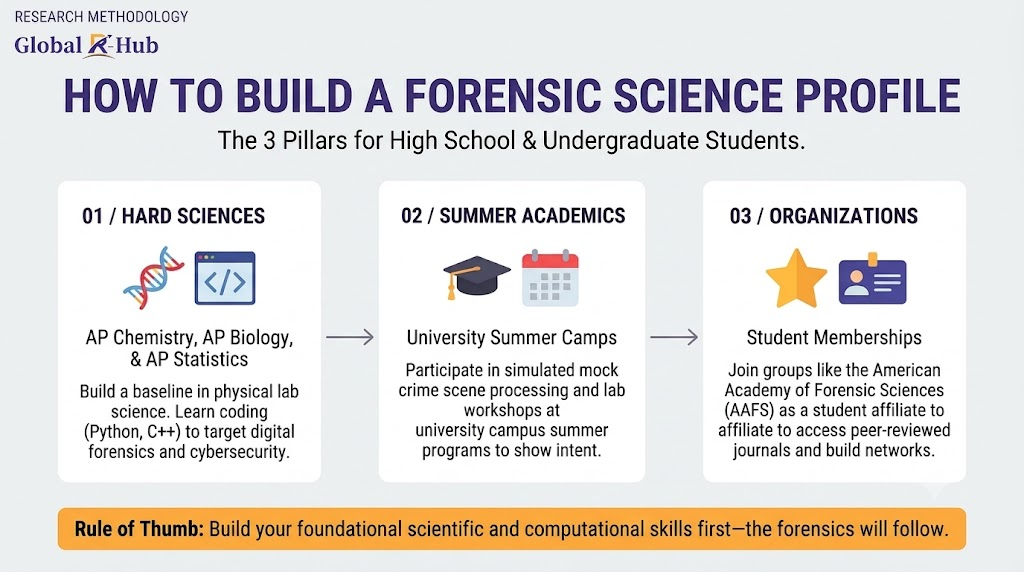
To build a competitive profile for undergraduate forensic programs, focus on these three pillars:
1. Master the Hard Sciences Forensic science is simply applied chemistry and biology. Prioritize AP Chemistry, AP Biology, and AP Statistics. If you want to stand out, learn how to code. Digital forensics the recovery of encrypted or deleted data from hard drives and mobile devices is currently the fastest-growing sector in the field. Learning Python, C++, or taking a cybersecurity course demonstrates high-level capability.
2. Attend Academic Summer Programs While not traditional internships, universities offer intensive summer practicums. Programs like the National Student Leadership Conference (NSLC) on Forensic Science or university-hosted summer STEM camps allow high schoolers to practice blood spatter analysis, fingerprint dusting, and mock crime scene processing in a simulated, legally safe environment.
3. Join Professional Organizations The American Academy of Forensic Sciences (AAFS) is the premier professional organization in the world. They offer a Student Affiliate membership category. Joining this organization gives you access to the Journal of Forensic Sciences, allowing you to read current methodologies and cite them in your own academic work.
If you cannot secure a physical lab placement due to age or geographic restrictions, you can still produce university-level forensic data through independent academic research. Much of modern forensic science is computational. You do not need a physical lab to analyze data; you need datasets, statistical software, and an academic mentor.
For example, a student interested in digital forensics could research the vulnerabilities of specific encryption algorithms. A student interested in forensic psychology could conduct a statistical analysis on the reliability of eyewitness testimony based on existing public trial transcripts. If you need help conceptualizing a specific, testable hypothesis, reviewing established research project ideas can help you narrow your focus.
The most effective way to prove your capability to university admissions officers is to write a formal academic paper and submit it for peer review. The High School Scholar Program pairs driven students directly with active university researchers. Your faculty mentor will guide you through designing a forensic methodology, analyzing data mathematically, and formatting your final manuscript to meet the strict standards of scientific publishing.
Once your paper is complete, you can target specific undergraduate scientific platforms. Consulting a directory of recommended journals will help you find a publication that matches your specific niche, whether that is forensic toxicology, digital cybersecurity, or forensic anthropology. Publishing a peer-reviewed paper demonstrates a level of academic rigor that far exceeds sorting files in a local police department.
Can high school students get forensic science internships? In active crime labs, no. Strict chain of custody laws and biohazard protocols prevent minors from handling evidence. High school students should instead look for university-hosted summer forensic programs, or focus on conducting independent, computational forensic research that does not require a physical laboratory.
Do I have to be a US citizen to work in forensic science? To work directly for US federal law enforcement agencies (FBI, DEA, CIA), yes, US citizenship is strictly required for security clearances. However, international students can freely work and intern in university academic research labs, private genetic testing facilities, and corporate digital cybersecurity firms.
What is the best major for forensic science? Do not major in "Forensic Science" for your undergraduate degree. Crime lab directors overwhelmingly prefer to hire students with hard science degrees: a B.S. in Chemistry, Biology, or Computer Science. A hard science degree gives you the foundational lab skills required, which you can then apply to forensics during a Master's degree or on-the-job training.