

What Is a Hypothesis and How Do You Write One for a Research Paper? | Global R-Hub
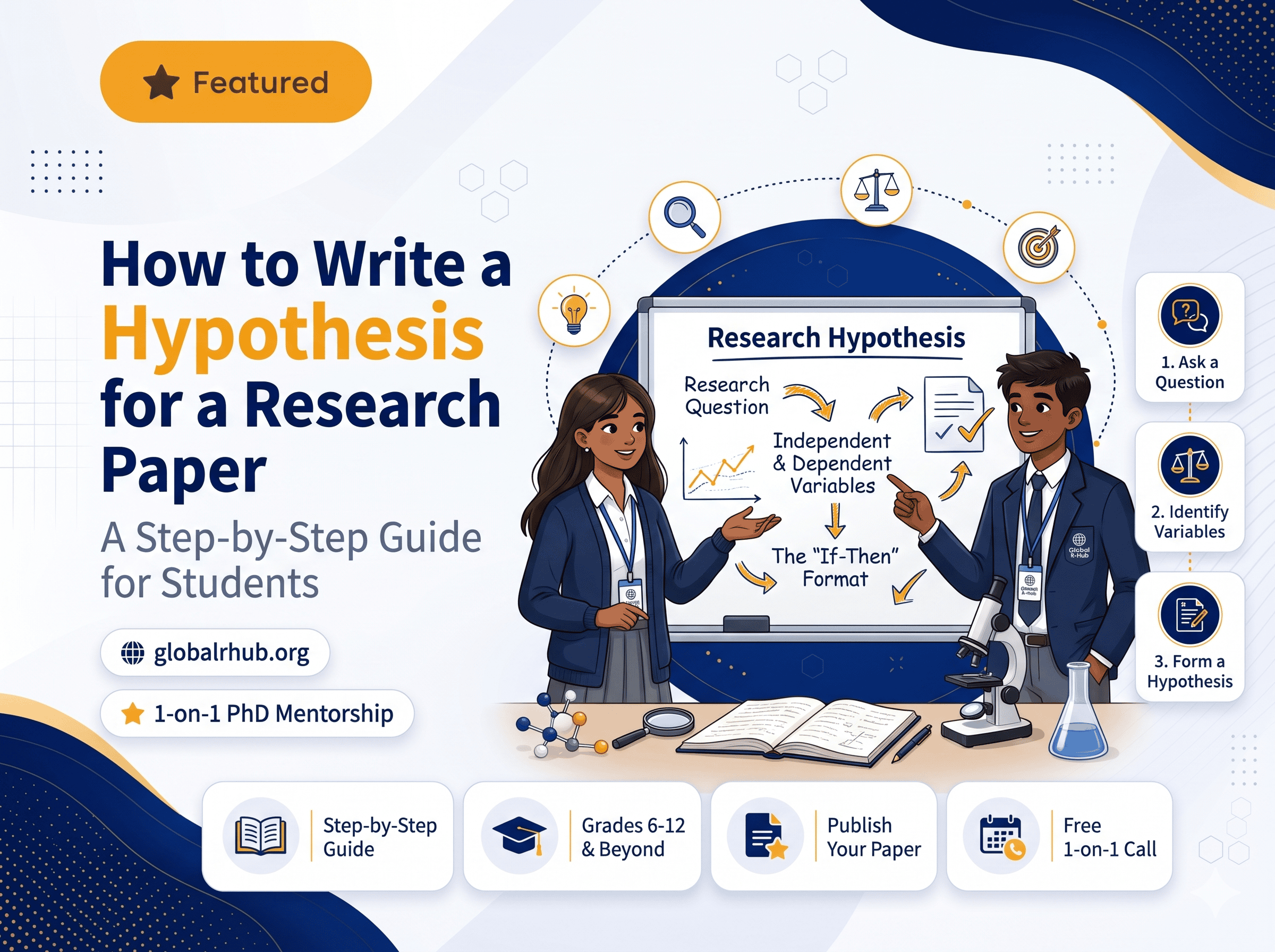
TL;DR: A hypothesis is a clear, testable prediction at the heart of your research paper. It tells the reader exactly what you expect to find and why. To write a strong hypothesis, you need a focused research question, clearly defined variables, and a measurable outcome. This guide breaks down what a hypothesis is, how to write one step-by-step, and how to avoid the common mistakes that hold student researchers back.
Introduction
Many students think a hypothesis is just an educated guess. It isn't. A hypothesis is a precise, evidence-based prediction about how two or more variables relate to each other.
Knowing how to write a strong hypothesis is one of the most important skills in academic research. Every other part of your paper—your methodology, your results, and your final discussion—depends on getting this right.
When students write vague hypotheses, their entire project loses direction. The paper becomes difficult to test, peer-reviewed journals reject it, and university admissions officers see a lack of depth. A hypothesis isn't just an opening sentence; it is the foundation of your entire research project.
Here is a simple, step-by-step guide to writing a strong hypothesis that stands up to real academic review, complete with examples and free tools.
What Is a Hypothesis and Why Does It Matter?
In simple terms: A hypothesis is a testable statement that predicts the relationship between a cause (independent variable) and an effect (dependent variable). It gives your study a clear direction and a measurable goal.
In a standard research paper, your hypothesis comes right after your Literature Review and right before your Methodology:
Literature Review: Shows what researchers already know and points out a "gap" (what is still unknown).
Hypothesis: States your prediction on how to fill that gap.
Methodology: Explains how you will test your prediction.
Without a clear hypothesis, a paper tends to wander. You won't know exactly what data to collect, how to measure your results, or what to talk about in your conclusion.
For students aiming for selective universities, a well-crafted hypothesis proves that you know how to think like a real scholar—moving beyond basic curiosity into structured, analytical thinking.
How to Write a Hypothesis: 6 Simple Steps
Writing a hypothesis isn't a single step; it is a short process where each stage builds on the last.
Step 1: Start with a focused research question
Before making a prediction, you need a specific question that can actually be answered with data.
Too broad: "How does stress affect students?"
Focused: "Does having more than three hours of daily homework lead to higher stress levels in Grade 11 students?"
If you cannot realistically collect data to answer your question, narrow it down before moving to Step 2.
Step 2: Identify your Independent and Dependent Variables
Every hypothesis needs at least two variables:
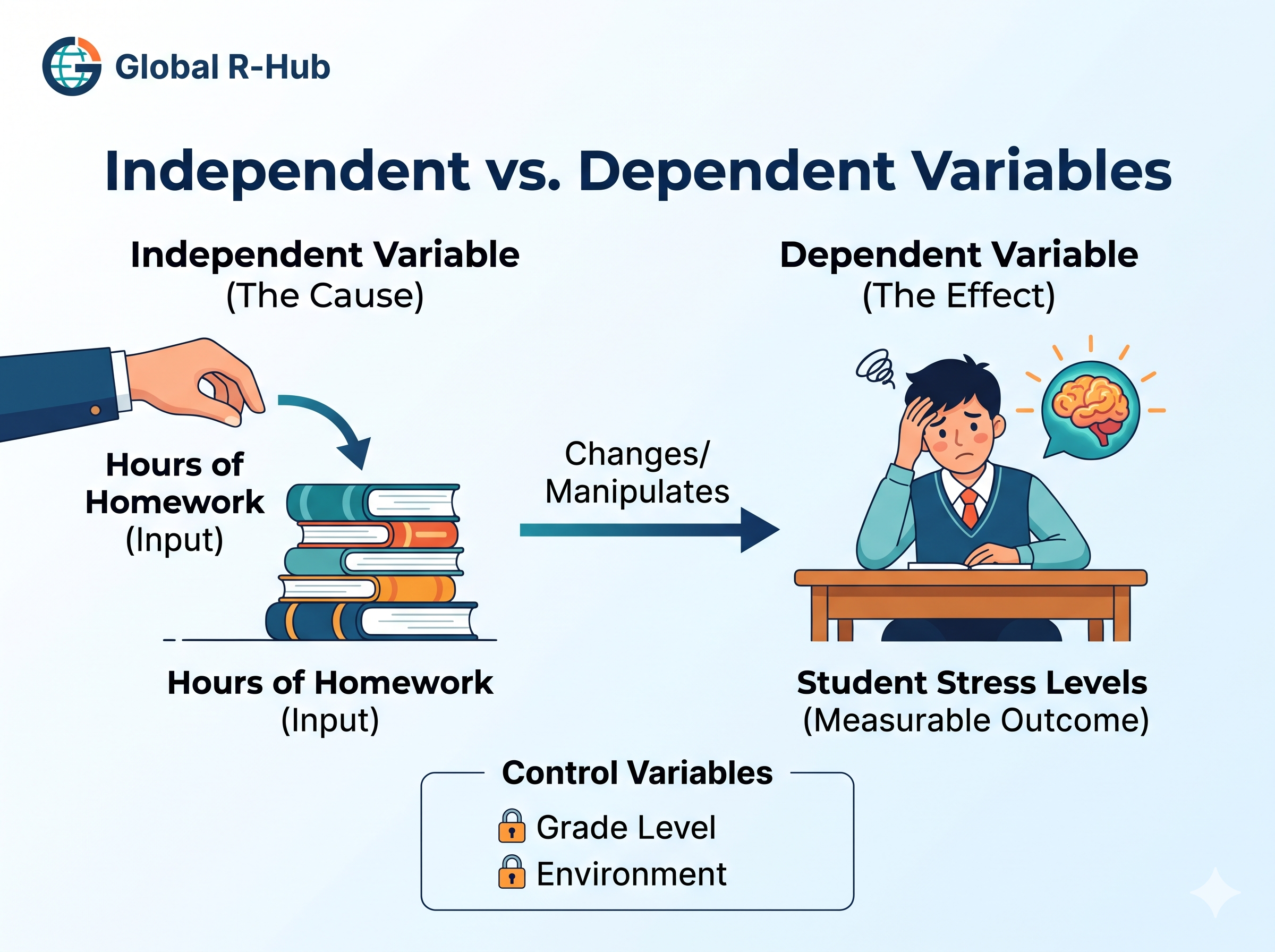
Independent Variable (The Cause): What you change or observe (e.g., daily homework hours).
Dependent Variable (The Effect): What you measure as an outcome (e.g., student stress levels).
Write both variables down clearly before drafting your sentence. If you don't define your variables, your prediction won't be testable.
Step 3: Check existing research (Literature Review)
Never pull a prediction out of thin air. Search Google Scholar or PubMed to see what past studies have found about your topic. If multiple studies show that heavy academic workloads increase anxiety in teenagers, your hypothesis should predict a similar pattern. Existing research gives you the evidence to back up your prediction.
Step 4: Choose your sentence format
There are two common ways to structure a hypothesis. Pick the one that best fits your subject:
The "If-Then" Format (Common in Biology, Physics, & Psychology):
"If [independent variable changes], then [dependent variable will respond in a specific way]."
The Direct Relationship Format (Common in Economics, Business, & Social Sciences):
"[Independent variable] has a significant positive/negative effect on [dependent variable] among [specific group]."
Step 5: Add specific details (Who, What, and How)
A strong hypothesis names the group being studied, the measurement tool, and the exact boundaries. Compare these two versions:
Vague: "Too much screen time hurts sleep quality."
Specific: "Using screens for more than four hours a day is linked to reducing sleep duration by over 30 minutes among high school students aged 15–17, as measured by the Pittsburgh Sleep Quality Index."
The second version tells the reader exactly who is being studied and how the result will be measured.
Step 6: Pass the "Falsifiability" Test
Ask yourself: What result would prove my hypothesis wrong?
In science and research, a hypothesis must be falsifiable—meaning it must be possible for data to prove it false. A statement like "Stress is bad for students" cannot be proven wrong with data because "bad" isn't a measurement.
Quick Tip: Make sure you don't accidentally write a question! "Does homework affect sleep?" is a research question. "Students who do more than three hours of homework per night sleep significantly less than those who do under one hour" is a hypothesis.
Weak vs. Strong Hypothesis: A Quick Comparison
To see how precision changes everything, look at this example from Environmental Science:
Feature | Weak Hypothesis | Strong Hypothesis |
|---|---|---|
Statement | "Air pollution affects the health of people living near factories." | "Urban residents living within 1 km of industrial factories report significantly higher rates of breathing issues—measured by the MRC Breathlessness Scale—compared to residents living more than 5 km away." |
Variables | Undefined ("air pollution" and "health" are too broad). | Clearly defined (Distance from factories vs. MRC Scale scores). |
Population | Vague ("people"). | Specific ("Urban residents within 1 km vs. 5+ km"). |
Testable? | No. Impossible to measure "health" as a single number. | Yes. Data can easily confirm or disprove the difference between groups. |
3 Places Where Students Usually Get Stuck
When students work on a research paper alone, they usually hit one of three roadblocks:
The Scope is Off: The hypothesis is either too huge to test with available data, or too narrow to matter.
Using Broad Ideas Instead of Measurable Variables: Students often write about broad concepts like "academic pressure" instead of measurable variables like "scores on the PSS-10 Perceived Stress Scale." You cannot collect data on a broad concept until you decide how to measure it.
Skipping the Literature Review: Students sometimes predict something that has already been proven 100 times, or something that past science has already disproven. Both lead to rejected papers.
How a 1-on-1 Mentor Solves This
At Global R-Hub, our PhD and faculty mentors help students clear these hurdles in a single session. An experienced mentor already knows which measurement scales are trusted in your field, what data you can realistically access, and where the real gaps in current research lie. Instead of spending weeks guessing if your topic works, you get a solid, publishable direction from day one.
5 Free Tools to Help You Build Your Hypothesis
Google Scholar: The best starting point to search across all subjects. Read the abstracts (summaries) of recent papers to see how other researchers connect your variables.
PubMed: The go-to database for Biology, Medicine, Neuroscience, and Public Health. It shows you the exact testing scales and metrics used by clinical researchers.
JSTOR: Ideal for Humanities and Social Sciences (Economics, Psychology, Sociology, History, and Law). You can read up to 100 articles a month for free.
Zotero: A free tool that saves and organizes all the papers, notes, and citations you find while researching your hypothesis.
The PICO Framework: A great checklist for health and social science topics. Make sure your hypothesis covers Population, Intervention (Cause), Comparison group, and Outcome (Effect).
Frequently Asked Questions (FAQs)
1. What is the difference between a hypothesis and a thesis statement?
A thesis statement is the main argument of an essay (supported by reading and reasoning). A hypothesis is a testable prediction for a research study (tested by collecting and analyzing data). If your paper involves analyzing data or running an experiment, you need a hypothesis.
2. Does every research paper need a hypothesis?
No. Quantitative studies (papers that use numbers, statistics, and experiments) need a hypothesis. Qualitative studies, literature reviews, and theoretical papers usually rely on a Research Question instead because they explore texts, interviews, or ideas rather than testing numerical variables.
3. How long should a hypothesis be?
Keep it between one and three sentences. One clear sentence is usually enough. In statistical papers, you might include a second sentence for your Null Hypothesis (which states that there is no relationship between the variables, serving as a baseline for your math tests).
4. Can a high school or undergraduate student publish a paper with an original hypothesis?
Yes! Every year, ambitious students publish original papers in peer-reviewed journals. Journals judge your paper by the quality of your hypothesis, your methodology, and your data analysis—not your age.
Turn Your Hypothesis into Published Research with Global R-Hub!
Writing a strong hypothesis is the first milestone in building a standout research paper. However, turning that prediction into a complete, peer-reviewed publication is much easier when you have an expert guiding you every step of the way.
At Global R-Hub (globalrhub.org), we pair ambitious middle school, high school, undergraduate, and graduate students 1-on-1 with PhD scholars and mentors from the world’s top universities.
How Global R-Hub helps you succeed:
Custom Topic & Hypothesis Building: Work with a subject-matter expert to craft a novel, testable hypothesis in AI, Computer Science, Biology, Economics, Business, Psychology, Law, or Physics.
End-to-End Publication Support: Get hands-on mentorship through literature reviews, data analysis, academic writing, and submitting to reputed peer-reviewed journals.
Standout College Applications: Earn an elite Letter of Recommendation from your mentor and build verifiable academic credentials that set you apart in top-tier university admissions.
Whether you fit into our Young Scholar Program (Grades 6–8), High School Scholar Program (Grades 9–12), Undergraduate/Graduate Research Tracks, or need dedicated Research Paper Support, we have a personalized pathway for you. Ready to start your research journey? Visit globalrhub.org today and book your FREE 1-on-1 Strategy Call to design your custom research and publication roadmap!