

Who Is Levent Alpöge, the Reclusive Genius Behind AI's Math Conquest?
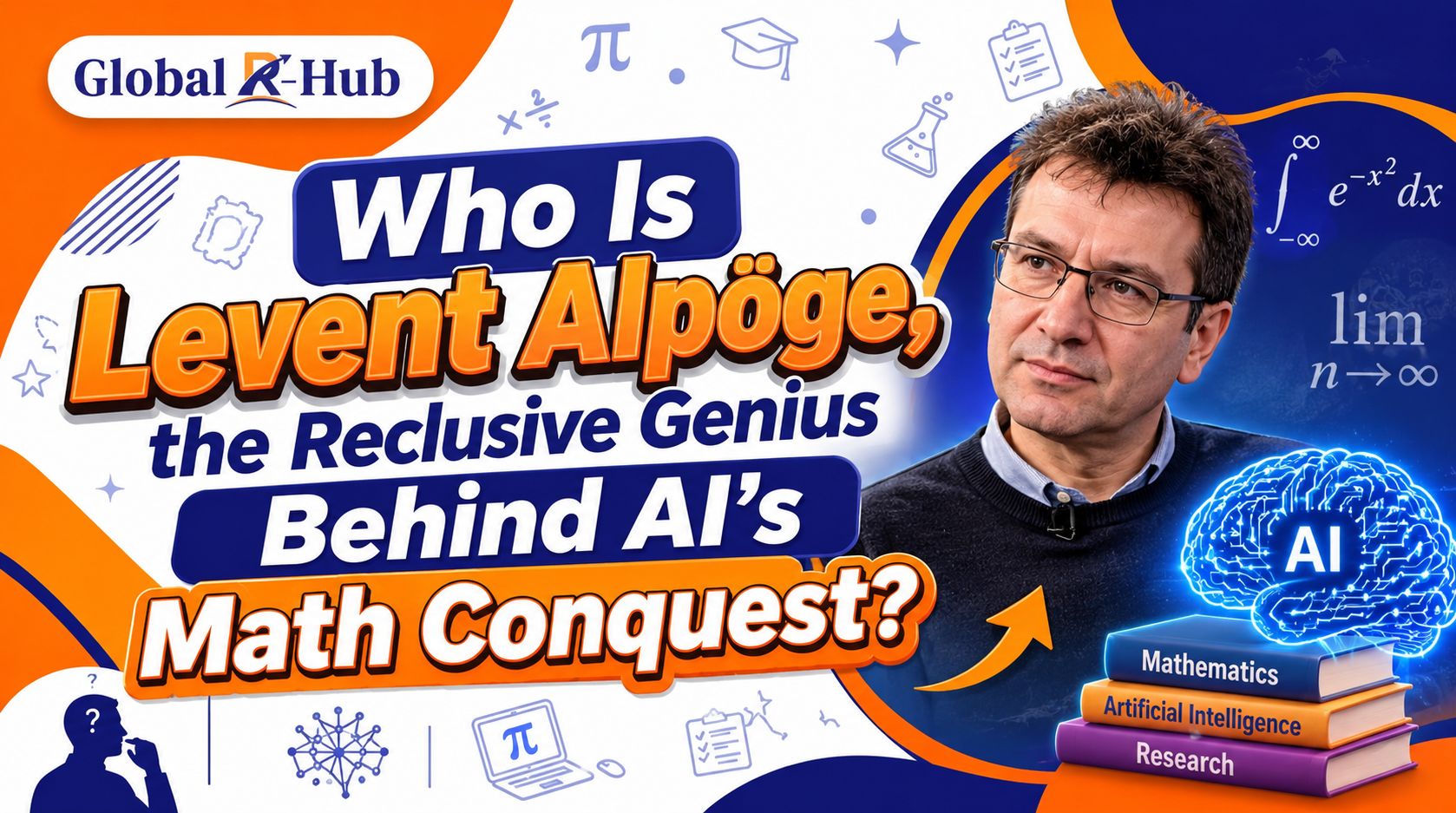
Who Is Levent Alpöge, the Reclusive Genius Behind AI's Math Conquest?
For Indian high school students building portfolios in mathematics, computer science, or artificial intelligence for university admissions, the frontier of AI-assisted theorem proving is one of the most exciting developments in modern science. When headlines ask who is Levent Alpöge, the reclusive genius behind AI's math conquest, students and parents often wonder how a number theorist teamed up with an AI system to tackle centuries-old unsolved problems and what that means for the future of math research. Exploring how human mathematicians, AI models, and formal proof assistants work together gives ambitious students a clear, lab-free way to enter cutting-edge STEM research.
At a Glance: Levent Alpöge & AI-Assisted Mathematics
Who He Is: Levent Alpöge is an American-Turkish mathematician trained at Harvard, Cambridge, and Princeton (where he earned his PhD in number theory under Fields Medalist Manjul Bhargava) who joined the technical staff at Anthropic.
The Breakthroughs: Working with Anthropic's Claude AI models, Alpöge drew global attention for a rapid series of AI-assisted mathematical results most notably releasing a massive formal proof of the 167-year-old Riemann hypothesis written in the Lean proof language.
The Core Tool (Formal Verification): Unlike ordinary text answers that can contain hidden logical flaws, proof assistants like Lean verify every single step against strict mathematical axioms.
High School Research Fields: Pure Mathematics & Number Theory, Formal Verification (Lean 4), Artificial Intelligence & Automated Reasoning, and Theoretical Computer Science.
Why Formal Proof Assistants Change the Game
In traditional mathematics, a mathematician writes a proof in prose and equations, and peer reviewers spend months or years checking whether every step holds up. When large language models first attempted advanced math, they frequently hallucinated plausible-sounding but broken arguments.
Pairing an AI system with a formal proof assistant like Lean 4 changes that workflow. The AI proposes lemmas, proof strategies, and formal code, while the proof assistant acts as an unforgiving mechanical referee rejecting any step that does not follow rigorously from established axioms. Even when a formal proof passes automated checking, however, mathematicians must still verify that the problem statement itself was encoded accurately and work to translate millions of lines of code into ideas humans can understand.
Comparing Traditional Proofs vs. AI-Assisted Formal Proofs
Understanding how different proof workflows operate helps students see why human mathematicians remain central to the field.
Proof Approach | How Arguments Are Built | Key Strengths & Current Challenges |
|---|---|---|
Traditional Human Proof | Written in natural language and mathematical notation; checked by human peer reviewers | Builds deep conceptual intuition and elegance, but very long proofs are hard for humans to audit line by line |
Formal Verification (Lean / Coq) | Every definition and step is encoded in a strict programming language checked by software | Guarantees logical rigor from axioms, though translating complex theories into code takes significant effort |
AI + Formal Verification | Human mathematicians guide AI models to search for proof paths and generate formal code | Can explore vast search spaces rapidly, but resulting proofs can be enormous and difficult for humans to interpret |
What This Means for High School Students in India
India has a deep tradition of mathematical talent from national math olympiads to computer science and engineering programs. High school students in India do not need a university supercomputer or private AI lab to learn formal mathematics.
Learning how to formalize proofs in Lean 4 or evaluate how AI models reason through competition-level math problems in grades 9–12 builds rare, high-signal skills in logic, software engineering, and mathematical maturity that stand out strongly in university applications.
How High School Students Can Research AI & Formal Math (Without a Lab)
You can build a structured, reproducible mathematics and computer-science research project on a standard laptop using free, open-source tools.
Step 1: Learn the Basics of Formal Proof Verification in Lean 4
Start with accessible, open-source interactive tutorials:
Try beginner-friendly resources such as the Natural Number Game and the Lean 4 documentation to see how everyday algebra and number-theory proofs translate into verified code.
Pick a well-defined set of classic high school or olympiad theorems (such as inequalities, modular arithmetic properties, or graph-theory lemmas) and formalize them step by step.
Step 2: Benchmark AI Reasoning on Structured Math Problems
Use Python and open math-benchmark datasets to design a clean empirical study:
Compare how different open or accessible AI models perform across problem categories (algebra, combinatorics, number theory, or geometry) and categorize the exact types of logical errors they make.
Test whether breaking a problem into smaller lemmas or asking a model to write formal Lean steps improves accuracy compared with standard text-only prompting.
Step 3: Turn Your Findings Into a Structured Research Paper
Selective university admissions committees and student STEM journals value a focused research question, reproducible code repositories, transparent error analysis, and clear mathematical exposition. Browsing curated research project ideas can help you narrow a broad interest in AI or pure math into a well-scoped high school study. If you want guidance from doctoral mentors to refine your methodology and prepare a manuscript for vetted recommended journals, consider applying to the High School Scholar Program.
Frequently Asked Questions
Who is Levent Alpöge?
Levent Alpöge is an American-Turkish number theorist with degrees from Harvard, Cambridge, and Princeton (where he studied under Fields Medalist Manjul Bhargava) who works at Anthropic on AI-assisted mathematical research.
What is the Lean programming language used in AI math proofs?
Lean is an open-source formal proof assistant that checks mathematical proofs line by line against formal logic and axioms, ensuring that no hidden gaps or invalid leaps slip into an argument.
Does AI solving hard math problems mean students should stop studying mathematics?
No. Even when AI helps generate massive formal proofs, human mathematicians are needed to formulate meaningful conjectures, verify formal definitions, simplify arguments into understandable concepts, and connect ideas across fields.
How can a high school student start a research project in formal math or AI reasoning?
Students can learn Lean 4 on a standard laptop, formalize a collection of classic or olympiad-level theorems, or run a systematic benchmark analyzing how AI models handle different types of mathematical proofs.