

Why AI Speeds Up Research But Not Lab Work in 2027
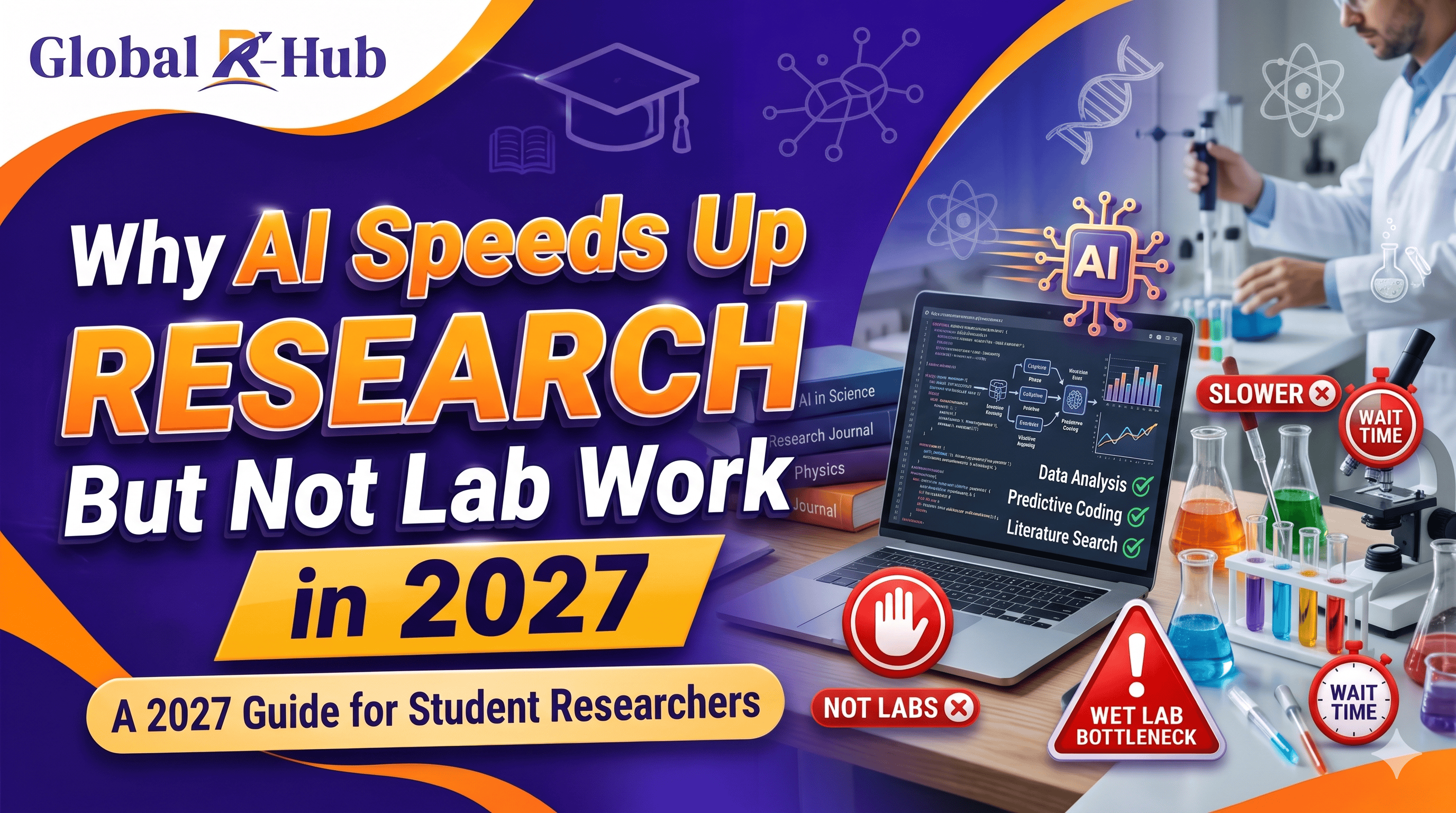
Why AI is Speeding Up Scientific Research But Not Lab Experiments (2027)
International university admissions committees expect applicants to demonstrate advanced methodological skills, but integrating artificial intelligence into high school projects often confuses aspiring scholars. While AI in scientific research has revolutionized data analysis, a recent joint report from Google, Google DeepMind, and M.I.T. reveals a stark reality: researchers are using AI heavily, but it is not helping as much in the physical laboratory. Understanding this divide allows independent student researchers to bypass physical lab bottlenecks and design highly rigorous computational projects from their laptops.
At a Glance: AI in Academic Research
Primary AI Use Cases: Systematic literature reviews, Python code generation, and massive dataset parsing.
The Wet-Lab Bottleneck: Physical experiments (pipetting, material synthesis) remain manual and unaccelerated by AI.
Strategic Advantage: Students can execute publishable "dry-lab" (computational) research without needing physical university lab access.
Key Finding: Google and M.I.T. confirm AI accelerates digital research workflows, not physical experimentation.
The Google, DeepMind, and M.I.T. Consensus on AI in Science
The recent findings published in September 2026 by Google, DeepMind, and M.I.T. establish that artificial intelligence acts as a digital accelerator rather than a physical replacement. Large Language Models (LLMs) and machine learning algorithms are exceptionally proficient at identifying patterns in vast oceans of existing data. When a scientist needs to cross-reference ten thousand genomic sequences or summarize forty peer-reviewed papers on carbon dating, AI reduces months of manual cataloging into a matter of hours.
However, science ultimately requires empirical validation. The report highlights that once a researcher formulates a hypothesis using AI, they must still walk into a physical laboratory to test it. AI cannot pour chemicals, calibrate a mass spectrometer, or maintain sterile cell cultures. This means the cognitive and analytical phases of research are operating at lightning speed, while the physical execution phase remains bound by traditional human constraints.
Why Physical Lab Experiments Remain the Ultimate Bottleneck
Physical science is constrained by the laws of thermodynamics, material availability, and mechanical precision. In a traditional wet lab, researchers must wait days for bacteria to grow in a petri dish or for a chemical synthesis to crystallize. While multi-million-dollar pharmaceutical companies employ robotics for automated liquid handling, the vast majority of academic laboratories still rely on graduate students to manually pipette reagents.
For high schoolers in India aiming to build an international university profile, this bottleneck is actually a strategic advantage. Because physical lab work is slow, manual, and gatekept by university insurance policies, attempting a physical chemistry or biology project is incredibly difficult for a teenager. The fact that AI cannot speed up wet-lab experiments means that physical laboratory access is no longer the ultimate metric of a student's research capabilities. The frontier of accessible student research has shifted entirely to the computational realm.
4 Ways AI is Speeding Up Scientific Research for Students
By embracing the computational advantages highlighted by M.I.T. and DeepMind, ambitious high school students can execute university-level methodologies entirely from a laptop.
Accelerating Systematic Literature Reviews
Before writing a hypothesis, a researcher must understand the current academic conversation. Traditionally, this required manually reading hundreds of abstracts. Today, AI-powered semantic search tools like Elicit, Consensus, and Semantic Scholar allow students to query massive databases of peer-reviewed literature using natural language. These tools instantly extract claims, methodologies, and limitations from dozens of papers simultaneously, allowing you to identify a highly scoped research gap in a fraction of the time.
Automating Large-Scale Data Parsing
Secondary data analysis is the most viable pathway for independent high school research. Portals like Kaggle, the World Bank, and the NASA EarthData repository provide free access to massive datasets. AI significantly speeds up the process of cleaning and structuring this data. Machine learning algorithms can rapidly identify outliers, normalize variables, and format thousands of rows of raw CSV data, transforming an overwhelming spreadsheet into a clean dataset ready for statistical regression.
Generating and Debugging Analytical Code
To analyze secondary data, student researchers must write code, typically in Python or R. AI serves as a powerful pair-programmer. Instead of spending weeks troubleshooting a broken pandas or matplotlib script, students can use AI to instantly debug their code, generate complex data visualization charts, or write the foundational scripts for neural network training. The AI acts as a technical tutor, allowing students to focus on the statistical implications of their data rather than syntax errors.
Predictive Modeling Without Physical Reagents
Instead of mixing chemicals in a beaker, students can use AI to run predictive computational models. Tools like DeepMind’s AlphaFold have mapped the 3D structures of virtually all known proteins. A high school student interested in biochemistry can use these AI-generated models to simulate how a new drug compound might bind to a specific protein receptor. This "dry-lab" methodology is completely safe, requires zero physical materials, and produces highly rigorous data that international university admissions committees deeply respect.
Designing a Viable Computational Research Project
To successfully publish a paper, you must design a methodology that leverages AI's strengths in data processing rather than fighting its physical limitations. Do not propose a project that requires you to physically build an AI-powered robot or test material strengths in a mechanical lab.
Instead, focus your research project ideas strictly on computational analysis. For example, use machine learning algorithms to analyze satellite imagery for deforestation tracking, or apply natural language processing (NLP) to analyze historical sentiment in digitized 19th-century newspapers. If you are unsure how to structure an IMRaD methodology around a purely digital dataset, partnering with an active doctoral researcher through the High School Scholar Program ensures your computational methodology is scientifically valid and formatted correctly for journal submission.
Maintaining Academic Integrity with AI
While AI accelerates data analysis and literature mapping, it cannot write your final manuscript. Academic journals and university admissions offices employ sophisticated AI-detection software to verify original authorship.
Your methodology, hypothesis, and the words on the page must be your own. If you use AI to generate Python code for your data analysis, you must explicitly state this in the "Methods" section of your paper. If you use AI to summarize literature, you must still manually read the original source texts to ensure the AI did not hallucinate facts. Maintaining strict transparency about how you utilized computational tools is critical when submitting your final manuscript to recommended journals for peer review.
Frequently Asked Questions
Will AI eventually replace human researchers in the lab?
No. While AI exponentially accelerates data analysis, literature reviews, and predictive modeling, physical laboratory experiments still require human execution, mechanical setup, and manual validation. AI is a digital tool that enhances human researchers, not a physical replacement for them.
How can high school students use AI in their research papers?
High school students can ethically use AI to identify gaps in existing literature, clean massive open-source datasets, debug Python code used for statistical analysis, and simulate computational models. Students must never use AI to generate the actual prose of their final academic manuscript.
What is the difference between wet-lab and dry-lab research?
Wet-lab research involves physical experiments using chemicals, biological matter, or physical materials (like titration or cell cultures). Dry-lab research is entirely computational, utilizing mathematics, computer code, and AI algorithms to analyze secondary data sets from a computer.