

12 Prestigious Essay Competitions for High Schoolers
12 Prestigious Essay Writing Competitions for High School Students (2026)
If you are building a profile for top-tier international universities, winning a prestigious essay writing competition signals intellectual maturity, independent thinking, and academic rigor to admissions officers. However, the internet is flooded with generic writing contests that carry zero weight on a college application. To actually stand out, you must target competitions evaluated by university faculty that demand deep research, peer-reviewed citations, and original argumentation.
At a Glance: High-Stakes Essay Competitions
Top Tier (Highest Prestige): John Locke Institute Essay Competition, The Concord Review, Marshall Society Essay Competition.
Core Skill Required: First-principles reasoning and empirical research, not just creative writing or opinion formulation.
Common Disqualifiers: Plagiarism (including AI generation), exceeding word limits by even one word, and missing strict registration deadlines.
Cost: Most top-tier competitions are free to enter, though some academic journals (like Concord Review) require a submission or subscription fee.
On this page:
Admissions officers at universities like Oxford, Cambridge, Harvard, and Stanford read thousands of applications featuring perfect grades and standard extracurriculars. A high placement in a globally recognized essay competition cuts through the noise because it proves three things a transcript cannot:
Independent Research Capacity: You can navigate academic databases (like JSTOR or Google Scholar), synthesize conflicting studies, and form a coherent literature review without a teacher forcing you to do it.
Original Argumentation: You do not just repeat what textbooks say. You can steel-man opposing arguments and dismantle them using logic and evidence.
University-Level Formatting: You already understand how to use Chicago, MLA, or APA citation styles properly, proving you are ready for undergraduate seminars.
These competitions demand rigorous academic research. Winning or being shortlisted in these carries significant weight on a university application, particularly for students targeting humanities, social sciences, or economics.
1. The John Locke Institute Essay Competition
Disciplines: Economics, History, Politics, Philosophy, Psychology, Theology, Law.
Word Limit: 2,000 words (excluding citations).
Deadline: Typically late June (registration required by late May).
Why It Matters: Evaluated by academics from Oxford and Princeton, this is arguably the most prestigious global competition for high schoolers. It demands logic-driven precision and a thorough deconstruction of the prompt's underlying assumptions. Check official John Locke details here.
2. The Concord Review
Disciplines: History (any topic).
Word Limit: 4,000 to 6,000+ words.
Deadline: Rolling (Quarterly).
Why It Matters: Not a traditional contest, but the only quarterly journal in the world that publishes academic history papers by secondary students. A publication here is often considered the humanities equivalent of winning a major STEM Olympiad.
3. The Marshall Society Essay Competition
Disciplines: Economics.
Word Limit: 1,500 words.
Deadline: Typically mid-August.
Why It Matters: Hosted by the economics society of the University of Cambridge, this competition asks students to apply economic theory to real-world policy issues. It is a must-do for prospective economics or finance majors.
4. Harvard International Review (HIR) Academic Writing Contest
Disciplines: International Relations, Global Health, Environmental Policy.
Word Limit: 800 to 1,200 words.
Deadline: Multiple cycles (Spring, Summer, Fall).
Why It Matters: Run by the Harvard International Review, this contest requires students to write a short, heavily researched policy article. Finalists are invited to participate in a virtual defense of their paper.
5. Princeton University Princeton Prize in Race Relations
Disciplines: Sociology, Race Relations, Civic Engagement.
Word Limit: Variable (application-based essay).
Deadline: January 31 annually.
Why It Matters: While partly an award for community service, the required essays demand deep sociological understanding of racial equity and systemic policy, directly evaluated by Princeton alumni and faculty.
6. The Immerse Education Essay Competition
Disciplines: Wide range (Architecture to Medicine to Creative Writing).
Word Limit: 500 words.
Deadline: Early January and late August.
Why It Matters: This acts as a scholarship gateway. Winners receive fully funded spots at their UK summer academic programs, while runners-up receive partial scholarships. It is highly competitive but slightly more accessible due to the low word count.
7. RES (Royal Economic Society) Young Economist of the Year
Disciplines: Economics.
Word Limit: 1,000 words.
Deadline: July.
Why It Matters: Open to students studying globally (though often UK-focused), this competition forces students to evaluate current economic crises (like inflation or housing shortages) using empirical data and macroeconomic frameworks.
If you are struggling to narrow down a topic that fits these high-tier academic prompts, reviewing curated research project ideas can help you bridge the gap between your classroom knowledge and a publishable thesis.
If your strengths lie in persuasive writing, cultural commentary, or journalism rather than deep academic citations, these competitions are the gold standard.
New York Times Student Editorial Contest: (April deadline). Students submit a 450-word evidence-based opinion piece on any topic. Evaluated by NYT journalists, it teaches concise, punchy argumentation.
Ayn Rand Institute Novel Essay Contests: (Deadlines vary by book). Students write essays based on Anthem, The Fountainhead, or Atlas Shrugged. Excellent for students interested in philosophy and political theory.
Profile in Courage Essay Contest: (January deadline). Hosted by the JFK Library, requiring a 700–1,000 word essay on an act of political courage by a US elected official.
St. John's College Essay Contest: (Varying deadlines). Focuses on the "Great Books" of Western civilization, requiring deep textual analysis rather than external empirical research.
Ocean Awareness Contest: (June deadline). Blends environmental science with advocacy writing, asking students to address climate change and ocean conservation through persuasive prose.
Every year, brilliant students submit exceptional essays only to be quietly disqualified for technical violations. Do not let three months of hard work evaporate over a formatting error.
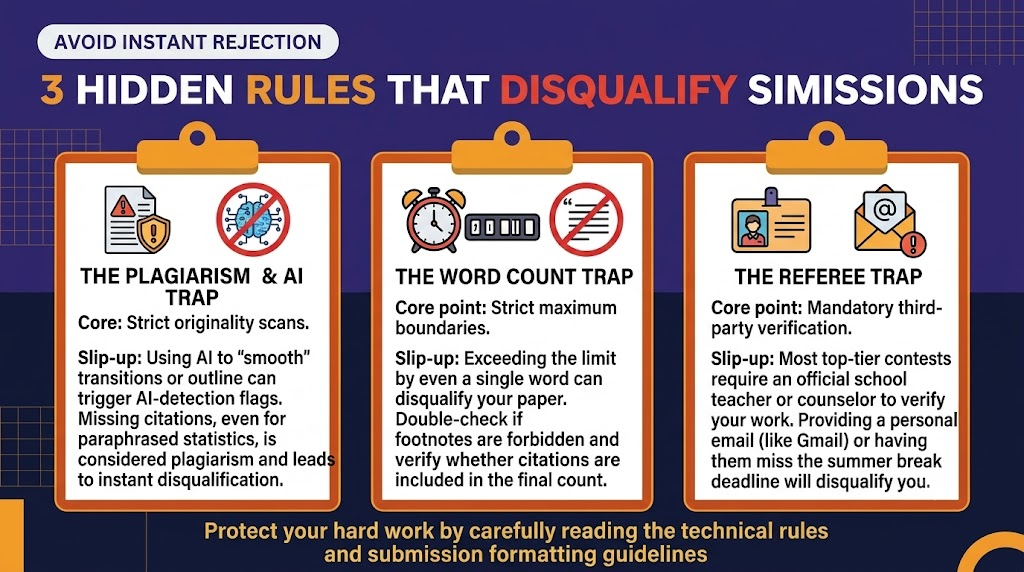
1. The Plagiarism and AI Trap Competitions now run all submissions through aggressive AI-detection software (like Turnitin). If you use ChatGPT to "smooth out your transitions" or generate your outline, you risk the system flagging your entire paper. Furthermore, failing to cite a statistic even if you reworded it constitutes academic plagiarism.
2. The Footnote vs. Endnote Word Count Violation Read the rules on word counts obsessively. The John Locke competition, for instance, strictly forbids in-text citations or footnotes if you want to keep them out of your word limit; they mandate endnotes. If you use footnotes, the judges will count them, pushing you over the 2,000-word limit and triggering instant disqualification.
3. The Academic Referee Requirement Many prestigious competitions require a school counselor or teacher to officially verify that the essay is your own work. This usually involves an automated email sent to their official school address (no personal Gmail accounts allowed). If your teacher misses this email over the summer break, your essay is discarded.
Students aiming to avoid these technical pitfalls and ensure their research meets international peer-review standards often benefit from structured mentorship. The High School Scholar Program pairs ambitious students with university faculty to navigate the entire process of writing, formatting, and submitting academic research.
A winning essay cannot be written in a weekend. Follow this timeline to ensure your submission is polished, rigorously researched, and logically flawless.
Week 1: Deconstruction & Literature Review. Break down the prompt. Identify the hidden assumptions. Gather 10-15 academic sources that argue both sides of the issue.
Week 2: The Outline & Thesis Generation. Formulate a thesis that is falsifiable and specific. Outline your essay, ensuring you dedicate at least one section to defeating the strongest counterargument.
Week 3: The Ugly First Draft. Focus purely on getting your arguments onto paper. Do not worry about word counts or beautiful prose yet; focus on logical flow and embedding your evidence.
Week 4: The Pruning Phase. Cut the fluff. Remove adverbs, passive voice, and unnecessary historical background that the judges already know. Check your word count.
Week 5: Citation & Formatting. Convert all your URLs and informal notes into flawless Chicago or APA citations. Ensure you are using endnotes or footnotes exactly as the rules dictate.
Week 6: The Blind Review. Hand your essay to a teacher or mentor who has not seen the prompt. If they cannot identify your core thesis by the end of the first paragraph, you need to rewrite your introduction.
Do essay competitions help with Ivy League admissions? Yes. Winning or placing highly in a globally recognized academic competition (like John Locke or Concord Review) serves as third-party verification of your intellectual caliber, which is highly valued by Ivy League and Oxbridge admissions committees.
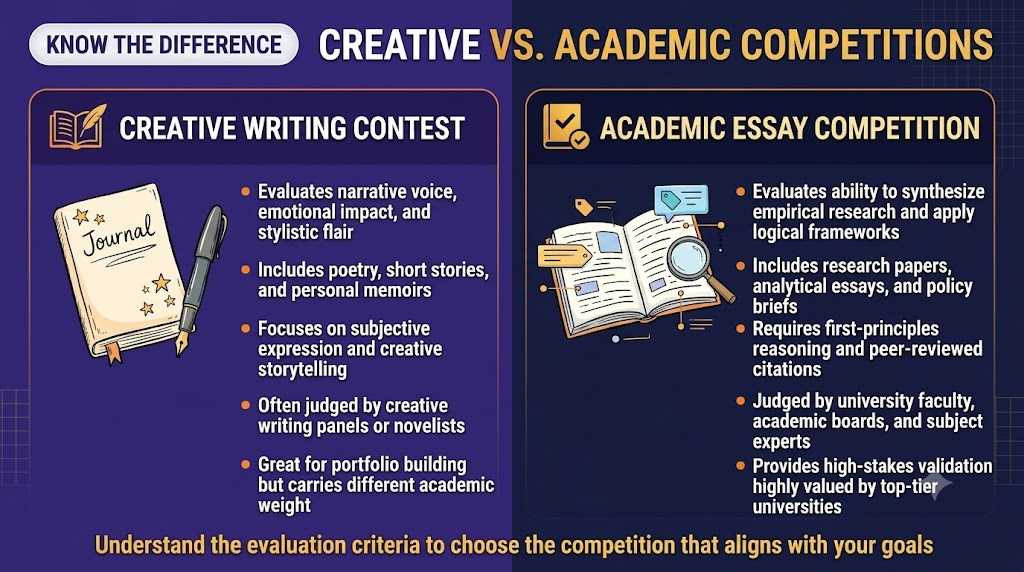
What is the difference between a creative writing contest and an academic essay competition? Creative writing contests evaluate narrative voice, emotional impact, and stylistic flair. Academic essay competitions evaluate your ability to synthesize empirical research, apply logical frameworks, and defend a falsifiable thesis using peer-reviewed citations.
Are there fees to enter high school essay competitions? Most university-sponsored essay writing competitions (such as John Locke or the Marshall Society) are entirely free to enter. However, publication-based competitions like The Concord Review require a submission fee to support their non-profit peer-review process. Always verify fees on the official organization websites.

