

John Locke Essay Competition: Rules, Deadlines, and How Winning Essays Actually Work
John Locke Essay Competition: Rules, Deadlines, and How Winning Essays Actually Work
Every spring, tens of thousands of high school students download the prompts for the John Locke Essay Competition, convinced that writing a polished, textbook-style summary of existing scholarship will earn them a spot at the Oxford awards gala. Most of them will not even make the shortlist. To stand out to the panel of senior academics from Oxford, Princeton, and other top universities, you cannot write like a high school student trying to prove what you have read; you have to write like an independent thinker dismantling a complex problem from first principles.
At a Glance: John Locke Essay Competition Quick Facts
Organiser: The John Locke Institute (Oxford, UK).
Eligibility: Senior Category: 18 years old or younger on the submission deadline. Junior Category: 14 years old or younger on the submission deadline.
Subject Categories: 7 Senior disciplines (Philosophy, Politics, Economics, History, Psychology, Theology, Law) with 3 questions each, plus a Junior Prize category.
Word Limit: Strictly 2,000 words maximum (excluding diagrams, tables of data, endnotes, and bibliography). Footnotes are not permitted.
Cost: Free for all entries registered by the May 31 deadline and submitted by June 30. (Late extensions incur a fee, historically around $20 USD, subject to annual confirmation on the official portal).
Prizes: Grand Prize of a $10,000 scholarship toward John Locke Institute courses; Category Winner prizes of $2,000 scholarships; plus Shortlist, Commendation, and High Commendation distinctions.
On this page:
The John Locke Essay Competition operates on a strict seasonal schedule, with a hard 2,000-word limit and a mandatory registration cutoff a full month before the essay itself is due. While you should always verify the exact calendar dates for the current cycle on the official John Locke Institute Essay Competition page, the annual window follows a consistent pattern:
Milestone | Typical Annual Window | Critical Requirement |
Questions Released | February / March | Choose 1 prompt from the 7 Senior categories (or Junior list). You may submit multiple essays across different prompts. |
Registration Opens | April 1 | Create your candidate profile on the official portal before drafting concludes. |
Registration Deadline | May 31 (11:59 PM BST) | Mandatory. If you do not register by May 31, you cannot submit an essay in June. |
Submission Deadline | June 30 (11:59 PM BST) | Final PDF upload, strictly under 2,000 words, with valid academic referee details. |
Late Submission Deadline | Mid-July (7- or 21-day options) | Available only to pre-registered candidates who pay a late entry fee before the June 30 cutoff. |
Referee Verification | Early July / Post-Submission | Your school teacher or counsellor must click the verification link sent to their official school email. |
Shortlist Notification | Mid-August | Candidates are notified whether their script has passed the initial triage into the final judging round. |
Awards Gala & Conference | September / October | Held in Oxford or London for shortlisted candidates, families, and faculty. |
Do not treat the May 31 registration deadline lightly. Every June, students who have spent weeks writing a brilliant paper discover they are locked out of the portal because they never registered their email address in May.
Students entering the Senior division (aged 18 and under) choose from 21 total questions divided evenly across seven core humanities and social science disciplines. If you will still be 14 years old or younger on the June 30 submission date, you are also eligible to enter the Junior Prize, which offers its own set of five to six cross-disciplinary prompts.
Category | What the Prompts Actually Test |
Philosophy | Epistemology, moral responsibility, free will, and the logical coherence of everyday beliefs. |
Politics | Legitimacy of state power, democratic trade-offs, sovereignty, and international justice. |
Economics | Incentives, unintended consequences of regulation, price mechanisms, and wealth distribution. |
History | Causation, counterfactual analysis, and challenging conventional historical narratives. |
Psychology | Human cognition, rationality versus emotion, mental illness categories, and social conformity. |
Theology | The existence and nature of God, secularism, scriptural interpretation, and religious ethics. |
Law | Jurisprudence, constitutional limits, criminal culpability, and the boundary between law and morality. |
A smart strategy used by top performers is cross-disciplinary selection. You do not need to take IB Economics to answer an Economics prompt, nor do you need formal training in Law to tackle a jurisprudence question. Often, applying an economic framework of incentives to a History question, or bringing rigorous philosophical definitions to a Psychology prompt, creates a much sharper argument than staying inside standard classroom boundaries. If you are still exploring where your intellectual strengths lie across the social sciences, browsing broader research project ideas can help you see how different academic lenses approach the same human problems.
Before the Oxford and Princeton examiners ever judge the quality of your prose, entries go through an administrative and formatting filter. Three specific technical errors trip up otherwise capable students every cycle:
Using Footnotes Instead of Endnotes: The official rules state plainly that essays must not include footnotes. All citations and supplementary notes must be placed at the end of the document as endnotes, followed by a full bibliography. Endnotes and the bibliography are excluded from the 2,000-word ceiling, whereas in-text parenthetical citations count toward your word total.
Failing the Academic Referee Check: Every candidate must provide the official school email address of an academic referee—a teacher, head of department, or school principal familiar with the student's written work outside the competition. Personal Gmail or Yahoo addresses for referees are rejected. If your teacher goes on summer break in July and misses the automated verification email from the Institute, your essay is disqualified. Warn your teacher in May and ask them to whitelist the John Locke domain.
The File Naming Convention: The submission portal requires your uploaded PDF to follow an exact naming formula:
FirstName-LastName-Category-QuestionNumber.pdf(for example,Aarav-Sharma-Economics-2.pdf). Ignoring small administrative instructions signals carelessness before a judge reads your first sentence.
The single biggest misconception propagated by generic prep blogs is that a John Locke essay is a miniature literature review. Indian students trained in board exam formats—or even standard AP and IB essays—often spend their first 800 words defining basic terms and quoting famous thinkers ("According to John Stuart Mill... whereas Karl Marx argues...").
Examiners at universities like Oxford and Princeton read hundreds of scripts. They already know what Mill and Marx said; they want to know what you think, and whether your reasoning holds up under pressure.
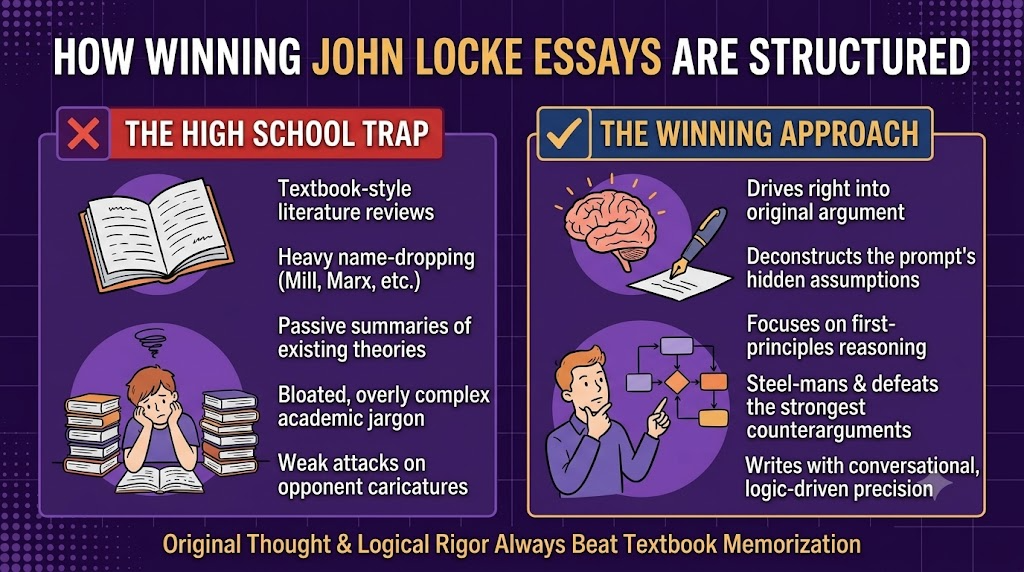
What separates a shortlisted or prize-winning essay from the rest:
Deconstruct the Premise Immediately: Every John Locke prompt contains a hidden assumption or a deliberately ambiguous word. If a Politics question asks, "Should we fear a world government?", do not start with a history of the United Nations. Start by asking who "we" refers to (autocrats, liberal democracies, or stateless minorities?) and what specific mechanism a "world government" implies.
Steel-Man Your Opponent: Weak essays attack a caricature of the opposing view. Winning essays build the strongest, most charitable version of the counterargument—known in philosophy as "steel-manning"—and then expose the exact logical flaw or empirical failure at its core.
Favour Depth Over Name-Dropping: Citing 45 papers superficially makes your essay read like a Wikipedia page. Engaging deeply with three or four foundational arguments, testing their logic with original examples or clean empirical data, is far more persuasive.
Write with Conversational Precision: Avoid bloated academic jargon. Short, declarative sentences that move logically from premise to conclusion always beat thesaurus-heavy prose.
With only 2,000 words available, the challenge is not writing enough—it is cutting away everything that does not directly advance your thesis. A disciplined 10-week schedule between mid-April and June 30 looks like this:
Weeks 1–2: Prompt Selection & Dissection. Pick two candidate questions across different categories. Break down every word in the prompt, identify the hidden premises, and draft a one-paragraph thesis for each before committing to the stronger one.
Weeks 3–4: Targeted Reading & Counterargument Mapping. Read foundational texts and contemporary critiques. Do not take passive notes; organize your reading into two columns: Arguments that support my thesis and The strongest objections I must defeat.
Week 5: Registration & The Structural Skeleton. Complete your official registration before May 31 and confirm your school referee. Write a bulleted outline where every section has a dedicated word budget.
Weeks 6–7: The 2,500-Word First Draft. Write your full argument without obsessing over the word limit yet. Focus entirely on logical transitions and empirical evidence.
Weeks 8–9: The Ruthless Edit & Stress-Testing. Cut 500 words of throat-clearing, repetitive adjectives, and background summaries. Have a mentor or teacher attack your central premise to see where the logic buckles.
Week 10: Endnotes, Formatting & Upload. Convert all citations to endnotes, verify the PDF file name, and upload at least 48 hours before the June 30 server rush.
Developing this level of college-grade analytical writing takes practice. Students who want structured mentorship in argumentative rigor and academic inquiry can explore the High School Scholar Program, where experienced researchers guide high schoolers through framing complex questions and defending original theses.
Because the competition attracts tens of thousands of applicants globally, even a genuinely brilliant essay has no guarantee of winning a category prize. However, treating the competition as a single lottery ticket is a waste of intellectual effort.
Once the competition cycle concludes, your 2,000-word philosophical or economic argument is the ideal foundation for a full-length, 3,500-word academic research paper. By expanding your empirical dataset, adding a formal methodology section, and formatting your citations for peer review, you can submit the expanded work to reputable student journals. You can review our curated list of recommended journals to find legitimate, peer-reviewed publications that accept humanities and social science manuscripts from high school authors. That way, regardless of what happens at the Oxford awards dinner, your months of thinking result in a permanent, verifiable academic credential.
What is the word limit and deadline for the John Locke Essay Competition?
The strict maximum word limit is 2,000 words, which excludes diagrams, data tables, endnotes, and your bibliography (footnotes are not allowed). Candidates must register every year by May 31 and submit their final essay by June 30 at 11:59 PM BST, though verify exact annual dates on the official John Locke Institute website.
Is the John Locke Essay Competition free to enter?
Yes, registration and submission are completely free for all students who register by the May 31 deadline and submit their essay by the June 30 deadline. The Institute only charges an administrative fee if a pre-registered candidate pays for a late submission extension in July, or if shortlisted students choose to buy tickets to attend the optional awards weekend in the UK.
Can Indian high school students participate in the John Locke Essay Competition?
Yes, the competition is open to students of any nationality worldwide, and Indian students from CBSE, ICSE, IB, and Cambridge IGCSE boards compete and make the shortlist every year. You only need to meet the age cutoff on the submission date (18 or under for Senior; 14 or under for Junior) and have a school teacher with an official school email address act as your academic referee.
What does the John Locke Essay Competition shortlist mean?
Being shortlisted means your essay passed the rigorous initial judging rounds and ranks among the top scripts globally, making it a finalist for the category prizes and the Grand Prize. Even if a shortlisted essay does not win the top $10,000 scholarship, reaching the shortlist—or earning a Commendation or High Commendation—is a recognized academic distinction on university applications.