

20+ Medical Research Topics for High School Students

A high school student cannot enrol patients, prescribe anything, or open a chart. That constraint eliminates most of the research topics for medicine that appear on lists written for undergraduates and quietly recycled for schools. "Effect of a new hypertension drug" is not a project you can run in Grade 11. It is a project you can only pretend to run.
What remains is more than enough. Epidemiology, health policy, pharmacology at the bench, bioinformatics, and survey-based public health are all real medicine, all publishable, and none of them require a patient. The 22 topics below are written as questions, and each names the data it needs.
The question that decides every research topic in medicine
Before you fall in love with a topic, answer one thing: who or what is your subject?
There are exactly three honest answers available to a school student, and each opens a different set of doors.
Someone else's data. National health surveys, disease registries and surveillance dashboards are public, anonymised and enormous, and consent was settled years ago under a proper protocol. This is the most underused route into medical research at school level.
Volunteers who said yes. Classmates, family, community members. Real human-subject research, with real obligations: written informed consent, parental consent plus the student's own assent for anyone under 18, and the right to withdraw. Journals increasingly ask what oversight you had.
Things that are not people. Bacteria on agar, a drug formulation in a beaker, published papers you are re-analysing. No consent needed, and the methods are often the cleanest.
Notice what falls outside all three: identifiable patient records, hospital charts, clinical samples, anything involving a diagnosis. If a topic quietly assumes access to those, it is not a topic you can do.
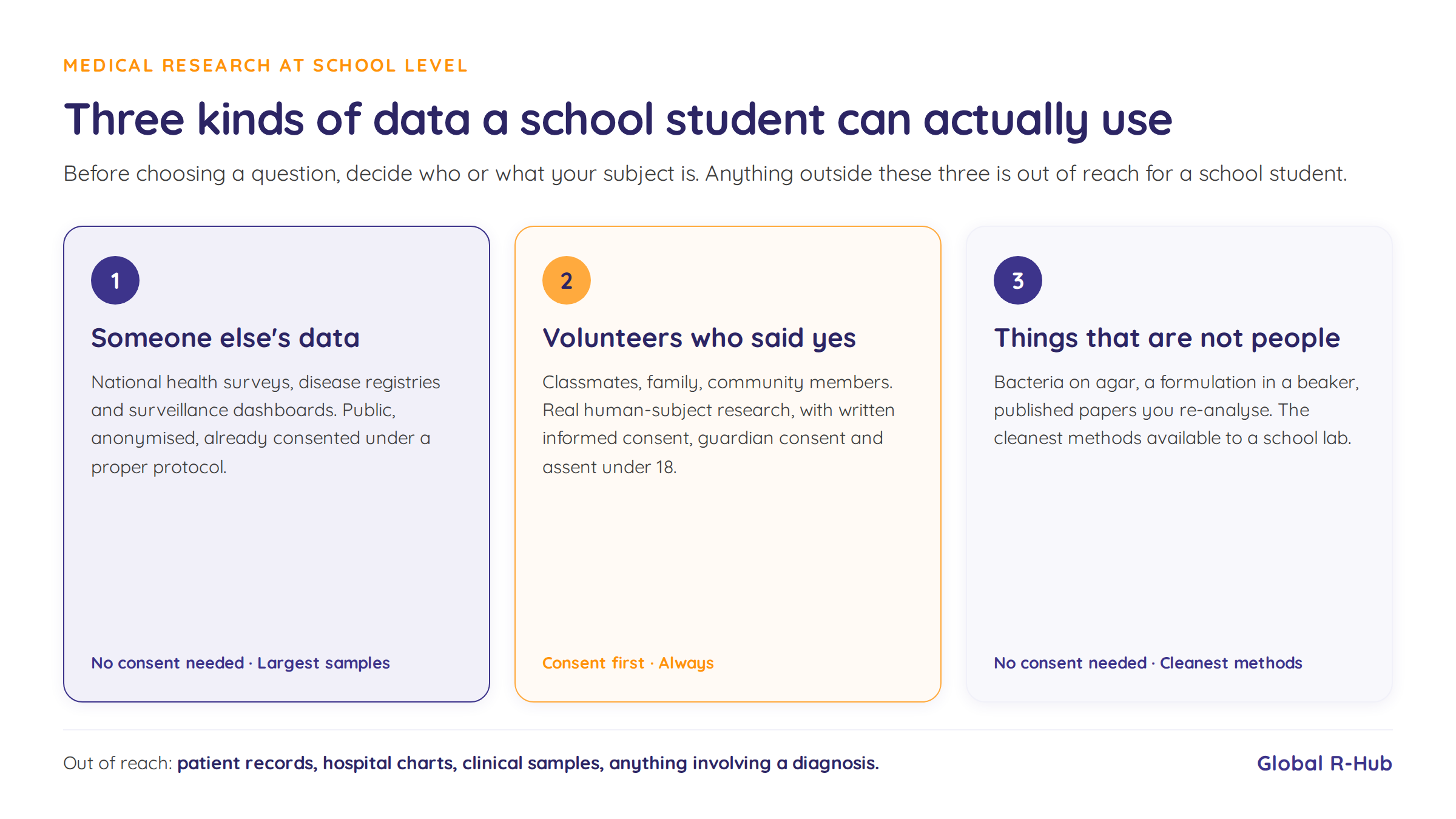
22 medical research topics, sorted by the data they need
Public health and epidemiology, using open datasets
Free, large, and the way much published health research actually works. Start with the WHO Global Health Observatory, the Global Burden of Disease results tool, India's NFHS district factsheets, and the CDC's NHANES.
# | Research question | Data source |
|---|---|---|
1 | Does district-level anaemia prevalence track household sanitation access? | NFHS district factsheets |
2 | Has the age profile of road traffic deaths shifted over a decade? | GBD results tool |
3 | Do childhood immunisation dropouts cluster in particular months? | WHO GHO, state HMIS bulletins |
4 | Does air quality predict next-week respiratory outpatient load? | OpenAQ plus published hospital bulletins |
5 | Do tobacco warning label policies track measured smoking prevalence? | WHO GHO, policy documents |
6 | Does dengue incidence lag rainfall by a predictable number of weeks? | Health bulletins, meteorological archives |
Human-subject studies you can run with consent
Small, careful, and entirely legitimate if the consent paperwork is done first.
# | Research question | Method |
|---|---|---|
7 | Does screen use before bed predict next-morning reaction time? | Within-subject design, reaction-time app |
8 | How accurate is a smartwatch heart rate against a manual pulse? | Paired readings, agreement analysis |
9 | Can students recognise the warning signs of a stroke? | Validated awareness questionnaire, scored |
10 | Does a short handwashing demonstration change technique a week later? | Pre and post observation, blinded scorer |
11 | Do painkiller users know the maximum safe daily dose? | Structured survey, anonymous |
Pharmacology, physiology and lab-adjacent questions
For students with a school laboratory and a teacher willing to supervise.
# | Research question | Method |
|---|---|---|
12 | Does caffeine dose change grip-strength endurance? | Randomised-order crossover, adults only |
13 | Which plant extracts inhibit bacterial growth? | Disc diffusion, zone diameter in mm |
14 | Does storage temperature degrade vitamin C in syrup? | Iodine titration across weeks |
15 | How much does posture change a blood pressure reading? | Standard cuff protocol, repeated measures |
16 | Do local antibiograms differ from national resistance patterns? | Compare published antibiogram reports |
Bioinformatics and clinical AI, laptop only
Some of the most interesting medical topics for a research paper right now need nothing but code.
# | Research question | Approach |
|---|---|---|
17 | Which genes are consistently differentially expressed across three public datasets? | GEO, GEO2R, overlap analysis |
18 | Does a symptom-checker chatbot change advice when age or gender wording changes? | Matched prompt set, blinded rating |
19 | Can a simple model match a published diabetes risk score? | NHANES variables, logistic regression |
A caution on clinical AI topics: the large intensive-care datasets students hear about, such as MIMIC, require credentialed access and a completed research ethics training course. Plan around them rather than counting on them.
Systematic reviews and health policy
No new data at all, and still real research. Often the strongest option for a student with no lab.
# | Research question | Method |
|---|---|---|
20 | What is the evidence that school start times affect adolescent sleep? | PRISMA-guided systematic review |
21 | How do five countries regulate direct-to-consumer genetic testing? | Comparative document analysis |
22 | Do published supplement trials report the outcome they registered? | Trial registry to publication audit |
Pick your reporting checklist before you write a word
This is the step almost no school-level guidance mentions, and the one that most changes how a medical paper is received.
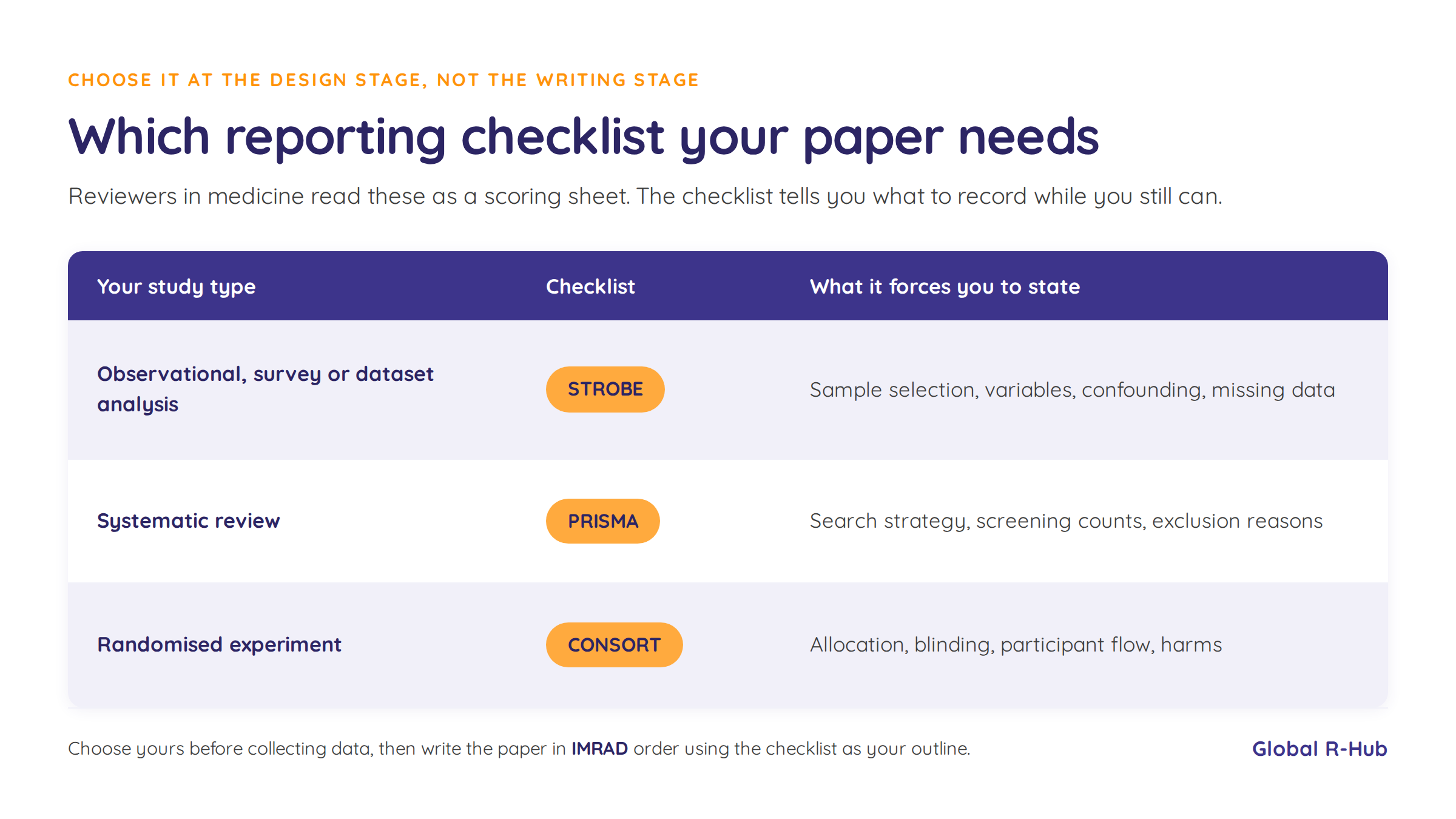
Medicine has agreed formats for reporting each study type, and reviewers use them as a scoring sheet. Choose yours at the design stage, not the writing stage, because the checklist tells you which measurements to record while you still can.
Your study type | Checklist | What it forces you to state |
|---|---|---|
Observational, survey, dataset analysis | STROBE | Sample selection, variables, confounding, missing data |
Systematic review | PRISMA | Search strategy, screening counts, exclusion reasons |
Randomised experiment | CONSORT | Allocation, blinding, participant flow, harms |
All three are free, a page or two long, and the difference between a paper a reviewer takes seriously and one they skim. Write the paper in IMRAD order (Introduction, Methods, Results, Discussion) and use the checklist as your outline.
Three mistakes that get student medical papers rejected
Collecting data before arranging consent. Retrospective consent is not consent. Anything involving people needs written permission before the first measurement, and for minors that means a guardian signing alongside the student's own assent. Data gathered without it cannot ethically be published, however good the finding.
Claiming causation from a correlation. Two variables moving together in a national dataset is an association. Writing "sanitation reduces anaemia" instead of "sanitation access was associated with lower anaemia prevalence" loses a reviewer fast. Name your likely confounders explicitly; that earns more credit than a confident sentence.
Writing about a topic with no literature you can read. If PubMed returns nothing readable on your question, you cannot write an introduction or a discussion. Search before you commit, not after.
What comes after the school paper
Medical research is a ladder, and one of the few fields where starting early compounds. A Grade 11 epidemiology paper teaches the same methods and statistical reasoning an MBBS student needs for a residency application five years later. The work gets more complex, not different in kind.
That is also why mentor fit matters more here than in most subjects. A question about differential gene expression and one about health policy are not the same craft. Global R-Hub's mentors and faculty include Dr. Nishtha Khatri, a pharmacology and therapeutics researcher at King's College London, and Dr. Kiran Shankar Kamble, a physician working in health systems and policy, and topic selection during the first weeks of the High School Scholar Program is largely about matching the question to the right one of them.
Further up the ladder, MBBS graduates preparing for residency face a version of the same problem with higher stakes, which is what the USMLE Research Support Program is built for. Students who want more worked examples across fields can browse our research project ideas, and it is worth checking where student work gets published before you settle on a study type, because different journals accept different ones.
Frequently asked questions
Can a high school student publish medical research? Yes, in student and early-career journals, and occasionally in indexed ones. The realistic route is an observational, review, or laboratory study rather than anything clinical.
Do I need ethics committee approval? For anything involving human participants, you need documented consent and ideally school or institutional oversight. Many journals ask for an ethics statement at submission and will not proceed without one.
Are these research topics for medical students too? The dataset, review, and bioinformatics questions scale directly. An MBBS student would add a larger sample, a stricter design, and a target journal chosen at the outset.