

AI Riemann Hypothesis Proof Explained (2027)
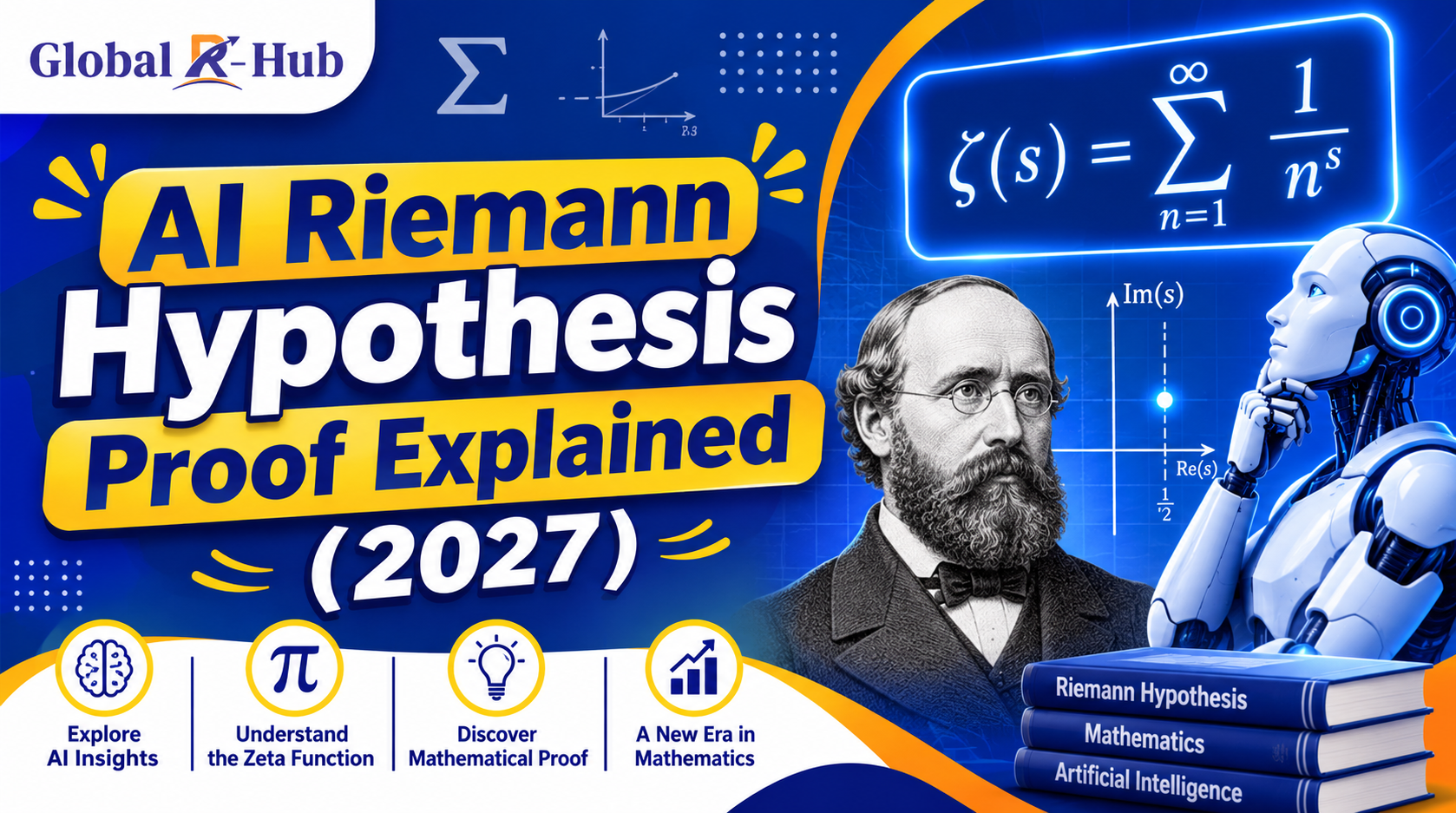
Is the AI Riemann Hypothesis Proof Real? What Mathematicians Say (2027 Guide)
For Indian high school students building strong portfolios in mathematics, computer science, or artificial intelligence for the 2027 university admissions cycle, few stories capture the future of STEM research quite like a machine-assisted attack on a 167-year-old unsolved problem. Headlines have swirled around the AI Riemann hypothesis proof with claims that independent mathematicians confirm a breakthrough developed alongside AI. When a claim touches one of the Clay Mathematics Institute's seven Millennium Prize Problems, however, careful researchers look closely at what has actually been checked, what "machine confirmation" means, and how high schoolers can learn the underlying math and formal-verification tools for themselves.
At a Glance: The AI Riemann Hypothesis Claim
The Problem: Proposed by Bernhard Riemann in 1859, the Riemann Hypothesis connects prime-number distribution to the non-trivial zeros of the Riemann zeta function and is a $1 million Millennium Prize Problem.
The November 2026 Development: Anthropic mathematician Levent Alpöge posted a note on November 20, 2026, describing a six-week collaboration with Claude and a formalization written in the Lean proof assistant.
How Verification Works: Independent researchers have compiled and checked aspects of the Lean formalization, while human mathematicians emphasize that translating and understanding dense formal code takes time and ongoing scrutiny.
High School Research Fields: Pure Mathematics, Number Theory, Formal Verification & Computer Science, and AI-Assisted Reasoning.
Why the Riemann Hypothesis Matters So Much in Math
Prime numbers whole numbers greater than 1 divisible only by 1 and themselves appear irregular as you move higher along the number line, yet their overall spacing follows deep statistical patterns. In 1859, Bernhard Riemann linked the distribution of primes to the behavior of the Riemann zeta function.
The Riemann Hypothesis conjectures that all non-trivial zeros of this function have a real part equal to one-half (lying along a single "critical line" in the complex plane). Proving it would sharpen our understanding of how prime numbers are distributed and resolve a central pillar of analytic number theory.
What Happened With the AI-Assisted Proof Claim?
In November 2026, mathematician Levent Alpöge published a note detailing work done in collaboration with Claude over roughly six weeks, building on earlier AI-assisted number-theory experiments including work on bounds for zeta zeros and formal exploration. Rather than presenting a short, conventional journal paper right away, the effort relied heavily on Lean, an interactive theorem prover and formal proof language designed to verify logical steps mechanically.
Following the release, independent researchers began compiling and inspecting the Lean formalization across independent setups. At the same time, prominent mathematicians including Fields Medalist Terence Tao have stressed that machine-checked formalization and human mathematical comprehension are distinct stages, and that thorough community verification of a result of this magnitude is an ongoing process.
Lean Code Compilation vs. Full Mathematical Consensus
High school students studying computer science and math often hear that "if formal code compiles, the proof is done." Comparing how verification works in formal logic versus traditional peer review helps keep expectations grounded.
Verification Stage | What It Checks | Strengths | Limitations to Keep in Mind |
Lean Proof Compilation | Whether every logical step follows the formal rules of the proof assistant | Mechanically catches skipped steps or formal syntax/logic errors at scale | Requires trusting the proof assistant's core logic and axioms, and may not immediately yield human intuition |
Independent Code & Kernel Checks | Whether multiple independent implementations or researchers reproduce compilation | Reduces single-machine or single-setup quirks during early inspection | Early checks are a starting signal, not a substitute for years of expert scrutiny |
Broad Mathematician Review & Consensus | Conceptual clarity, conceptual novelty, and long-term community acceptance | Builds deep human understanding, readable exposition, and historical durability | Historically takes significant time for major theorems on difficult problems |
What This Shift Means for Young STEM Researchers
Even as verification continues, the episode highlights a major shift in how mathematical research is done. AI tools are increasingly used to brainstorm analogies, suggest technical steps, or help draft formal code, while humans remain essential for choosing meaningful questions, guiding strategy, and interpreting results.
For students in India, the takeaway is empowering rather than discouraging: mathematics is not "finished" by a headline. Understanding definitions, testing conjectures, and learning modern proof tools gives ambitious students a genuine edge in university applications and STEM competitions.
How High School Students Can Research Number Theory & Formal Proofs (Without a Lab)
You do not need a supercomputer or a research grant to explore prime numbers, analytic functions, or formal logic. Both computational number theory and interactive theorem provers run on standard student laptops.
Step 1: Explore Prime Distribution and Zeta Functions in Python
Start with concrete experiments before tackling abstract generalizations:
Use Python (NumPy, SymPy, mpmath, and Matplotlib) to explore prime-counting functions, gaps between consecutive primes, and numerical approximations of the zeta function.
Compare empirical patterns in prime counts against standard asymptotic estimates to build intuition for why small irregularities matter.
Step 2: Try Interactive Proof Assistants Like Lean
Instead of only reading about formal verification, test how rigorous proof checking works in practice:
Install Lean and work through introductory logic and number-theory exercises (such as basic divisibility, primes, or modular arithmetic).
Notice how a computer proof assistant forces you to state every assumption explicitly a skill that sharpens mathematical writing across every STEM subject.
Step 3: Shape a Focused Project With Structured Mentorship
Selective university admissions committees and student journals look for clear scope, accurate definitions, reproducible code or proofs, and disciplined structure (such as introduction, methods/definitions, results/proofs, and discussion). Browsing curated research project ideas can help you turn a big topic like number theory or formal verification into a manageable high school project. If you want guidance from doctoral mentors to refine your mathematical framing and prepare a paper for vetted recommended journals, consider applying to the High School Scholar Program.
Frequently Asked Questions
Is the AI Riemann Hypothesis proof officially settled?
Independent researchers have been actively compiling and inspecting the formal Lean code associated with the November 2026 claim, while mathematicians note that full community consensus and human-readable understanding take time and ongoing verification.
What is the Riemann Hypothesis in simple terms?
Proposed by Bernhard Riemann in 1859, it is a famous conjecture about the non-trivial zeros of the Riemann zeta function and their close connection to how prime numbers are distributed along the number line.
What is Lean, and why do mathematicians mention it with AI proofs?
Lean is a formal proof assistant programming language that checks mathematical arguments step by step according to strict formal rules, making it useful for verifying complex or machine-assisted proofs.
How can high school students study this topic without a lab?
Students can use Python libraries like SymPy and mpmath to explore prime distributions and zeta-function behavior, or practice formal logic and basic number theory using Lean on a personal computer.


