

Anthropic Riemann Claim: What It Means (2027)
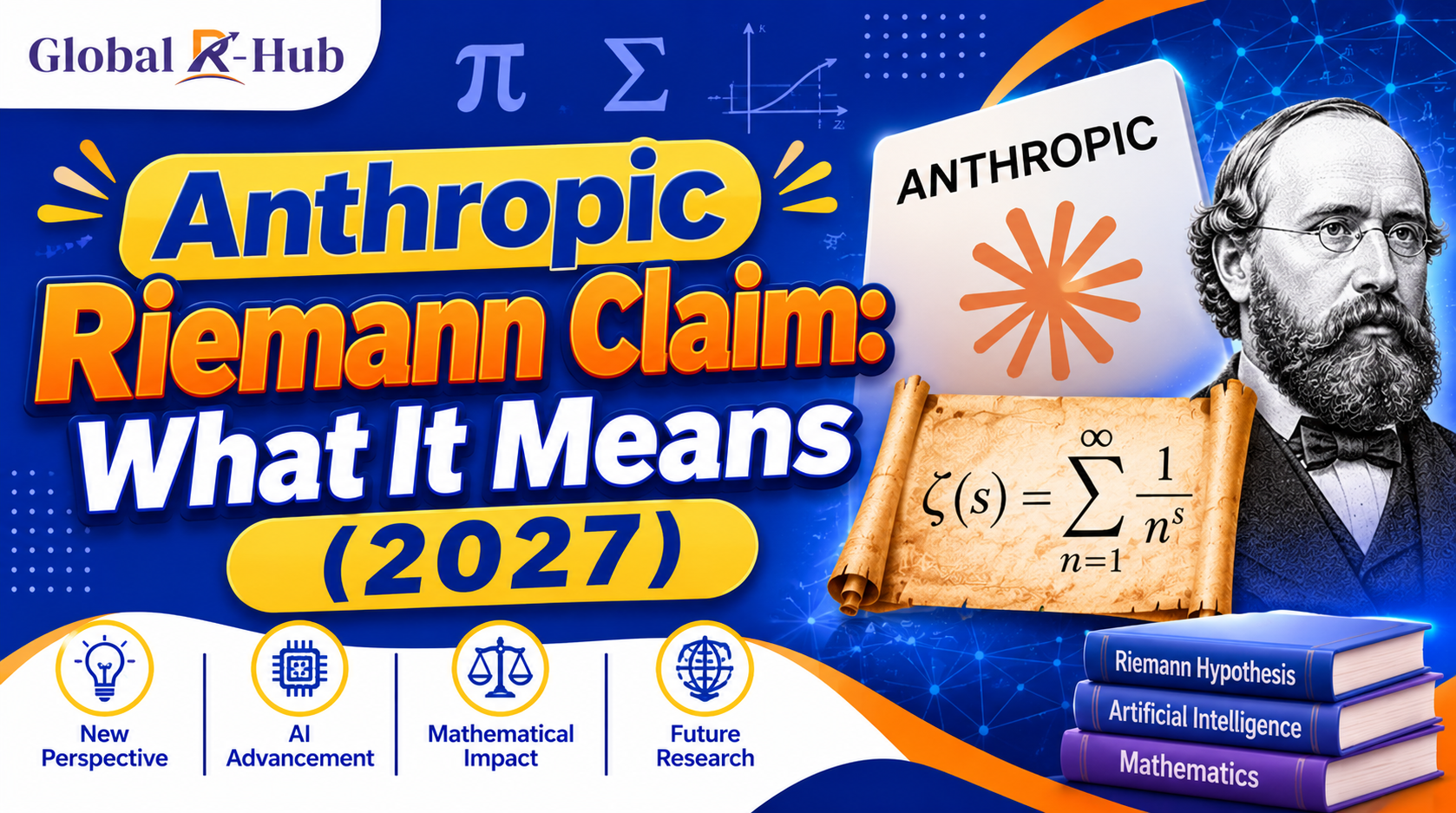
Anthropic Mathematician Claims Riemann Hypothesis Proof: What It Means (2027 Guide)
For Indian high school students building portfolios in mathematics, computer science, or artificial intelligence for the 2027 university admissions cycle, few stories spark as much curiosity as a machine-assisted claim on a 167-year-old unsolved problem. When reports broke that an Anthropic mathematician claims to have proved the Riemann hypothesis widely regarded as one of the most famous problems in all of mathematics students, parents, and researchers alike began asking what actually happened, how computers check mathematical proofs, and how young scholars can explore the underlying ideas themselves.
At a Glance: The Riemann Hypothesis Claim
The Problem: First proposed by Bernhard Riemann in 1859, the Riemann Hypothesis links prime-number distribution to the non-trivial zeros of the Riemann zeta function and is one of the Clay Mathematics Institute's seven $1 million Millennium Prize Problems.
The Claim: On November 20, 2026, mathematician Levent Alpöge posted a note stating that working with Claude over roughly six weeks led to a proposed proof of the Riemann Hypothesis (and an extension toward the Generalized Riemann Hypothesis), formalized in Lean.
Verification Status: Rather than a short traditional paper, the release centered on Lean formalization files, with independent verification and human mathematical scrutiny still underway.
High School Research Fields: Pure Mathematics, Number Theory, Formal Verification & Computer Science, and AI-Assisted Reasoning.
Why the Riemann Hypothesis Is So Famous in Mathematics
Prime numbers integers greater than 1 that have only two divisors, 1 and themselves are the multiplicative building blocks of arithmetic. Yet their exact placement along the number line looks irregular up close while following deep statistical patterns over large scales.
In 1859, Bernhard Riemann showed that the distribution of prime numbers is closely tied to the behavior of the Riemann zeta function, specifically the locations of its non-trivial zeros. The Riemann Hypothesis conjectures that those non-trivial zeros share a striking structural property (a real part of one-half). Proving it would sharpen key guarantees about prime numbers and resolve a foundational question in analytic number theory.
How AI and Formal Proofs Enter the Picture
According to Alpöge's November 2026 note and subsequent coverage, the six-week effort involved guiding Claude across mathematical ideas including adapting techniques from number theory and function fields while relying on Lean, a formal proof assistant designed to check logical steps mechanically. Because a raw expanded write-up was described as massive, the initial emphasis was placed on formal Lean code rather than a concise conventional article.
For students following modern research, this is a pivotal distinction: a computer proof assistant can verify whether formal steps follow strict logical rules, while human mathematicians still need time to read, interpret, and build intuition around complex arguments.
Comparing Traditional Proofs, Formal Code, and Community Review
Aspect | Traditional Written Proof | Lean Formalization | Independent Peer & Community Review |
Primary Goal | Communicate mathematical ideas and reasoning clearly to human experts | Check formal logical transitions step by step inside a proof assistant | Confirm correctness, clarity, and broader mathematical significance |
Main Strength | Builds intuition, readability, and conceptual insight | Mechanically enforces strict formal rules across large proofs | Tests assumptions, checks statement fidelity, and establishes long-term trust |
Typical Bottleneck | Subtle gaps or omitted details can take years to spot | Formalizing complex math and reading huge generated outputs can be dense and slow | Requires deep domain expertise and sustained time from multiple mathematicians |
What This Means for High School Students in India
Even when headlines sound dramatic, the real lesson for ambitious students is practical and encouraging. Mathematics is built on clear definitions, careful reasoning, and verifiable steps and new AI tools are changing how researchers brainstorm and test ideas alongside human insight.
Rather than treating major math news as a spectator sport, high schoolers can use it as a spark to build genuine foundational skills in number theory, programming, and formal logic.
How High School Students Can Research Number Theory & Formal Logic (Without a Lab)
You do not need specialized lab equipment to explore prime numbers, zeta-function behavior, or formal reasoning. Everything you need to start can run on a standard laptop.
Step 1: Explore Primes and Zeta Functions in Python
Begin with concrete numerical experiments before diving into advanced theory:
Use Python (SymPy, mpmath, NumPy, and Matplotlib) to compute prime counts, inspect gaps between consecutive primes, and evaluate numerical values of the Riemann zeta function.
Visualize how prime counts compare against standard estimates across growing intervals to build strong quantitative intuition.
Step 2: Practice Formal Logic With an Interactive Proof Assistant
Get hands-on experience with how computer-checked proofs work:
Install Lean and work through beginner exercises in propositional logic, divisibility, and elementary number theory.
Pay attention to how formal tools require every assumption to be stated clearly a habit that improves clarity in math competitions and research writing alike.
Step 3: Build a Focused Research Project With Mentorship
Admissions committees and student research journals look for a clear question, well-defined terms, reproducible work, and structured sections (such as introduction, methods, results, and discussion). Browsing curated research project ideas can help you narrow down a focused number-theory or computational math topic. If you want one-on-one guidance from doctoral mentors to refine your project and prepare a manuscript for vetted recommended journals, consider applying to the High School Scholar Program.
Frequently Asked Questions
Has the Riemann Hypothesis officially been solved?
Following the November 2026 announcement by Levent Alpöge involving Claude and Lean formalization, independent verification and broader mathematician review are part of evaluating any claim on a problem of this scale, while the Clay Mathematics Institute continues to treat the Riemann Hypothesis as an unsolved Millennium Prize Problem pending confirmed resolution.
Why is the Riemann Hypothesis considered one of the most famous problems in math?
Proposed in 1859 by Bernhard Riemann, it connects the distribution of prime numbers to the non-trivial zeros of the Riemann zeta function and carries a $1 million Clay Mathematics Institute Millennium Prize.
What is Lean, and how does it relate to AI-assisted math?
Lean is a formal proof assistant language that checks mathematical proofs step by step according to formal logical rules, making it valuable for verifying complex or machine-assisted arguments.
How can high school students start a research project on this topic?
Students can use Python libraries like SymPy and mpmath to investigate prime distributions and zeta-function behavior, practice basic formal proofs in Lean, and write up a clear, structured research study.


