

What a Riemann Hypothesis Proof Means for You
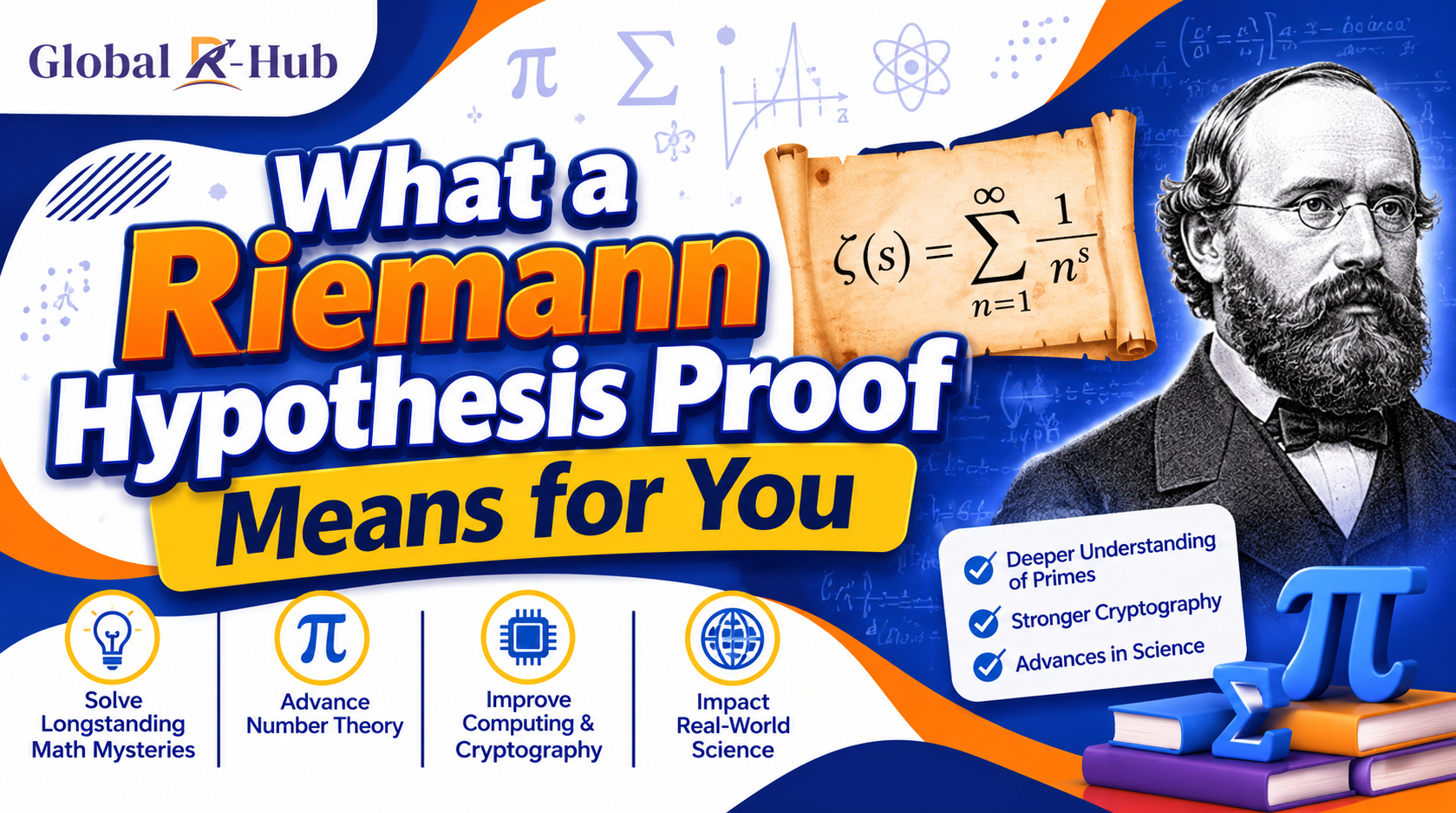
What Does a Solution to the Riemann Hypothesis Mean for You? (2027 Guide)
For Indian high school students building portfolios in mathematics, computer science, or data science for the 2027 university admissions cycle, few mathematical headlines trigger as much speculation as the Riemann Hypothesis. Whenever news breaks around a potential proof including the November 2026 claim involving mathematician Levent Alpöge, Claude, and Lean formalization students and parents naturally ask: what does a solution to the Riemann hypothesis mean for you? The honest answer separates everyday life from pure mathematics: a proof will not suddenly empty bank accounts or break your browser's security tomorrow, but it would tighten our understanding of prime numbers, unlock hundreds of conditional theorems in number theory, and reshape how mathematicians work alongside AI.
At a Glance: What a Riemann Hypothesis Proof Changes
Everyday Encryption & Bank Security: Does not break RSA, elliptic-curve cryptography, or everyday online security on its own.
Prime-Number Guarantees: Establishes a universal bound on how far prime-count estimates can fluctuate from true prime counts as numbers grow arbitrarily large.
Conditional Math Theorems: Turns results currently proved "assuming the Riemann Hypothesis (or Generalized Riemann Hypothesis)" into unconditional theorems provided no other unproven assumption is used.
High School Research Fields: Pure Mathematics, Number Theory, Algorithm Analysis, and Cybersecurity / Cryptography Foundations.
1. What It Means for Your Everyday Online Security and Encryption
One of the most persistent myths around the Riemann Hypothesis is that proving it will instantly crack modern encryption. Because prime numbers play a starring role in cryptography, people often assume a breakthrough in prime-number theory automatically unlocks secret keys.
In reality, knowing a tighter bound on how many primes exist below a giant number is very different from efficiently factoring a massive RSA modulus or solving a discrete logarithm problem. Existing encryption deployments do not suddenly become vulnerable simply because a long-standing number-theory conjecture is proved; rather, long-term cryptographic migration away from classical public-key systems is driven by quantum computing progress. Knowing the difference between counting primes and factoring large composites is a mark of clear, disciplined mathematical thinking.
2. What It Means for Prime Numbers and "Conditional" Mathematics
Up to one million, there are exactly 78,498 prime numbers, and standard approximations like the logarithmic integral come remarkably close. As numbers grow astronomically larger, however, counting every prime directly becomes impossible, and mathematicians rely on error bounds to guarantee how far approximations can drift. A valid proof of the Riemann Hypothesis supplies a sweeping guarantee on the fluctuations in prime distribution across the entire number line.
Even more importantly for research mathematicians, hundreds of theorems across analytic number theory and algorithm analysis have been written conditionally—meaning "if the Riemann Hypothesis (or its generalized form) is true, then this result holds." A verified proof converts those conditional guarantees into unconditional mathematical facts, while a counterexample or disproof would force researchers to separate which conclusions survive on their own.
Common Myths vs. Mathematical Reality
Topic | Common Myth | Mathematical Reality |
|---|---|---|
Internet Encryption | A proof of the Riemann Hypothesis immediately cracks modern encryption | A prime-distribution bound does not give a shortcut for integer factorization or discrete logarithms |
Prime Counting | We still have no idea how primes behave on average | The Prime Number Theorem already describes average prime density; the Riemann Hypothesis sharpens error bounds |
Algorithm Speed | Proving the conjecture automatically speeds up every computer program | Only algorithms that explicitly rely on the hypothesis gain unconditional guarantees; other bottlenecks stay as they are |
Proof Status | A machine-assisted release ends all debate immediately | Formal code checks and independent mathematician verification take time and careful scrutiny |
3. What It Means for You as a High School STEM Student
For students in India, the bigger takeaway is not a sudden change to your daily apps it is how mathematical discovery itself is evolving. Combining human intuition, symbolic and numerical computation, and formal proof assistants like Lean is opening new ways to test conjectures and check logical steps rigorously.
At the same time, major claims in mathematics still demand patience, careful reading of exact theorem statements, and independent verification. Students who learn to ask what is actually proved, under which assumptions, and why it matters stand out far more than students who simply repeat viral headlines.
How High School Students Can Research Prime Numbers & Number Theory (Without a Lab)
You do not need a university research lab to explore prime distribution, error bounds on prime counts, or computational number theory. A standard laptop with Python is plenty to run meaningful experiments.
Step 1: Compare Exact Prime Counts With Approximations in Python
Use Python (SymPy, NumPy, mpmath, and Matplotlib) to write a script that counts primes up to different cutoffs and compares the exact count against estimates like x / ln(x) and the logarithmic integral. Plotting the difference (error) as numbers grow gives you concrete visual intuition for why mathematicians care so deeply about error bounds.
Step 2: Study Prime Distribution Across Arithmetic Progressions
Explore how prime numbers split into different remainder classes such as primes leaving a remainder of 1 versus 3 when divided by 4. Measuring empirical counts and differences across ranges in Python helps you see why seemingly balanced averages can still hide subtle asymmetries that motivate deeper conjectures.
Step 3: Turn Your Exploration Into a Focused Research Paper
Selective university admissions committees and student STEM journals look for clear definitions, well-framed questions, reproducible code, and disciplined structure (such as introduction, methods, results, and discussion). Browsing curated research project ideas can help you narrow down a number-theory or computational math question. If you want guidance from doctoral mentors to refine your analysis and prepare a manuscript for vetted recommended journals, consider applying to the High School Scholar Program.
Frequently Asked Questions
Does solving the Riemann Hypothesis break modern encryption?
No. Modern encryption systems like RSA and elliptic-curve cryptography depend on the computational difficulty of problems such as integer factorization and discrete logarithms, not on the Riemann Hypothesis being unproved.
Why do people connect the Riemann Hypothesis to prime numbers?
The Riemann Hypothesis concerns the non-trivial zeros of the Riemann zeta function, which are tightly linked through explicit mathematical formulas to how prime numbers are distributed and how large fluctuations in prime counts can get.
What happens to other math theorems if the Riemann Hypothesis is proved?
Many theorems in analytic number theory and related fields that currently depend on assuming the Riemann Hypothesis (or its generalized form) would become unconditional results, freeing researchers from that assumption.
How can high school students explore this topic for a research project?
Students can use Python libraries like SymPy, NumPy, and mpmath to test prime-counting approximations, analyze prime gaps or remainder classes, and write a structured mathematical or computational research paper.


