

CML Math Questions: 7 Tips to Win the Continental Math League
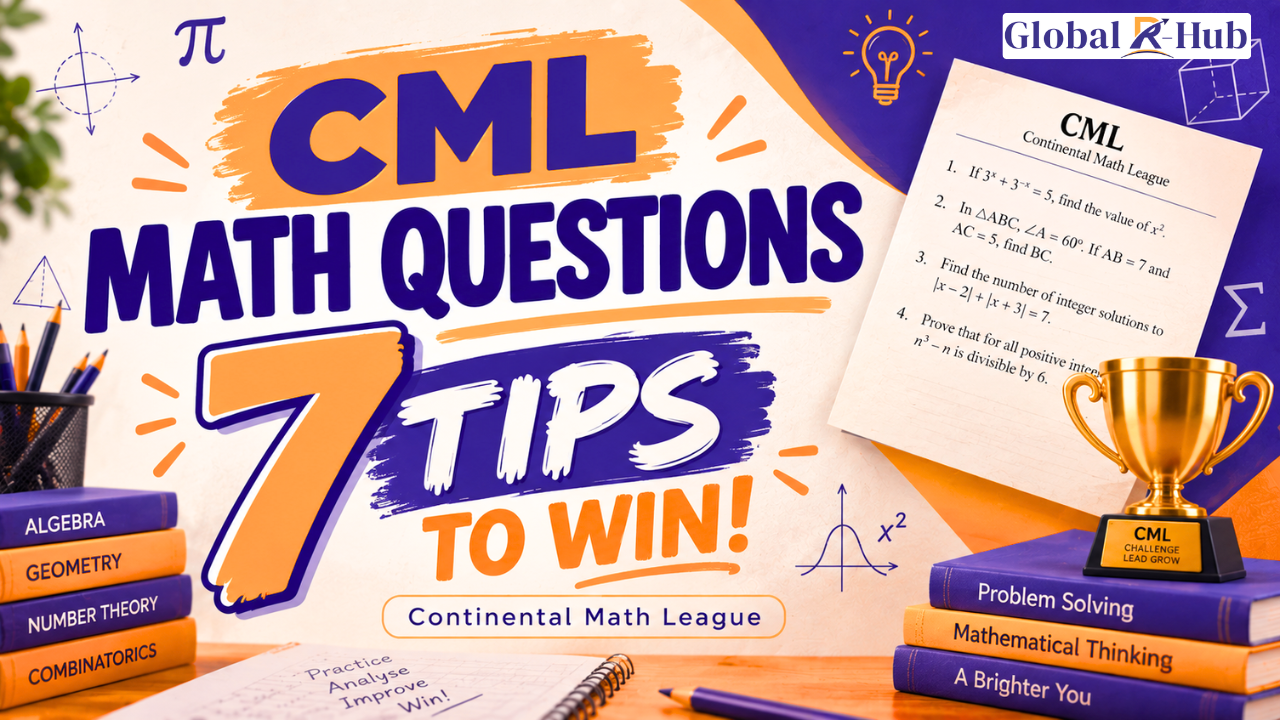
Six questions. Thirty minutes. No calculator. That is a Continental Math League meet, and it is why capable students walk out with three right and no clear idea where the other three went.
CML math questions are rarely hard the way an olympiad problem is hard. They are wordy, and they punish anyone who starts calculating before finishing the sentence. Here is what the questions actually ask, how the 2026-27 season is structured, and seven habits that move a score up.
What CML math questions actually look like?
The league has run since 1980, and the format has barely shifted: non-routine word problems that reward careful reading and analytical reasoning rather than memorised formulas. CML describes its two middle-grade divisions in terms of reading first and computation second: the Euclidean division calls for average reading comprehension and analytical reasoning, the Pythagorean division for above-average. In both, the arithmetic is expected to sit at grade level rather than beyond it.
Everything is done on paper. Calculators are allowed only in the Calculus League, where ETS-approved models are permitted. Each question has a single answer, graded by the school against the key CML supplies, so the number on the line is what scores.
Here is a question written in the same style as a middle-grade meet. It is an illustration, not a problem from a past paper.
A shop packs pencils in boxes of 12 and pens in boxes of 8. There are 5 more boxes of pencils than boxes of pens, and 140 items altogether. How many pens are there?
No advanced mathematics is involved. One equation, 20p + 60 = 140, gives four boxes of pens and therefore 32 pens. The difficulty is building that equation inside five minutes and noticing that the question asks for pens, not boxes. That is the skill CML tests, repeated six times in a sitting.
How the 2026-27 CML season works?
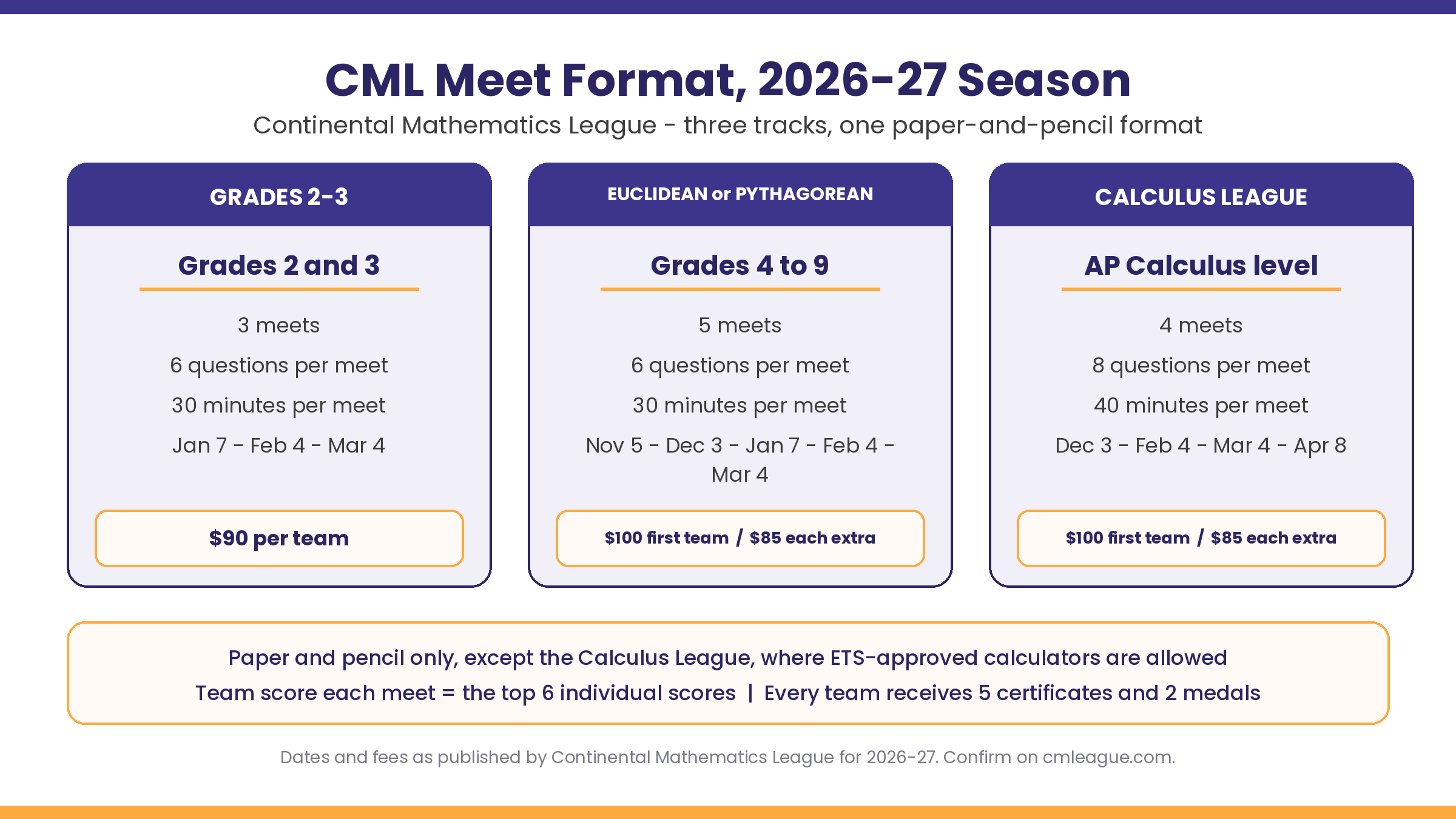
Registration for 2026-27 is open, and the shape of the year depends on which track a student sits.
Track | Grades | Meets | Format | Meet dates | Fee |
|---|---|---|---|---|---|
Grades 2-3 | 2, 3 | 3 | 6 questions, 30 minutes | 7 Jan, 4 Feb, 4 Mar 2027 | $90 per team |
Euclidean or Pythagorean | 4-9 | 5 | 6 questions, 30 minutes | 5 Nov, 3 Dec 2026; 7 Jan, 4 Feb, 4 Mar 2027 | $100 first team, $85 each additional |
Calculus League | AP Calculus level | 4 | 8 questions, 40 minutes | 3 Dec 2026; 4 Feb, 4 Mar, 8 Apr 2027 | $100 for the first team, $85 each additional |
One point that surprises families: the Euclidean and Pythagorean divisions stop at Grade 9. A student in Grades 10 to 12 has no general paper to sit and can enter only through the Calculus League, which assumes they are already working at AP Calculus level.
Schools register, download the papers as PDFs, and run each meet in class on the scheduled day or the nearest possible one. There is no cap on how many students may sit a meet.
Two rules are worth knowing before the season starts. A team cannot enter both the Euclidean and Pythagorean divisions, and no individual student may compete in both, though a school may register separate teams for each. CML also expects students to compete at or above their own grade level, so a Grade 5 student may sit the Grade 6 paper.
Scoring is cumulative rather than one-shot. An individual score is simply the number of questions answered correctly, added up across the season. The team score for each meet is the sum of the top six individual scores that day, and the names making up that six can change from meet to meet. Every participating team receives five certificates and two medals, with regional and national awards on top.
If your school does not run CML
A student whose school does not participate can enter as a "Home School" registration, which CML prices at $25 per child per league. You create an account without buying anything, then email the office to have that pricing applied. No student may compete on a school team and as a home school entry in the same league. Families outside the United States should confirm arrangements with CML directly, since every meet has to be proctored and timed by an adult.
Seven tips for a higher CML score:
1. Spend the first thirty seconds reading, not solving
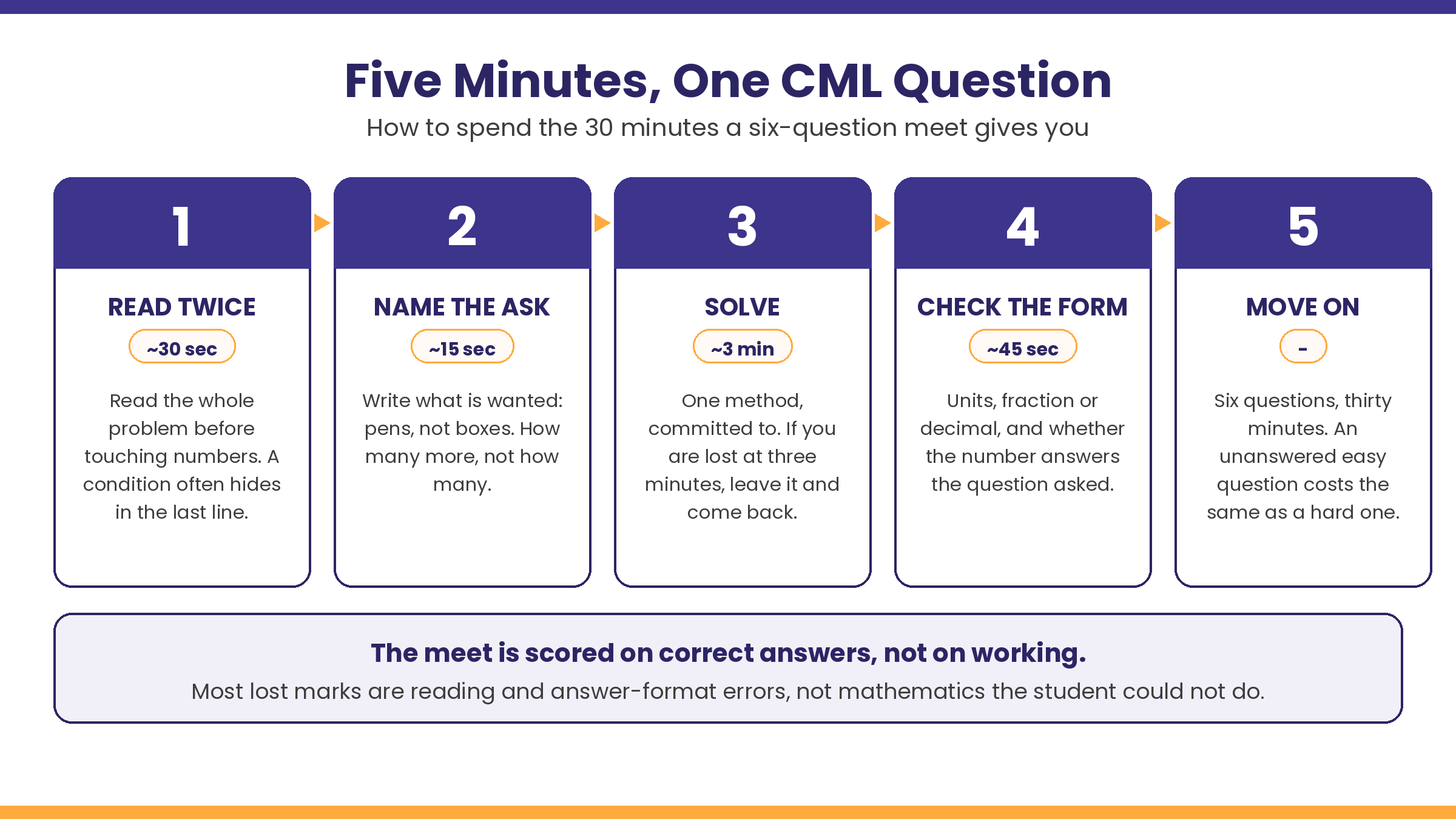
Thirty minutes across six questions is five minutes each, which feels tight enough that students start writing immediately. That instinct is what costs them. CML problems routinely hold a condition back until the final clause, and a student who has already committed to a method has to start again. Reading the whole problem twice costs half a minute and saves two.
2. Work from the solutions, not the score
CML supplies step-by-step solutions along with the answer key for grades 2-3, Euclidean, Pythagorean, and Calculus meets. Most schools hand back a score and stop there. Ask your teacher for the solution sheet after each meet and work through it, including the questions you answered correctly, because a correct answer reached slowly is a question you will lose next time under the same clock.
3. Decide what the answer should look like before you solve
Before the calculation, write down what is being asked and in what form: pens rather than boxes, minutes rather than hours, the difference rather than the total. It takes ten seconds, and it catches the most common way a student leaks marks, which is a correct calculation answering a slightly different question.
4. Scan all six questions before you start the first one
The questions are not strictly ordered by difficulty, and the one a particular student finds easiest might be the fifth. Read all six, start with the two that look immediately tractable, and bank those points while you are fresh.
5. Practise one grade above your own
Since CML anticipates that students work at or above their present grade level, practising at your own level leaves you at the bottom of the expected range. Euclidean students who find the papers comfortable should be trying Pythagorean material, which is the same topics with a heavier reading load.
6. Be careful where your practice problems come from
Search for continental math league practice problems pdf, and you will find plenty of files on document-sharing sites: mislabelled grades, wrong division, often no solutions attached. The official material is easier to find than most people realise. Free sample tests exist for every grade on the CML math page, reached by clicking the large CML logo above a grade level. Beyond that, the Best of CML problem books collect non-routine problems with solutions by grade band, at $40 each with a reduced price for league members and no shipping charge. Parents can order them directly. If you exhaust those, past AMC 8 papers are the closest free substitute in style.
7. Play the season, not the meet
Five meets running from November to March are five chances, not one exam. Treat the first meet as a diagnostic: note which of the six you got wrong and whether the cause was reading, method, or arithmetic, then aim to convert one extra question next time. That is also how team scores are built, since a student who was not in the top six in November can be in it by February.
Four mistakes that cost more than the hard questions:
Answering the wrong quantity. Finding the number of boxes when the question asked for pens scores zero, the same as not solving it at all.
Leaving the answer in the wrong form. An unsimplified fraction or a missing unit can be marked wrong. Write the answer as the question frames it.
Rushing the arithmetic. Without a calculator, a misplaced decimal or a slip in a two-digit multiplication ends a question that was otherwise solved. Build in a quick second pass.
Leaving a blank. A wrong answer costs nothing beyond the point you were not going to get anyway, so every line should have something in it before time is called.
What comes after CML?
CML is a good first competition precisely because it is low-stakes and spread across a season. It also has a ceiling. Students in Grade 8 or 9 who are consistently near the top of the Pythagorean papers are usually ready for the AMC 8 and AMC 10, and our guide to the AIME sets out where that route leads.
The other direction is depth rather than speed. Competition problems come with an answer waiting at the back of the book; research questions do not. Students who enjoy the modelling side of CML problems often take well to a mentored project in applied mathematics, statistics or data science, which is what the Young Scholar Program covers for Grades 6 to 8 and the High School Scholar Program for Grades 9 to 12.
Our research project ideas are organised by subject and show the kind of question a student can genuinely answer in a term.
Frequently asked questions
Where can I find real CML math questions to practise with? Free sample tests are published for every grade on the CML site, and the Best of CML books collect past problems with full solutions for grades 2-3, 4-6 and 7-9. Files circulating elsewhere are often mislabelled by grade or division.
How many questions are in a CML meet, and how long is it? Six questions in 30 minutes for grades 2 to 9, and eight questions in 40 minutes for the Calculus League. Calculators are permitted only in the Calculus League.
Is CML only for students up to Class 9? The Euclidean and Pythagorean divisions are, and grades 2 and 3 have their own shorter track. Above Grade 9 the only CML option is the Calculus League, which is pitched at AP Calculus level rather than at general problem solving.
Can my child take part if their school does not offer CML? Yes. CML accepts homeschool registrations at a reduced per-child fee, with a parent acting as proctor and keeping to the published time limits.
Does doing well in CML help with university applications? A regional or national award carries weight as evidence of sustained problem-solving ability. Participation alone is a line on a form rather than a differentiator, which is why students who are strong in CML usually pair it with something deeper as they move through high school.
Disclaimer: CML dates, fees, divisions, and rules are set by Continental Mathematics League and change from year to year. Confirm current details on cmleague.com before registering.