

Debate Competition Guide 2026: 12 Contests High School Students Can Enter
You won your class debate, maybe the inter-house final too, and then a teacher told you to "try for nationals," and unfortunately that was where the advice stopped.
This gap is the real problem with debates or any other competition for school students. There is no shortage of tournaments or competitive events, only a dearth of experienced mentors explaining which competitions you are eligible for, which ones you can enroll alone, and which sit behind a national team that you cannot sign up for individually. So this list is sorted by how you get in, not by prestige: six Indian competitions, six international competitions, and an honest note wherever a fee or date is unpublished.
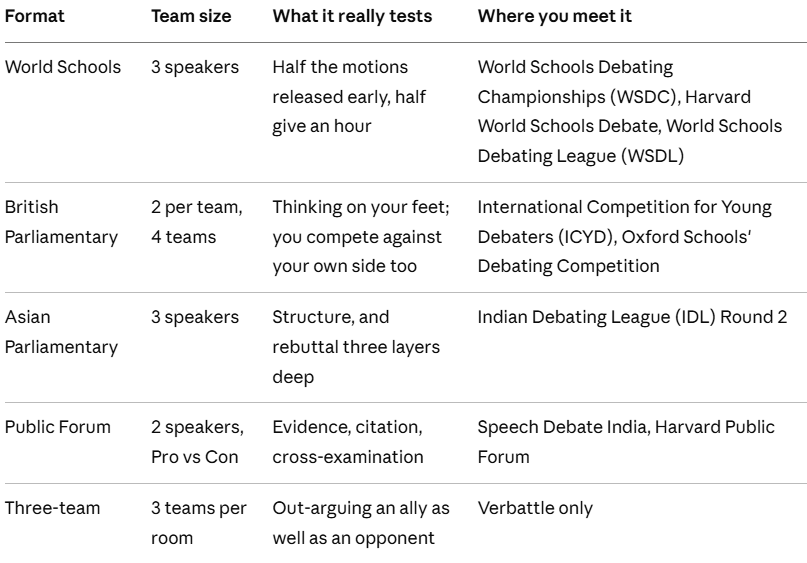
Before The List: The Five Formats You Will Meet
Most students lose their first tournament to the format, not the topic; eight minutes when you rehearsed four, or a side decided by lottery.
Six Debate Competitions In India Worth Your Time
1. Indian Schools Debating Championship: the only route to Team India
Who: ages 12–18 for Team India selections; grades 9–12 for the Indian Schools Debating Championship (ISDC) itself · Format: World Schools, with shorter six-minute speeches in ISDC prelims · When: zonals late August to early October, selection camp in Chennai 26–30 December · Cost: ₹1,000 per student for regionals, ₹6,000 per championship team, bursaries available
The Indian Schools Debating Society, or ISDS, founded in 2008 and funded by the Ramco Group, is the one body that picks India's WSDC team, and India were world champions in 2025 in Panama City, so the ceiling is not theoretical. Roughly 65 to 70 students reach the December camp. The 2026–27 dates are not out, so watch the site from late August.
2. Verbattle: the format nobody else runs
Who: school teams, Beginner to Senior; junior tracks need no experience · Format: its own three-team debate · Languages: English, Kannada, Hindi · When: Karnataka from July to a 20 August final, Tamil Nadu in August, Maharashtra in September, Junior Hindi Online in October, Senior National in November · Cost: unpublished
Verbattle has run since 2005 and put over 80,000 students through competition. Three teams debate one statement, with sides drawn by lottery, so two teams can end up defending the same motion, and half the round goes on out-arguing someone who agrees with you. Speaker counts shift by category and stage. The stage names are the other half of the appeal: Clamber, Skirmish, Combat, Confrontation, Face-Off.
3. Frank Anthony Memorial All-India Inter-School Debate: for ICSE and ISC schools
Who: CISCE-affiliated schools only; Standards XI–XII and IX–X, two students each · Format: sealed envelope, motion one hour before, four minutes to speak, two to answer questions · When: three levels, regionals in July, zonals in August, nationals in September · Cost: not published; entry via school circular
Over 700 schools competed in 2025. Books and journals are allowed in that prep hour. Phones and internet are not, which is why this one quietly rewards students who read. Awards run to ₹5,000 plus medals, and there is no public registration page; ask your coordinator now, not in September. Background sits on Wikipedia.
4. Indian Debating League: the one you can enter alone
Who: school students in age-banded divisions; check the current edition, since the bands have changed between seasons · Format: Round 1 solo one-versus-one, Round 2 3v3 Asian Parliamentary, finals 3v3 World Schools · When: registration around October, rounds in November, finals at IIT Delhi in late November or early December · Cost: ₹1,300 for the 2024 edition; current pricing unlisted
If your school has no debate society, start here. Round 1 is a one-versus-one spar with three chances to qualify, no partner, no team, no permission needed. The Indian Debating League is also the official Indian partner for Oxford Schools', which matters in a minute.
5. Speech Debate India × Harvard Debate Council: the American format, in Mumbai
Who: grades 4–12, split into elementary, middle and high school · Format: US Public Forum, two students, Pro versus Con · When: online on 8–9 August and 19–20 September 2026; Mumbai in October and January · Cost: ₹5,500 per day, so ₹11,000 for two days and ₹16,500 for three, before GST
Speech Debate India, run with the Harvard Debate Council, is the most legible Indian circuit for American admissions readers — evidence-heavy, properly cited, with a season-long national ranking. In-person rounds run at the American School of Bombay, Pathways Gurgaon and Indus Bangalore. A separate Growth Track issues certificates without ranking, a kinder first outing. Also the priciest option here.
6. Dr Amidas Goradia International Inter-School Debate: the Turncoat round
Who: school teams, including international entries · Format: Extempore, Turncoat and Bridge prelims, then a six-team final · When: early-to-mid August · Cost: not published
Twenty-four editions old and hosted by The Indian School, New Delhi, this drew 51 schools in 2025, including teams from Nepal, Nigeria and Muscat. Turncoat alone is worth the entry: you argue both sides of a motion, against yourself, in ninety seconds. Nothing exposes a memorised script faster.
Six International Debate Competitions Open To Indian Students
7. International Public Policy Forum: write your way in
Who: teams of three to six from one school or after-school programme, anywhere in the world; no qualifier · Format: 3,000-word essay, then a 64-team knockout by email, then live finals · When: registration through October, finals in April at NYU School of Law · Cost: normally $25 per team; early-bird for 2026–27 is currently free
Start here. The International Public Policy Forum, or IPPF, run by the Brewer Foundation with New York University, is the rare global competition you can enter. The Elite Eight fly to New York on a funded trip, airfare, hotel and stipend for three students and two chaperones, with extra members paying their own way — and the winner takes $10,000 and the Brewer Cup. This year's resolution asks whether the UN should prioritise the rights of women and girls over state sovereignty.
8. World Schools Debating Championships: the national team route
Who: one national team per country; you cannot enter directly · Format: World Schools, three speakers, eight-minute speeches, four prepared and four impromptu rounds · When: July · Cost: reached only through Indian Schools Debating Society selection
The World Schools Debating Championships is the summit, and Nairobi 2026 drew more than 70 national teams. The only Indian route in is the ISDS ladder above, worth stating plainly, because students lose seasons hunting a registration link that does not exist. If this is the goal, enter an ISDS zonal this August.
9. Oxford Schools' Debating Competition: an Oxford final for under £60
Who: roughly ages 14–18, teams of two from one school · Format: British Parliamentary · When: regionals January–February, Finals Day at Cherwell College Oxford (14 March in 2026) · Cost: £60 per team, £35 for state schools, bursaries to £25
Run by the Oxford Union, though the final itself is debated in Cherwell College's chamber. One rule matters enormously: India has an official regional partner, the Indian Debating League, and students in a partner region may only compete through that region's round. You cannot enter the UK regionals or the online international round from India. Read the international rounds page first.
10. International Competition for Young Debaters: best option if you are under 15
Who: aged 15 or under on 31 August, teams of two from one school · Format: British Parliamentary, five-minute speeches · When: Indian registration closes early March, qualifier mid-March, finals at the Oxford Union on 2 May 2026 · Cost: about ₹3,000 per team for the Indian selection
The ICYD calls itself the largest junior British Parliamentary competition in the world, and 2026 was its 23rd edition. Indian teams qualify through the ISDS ICYD selection rather than registering in the UK, and India has won it more than once, including 2025. In Class 8, 9 or 10, a far more realistic target than WSDC.
11. Harvard and Stanford: Online mode
Who: school entries, no nationality restriction · Format: Public Forum, World Schools, Congress and speech events · When: Harvard 11–15 February 2027, registration 30 November to 8 February; Stanford in early February · Cost: around $100 per team for Harvard's online series; other online fees unpublished
The Harvard National Speech and Debate Tournament draws over 5,500 competitors each February. Its 2026 edition ran online divisions in Public Forum (Beginner and Open International) and World Schools; the 2027 listing is currently marked in person, so confirm before you plan around it. The Harvard Debate Council also runs a separate online international series with Asia time-zone slots. The Stanford Invitational went fully online on the NSDA Campus, making it the most accessible major American tournament. Skip Yale; Zoom runs on Sunday only.
12. World Schools Debating League: seven rounds, all impromptu
Who: inter-school teams only, in Open and Junior (15 and under); India is a listed territory · Format: World Schools, eight-minute speeches, thirty minutes of prep · When: seven weekly rounds on Wednesday evenings, online · Cost: not published
Created by LearningLeaders with the Harvard College Debating Union, the World Schools Debating League runs across 21 Asian territories. No motions are released in advance across any of the seven prelims, which is brutal and excellent training.
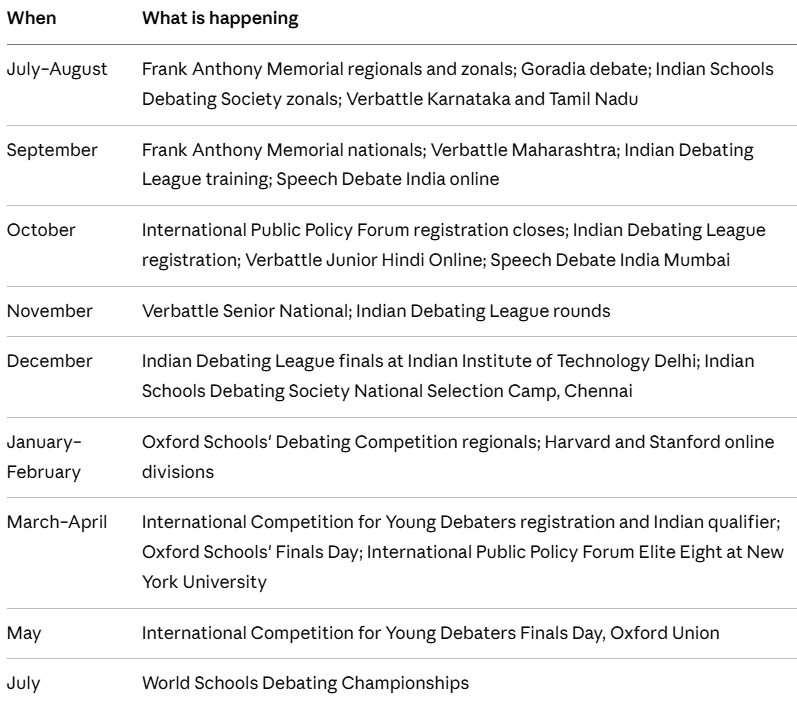
What does the debate year actually look like?
Where Debate Ends, Research Begins:
Debate teaches you to build an argument under time pressure. What it cannot give you is evidence of your own. Every motion rests on somebody else's paper, and admissions officers, who see thousands of debate certificates, notice who cites research and who has produced some.
That jump is shorter than it looks. A motion you argued well is already a research question in costume: a claim, a counter-claim, and a gap where real data should be. We walk through the conversion in how to turn debate skills into a standout capstone project, and the Journals Directory lists twelve peer-reviewed publications that take student work.
Global R-Hub's Global R-Hub High School Scholar Program pairs Grades 9–12 students with a PhD mentor across 16 weeks, ending in a publication-ready paper, a global certificate, and a letter of recommendation. Grades 6–8 have the Global R-Hub Young Scholar Program. Still choosing a field? The Psychometric Assessment takes eight minutes, or browse the Project Ideas Library.
READY TO DIVE IN? Start your research journey with R-Hub. Get mentored by PhD researchers and publish work that stands out in admissions.
Frequently Asked Questions
Which debate competition should a complete beginner enter first? The Indian Debating League, Round 1 is a solo one-versus-one spar, so you need no partner and no school team. Verbattle's Beginner and Junior tracks are next-easiest.
Can an Indian student enter the World Schools Debating Championships directly? No. WSDC takes one team per country, and India's is selected only through the Indian Schools Debating Society, zonals from August, then the Chennai camp in late December.
What is the cheapest international debate competition for Indian students? The International Public Policy Forum. Entry is normally $25 per team, early-bird registration for 2026–27 is currently free, and the qualifying rounds are written and remote.
Do debate competitions help with college applications? They evidence communication and reasoning, but they are common. What is uncommon is pairing a debate record with original research on the same theme; an olympiad qualification plus a published paper reads very differently from either alone.