

How Do Heat Pumps Work? (2027 Illustrated Guide)
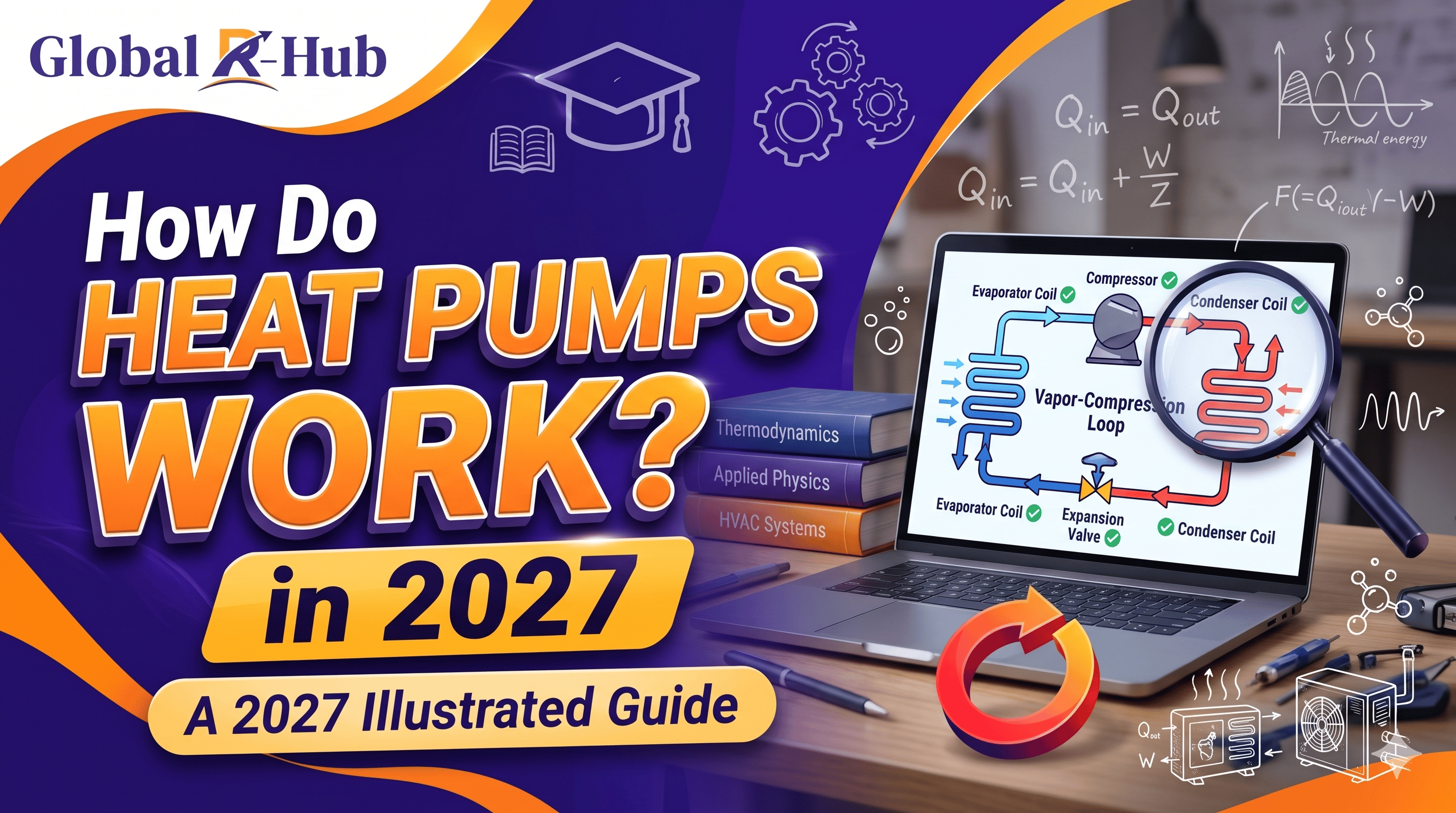
How Do Heat Pumps Work? An Illustrated Guide for Students (2027)
Students preparing engineering or environmental science profiles for the 2027 university admissions cycle frequently look to clean energy technologies for independent study. Understanding how do heat pumps work gives high schoolers a practical gateway into applied thermodynamics, mechanical engineering, and climate policy. Rather than burning fuel to create heat, a heat pump uses a closed-loop refrigeration cycle to transfer existing thermal energy from one location to another, delivering several units of heat for every single unit of electricity it consumes.
At a Glance: Heat Pump Engineering Quick Facts
Core Thermodynamic Process: Closed-loop vapor-compression refrigeration cycle.
Typical Efficiency (COP): 3.0 to 5.0 (meaning 300% to 500% thermal output relative to electrical input).
Primary Components: Evaporator coil, compressor, condenser coil, expansion valve, and reversing valve.
Key Research Fields: Mechanical Engineering, Applied Thermodynamics, Sustainable Energy, and Climate Policy.
How Do Heat Pumps Work Without Burning Fossil Fuels?
Heat pumps heat and cool buildings by moving existing thermal energy against its natural temperature gradient rather than generating heat through combustion or electrical resistance. Even cold outdoor air contains significant molecular kinetic energy, and a heat pump captures that energy using a specialized chemical refrigerant that boils at very low temperatures.
In everyday physics, heat naturally flows from warmer objects to cooler ones, which is why a hot cup of tea cools down to room temperature. A heat pump reverses that natural flow by manipulating pressure. By lowering the pressure of a liquid refrigerant outdoors, the system forces it to absorb ambient heat and evaporate into a gas. A compressor then squeezes that gas to raise its temperature far above indoor room temperature, allowing the heat to flow smoothly into the building. Because the electricity is only used to pump the refrigerant and run fans not to create heat from scratch the system achieves far higher energy efficiency than gas furnaces or standard electric heaters.
The 4 Stages of the Heat Pump Vapor-Compression Cycle
The vapor-compression cycle consists of four continuous mechanical stages evaporation, compression, condensation, and expansion—that circulate refrigerant between an outdoor coil and an indoor coil. By shifting the refrigerant between liquid and gas states, the heat pump absorbs latent heat on one side of the loop and releases it on the other.
                        [OUTDOOR UNIT: Cold Side]
               Absorbs ambient heat from air/ground/water
              ┌──────────────────────────────────────────┐
              │       1. EVAPORATOR COIL (Low Press.)    │
              │    Cold Liquid  ───►  Cool Low-P Gas     │
              └────────────────────┬─────────────────────┘
                    ▲              │
                    │              ▼
        ┌───────────┴──────┐   ┌───┴───────────────────┐
        │ 4. EXPANSION     │   │ 2. COMPRESSOR         │
        │    VALVE         │   │    (Electricity In)   │
        │ Drops pressure & │   │ Squeezes gas to high  │
        │ temperature      │   │ pressure & high temp  │
        └───────────▲──────┘   └───┬───────────────────┘
                    │              │
                    │              ▼
              ┌─────┴────────────────────────────────────┐
              │       3. CONDENSER COIL (High Press.)    │
              │     Hot Gas     ───►  Warm Liquid        │
              └──────────────────────────────────────────┘
                        [INDOOR UNIT: Warm Side]
                    Releases thermal energy into room
Evaporate Liquid Refrigerant to Absorb Outdoor Heat
At the start of the heating cycle, cold liquid refrigerant enters the outdoor evaporator coil at low pressure. Because the refrigerant is engineered to boil at temperatures well below minus 20 degrees Celsius, even chilly winter air is warmer than the liquid inside the coil. Thermal energy flows from the outdoor air into the refrigerant, causing it to boil and transform into a low-pressure gas.
Compress the Vapor to Raise Its Temperature
The low-pressure gas then travels into an electrically powered compressor. Following the combined gas law, compressing a gas into a smaller volume dramatically increases both its pressure and its temperature. The refrigerant leaves the compressor as a high-pressure, high-temperature vapor, often reaching between 50 and 80 degrees Celsius.
Condense the Hot Gas to Release Indoor Heat
This hot vapor flows into the indoor condenser coil, where a fan blows cooler indoor air across the metal fins. Because the vapor is now significantly hotter than the room, thermal energy transfers into the indoor air. As the refrigerant loses this heat, it condenses back into a high-pressure liquid.
Expand the Liquid to Reset the Pressure
Before the warm liquid returns outdoors, it passes through a narrow expansion valve. The sudden drop in pressure causes the liquid refrigerant to expand and cool rapidly, returning it to its original frigid, low-pressure state so it can absorb outdoor heat all over again. When cooling is needed during Indian summers, a reversing valve simply flips the direction of refrigerant flow, turning the indoor coil into the evaporator and pushing indoor heat outside.
Why Heat Pumps Achieve Over 100 Percent Efficiency
Heat pumps appear to exceed 100 percent efficiency because they measure moved thermal energy rather than converted energy, a ratio engineers call the Coefficient of Performance (COP). A heat pump with a COP of 3.5 uses 1 kilowatt-hour of electricity to move 3.5 kilowatt-hours of heat into a building, which does not violate the First Law of Thermodynamics because the extra 2.5 units were already present outdoors.
For comparison, a standard electric resistance heater converts electricity directly into heat at a maximum theoretical efficiency of 100 percent (a COP of 1.0). Modern gas boilers typically operate between 80 and 95 percent efficiency because some thermal energy escapes through exhaust flues. According to the International Energy Agency (IEA), heat pumps are typically three to five times more energy-efficient than fossil fuel boilers, making them a cornerstone of global building decarbonization strategies.
Engineers calculate COP using a straightforward ratio:
COP (Heating) = Thermal Energy Delivered (Q_hot) / Electrical Work Input (W)
The theoretical upper limit of any heat pump is governed by the Carnot efficiency limit, which depends strictly on the temperature difference between the outdoor heat source and the indoor heat sink. As the outdoor temperature drops further below the desired indoor temperature, the compressor must work harder, causing the COP to decline.
Air-Source vs. Ground-Source Heat Pump Systems
Heat pumps are classified primarily by where they draw their ambient thermal energy, with air-source and ground-source systems serving different climates, budgets, and building scales. Choosing between them requires balancing upfront installation costs against seasonal temperature stability and long-term COP performance.
Feature | Air-Source Heat Pump (ASHP) | Ground-Source / Geothermal Heat Pump (GSHP) |
Heat Source / Sink | Ambient outdoor air | Underground soil or water loop (stable year-round temp) |
Typical Heating COP | 2.5 to 4.0 (varies with outdoor weather) | 4.0 to 5.5 (highly consistent across seasons) |
Installation Complexity | Low; similar to a split air conditioner | High; requires drilling vertical boreholes or trenching |
Upfront Cost | Moderate | High due to excavation and ground-loop piping |
Best Use Case | Urban apartments, residential retrofits, mild-to-cold climates | Large campuses, commercial buildings, extreme climates |
As detailed in technical guides from the U.S. Department of Energy, ground-source heat pumps maintain higher efficiency during extreme weather because soil temperatures a few meters underground remain relatively constant year-round. However, air-source systems dominate global adoption because they require no excavation and can be installed rapidly in dense cities.
How High School Students Can Research Heat Pump Technology
High school students interested in mechanical engineering, physics, or sustainability can investigate heat pump performance through computational modeling without needing access to a university thermal lab. Because heat pump behavior follows well-defined thermodynamic equations and relies on publicly available weather and energy data, it is an ideal subject for independent dry-lab research.
Model Coefficient of Performance Across Indian Climate Zones
Instead of writing a descriptive overview, narrow your focus to a quantitative research question. For example, you could model the seasonal COP of an air-source heat pump water heater across distinct Indian climate zones such as humid coastal Mumbai, dry hot Jaipur, and cold winter Shimla. Using Python and open-source thermodynamic libraries like CoolProp alongside public meteorological datasets, you can simulate how ambient humidity and temperature fluctuations alter electricity consumption across all twelve months.
Analyze Decarbonization Potential Using Public Energy Data
If your interests lean toward energy policy or environmental economics, evaluate the carbon footprint of switching commercial buildings from diesel boilers or electric geysers to heat pumps. Because a heat pump runs on grid electricity, its real-world emissions depend on the carbon intensity of the local power grid. You can combine national electricity generation datasets with IEA efficiency benchmarks to calculate the exact grid-decarbonization threshold at which heat pumps outperform natural gas in different Indian states. Exploring curated research project ideas can help you refine how to isolate variables like grid mix and refrigerant Global Warming Potential (GWP).
Structure Your Findings for Academic Publication
A strong engineering paper requires a clear IMRaD structure (Introduction, Methods, Results, Discussion), documented simulation parameters, and sensitivity analysis showing how your results change under different assumptions. If you need structured faculty feedback to validate your thermodynamic equations, debug your Python models, and prepare your draft for submission, working with a doctoral mentor through the High School Scholar Program can help turn an ambitious technical model into a rigorous manuscript ready for vetted recommended journals.
Frequently Asked Questions
How do heat pumps work in freezing winter temperatures?
Heat pumps continue extracting heat in sub-zero weather because their internal refrigerants boil at temperatures far below freezing, often between minus 20 and minus 40 degrees Celsius. Even air at minus 10 degrees Celsius holds substantial thermal energy relative to absolute zero, allowing cold-climate inverter compressors to absorb and concentrate that heat indoors.
What is the difference between a heat pump and an air conditioner?
A standard air conditioner and a heat pump use the exact same vapor-compression hardware, but an air conditioner can only move heat in one direction from inside a room to the outdoors. A heat pump includes a reversing valve that flips the refrigerant cycle, allowing the same machine to cool a building in summer and heat it in winter.
Why is a heat pump more efficient than an electric resistance heater?
An electric resistance heater converts 1 unit of electrical energy into at most 1 unit of heat energy, capping its efficiency at 100 percent. A heat pump uses that same 1 unit of electricity to run a compressor that transports 3 to 5 units of existing ambient heat from outdoors into the room, achieving 300 to 500 percent effective thermal output.
Can high school students conduct heat pump research without a lab?
Yes. High school students can execute rigorous heat pump research entirely on a computer using open-source thermodynamic property libraries like CoolProp, Python scripts, and public climate or energy grid datasets to simulate COP performance, refrigerant trade-offs, and regional carbon savings.