

7 Inter Disciplinary Project Ideas for Students

7 Inter Disciplinary Project Ideas for High School Students
For high school students targeting highly selective international universities, mastering a single academic subject is no longer enough to guarantee admission. Admissions committees actively seek out students who can execute an inter disciplinary project research that synthesizes the methodologies, data, and perspectives of two completely different academic fields to solve a complex, real-world problem.
At a Glance: Designing a Cross-Subject Research Study
Definition: An inter disciplinary project integrates concepts and methods from two or more distinct academic disciplines (e.g., Computer Science and Sociology) to answer a question that neither field could answer alone.
Core Value for Admissions: Demonstrates intellectual agility, advanced problem-solving, and the ability to synthesize complex, conflicting data traits highly valued by Ivy League and Russell Group universities.
Ideal Timeline: 3 to 6 months (from initial literature review to final manuscript draft).
Final Output: A 3,000 to 5,000-word academic manuscript ready for peer review, rather than a standard classroom presentation board.
On this page:
Before selecting a research topic, high school students must understand what elite universities actually mean by "interdisciplinary." Many students mistakenly submit multidisciplinary projects, which severely limits the academic rigor of their work.
In a multidisciplinary approach, a student looks at a topic from different angles but keeps the subjects separate. For example, a student researching climate change might write one chapter on the chemical makeup of greenhouse gases (Chemistry) and a separate chapter on the economic cost of carbon taxes (Economics). The disciplines sit side-by-side but never interact.
In an inter disciplinary project, the boundaries between the subjects dissolve. The student uses the tools of one discipline to solve a problem in another. For example, using computational algorithms (Computer Science) to track and predict the evolution of regional dialects in historical texts (Linguistics). The research question cannot be answered without blending both fields simultaneously. Harvard College explicitly notes that they look for students who can draw connections across diverse areas of study to generate new insights.
If you are aiming to build a compelling research profile, you need topics that go beyond standard high school curricula. Here are seven rigorous project frameworks that effectively bridge distinct academic fields.
1. Algorithmic Bias in Criminal Sentencing (Computer Science + Sociology)
The Intersection: Merging machine learning mechanics with sociological concepts of systemic inequality.
The Research Question: How do historical arrest data sets train predictive policing algorithms to disproportionately target specific demographic neighborhoods?
Methodology: Analyze publicly available datasets on predictive policing software, evaluating the mathematical weight given to specific zip codes versus historical demographic data.
2. The Behavioral Economics of "Greenwashing" (Psychology + Economics)
The Intersection: Combining cognitive biases with consumer spending patterns.
The Research Question: To what extent does eco-friendly packaging design override a consumer's rational price-sensitivity when purchasing daily commodities?
Methodology: Design a controlled survey presenting consumers with identical products in different packaging (standard vs. "greenwashed") at varying price points to calculate the premium buyers are willing to pay for perceived sustainability.
3. Historical Climatology and Agricultural Collapse (Earth Science + History)
The Intersection: Using paleoclimatology data to explain historical political shifts.
The Research Question: How did localized micro-ice ages or prolonged droughts directly correlate with the economic collapse and political restructuring of specific 17th-century agrarian societies?
Methodology: Cross-reference geological records (such as ice core data or tree-ring analysis) from a specific region and time period with primary source historical trade logs and agricultural yield records.
4. Urban Heat Islands and Public Health Infrastructure (Civil Engineering + Public Health)
The Intersection: Linking city planning and architectural design directly to respiratory and cardiovascular disease rates.
The Research Question: What is the statistical correlation between the density of concrete infrastructure in specific urban sectors and the localized rate of heat-related hospital admissions?
Methodology: Overlay GIS (Geographic Information System) satellite temperature mapping of a major city with localized hospital admission rates for asthma and heatstroke during peak summer months.
5. The Bioethics of Genetic Patenting (Molecular Biology + Law/Ethics)
The Intersection: Synthesizing the mechanics of CRISPR gene editing with intellectual property law.
The Research Question: How do current international intellectual property frameworks fail to adequately regulate the patenting of synthetically modified human genetic sequences?
Methodology: Conduct a comparative analysis of recent biotechnology patent rulings across different jurisdictions (e.g., the US vs. the EU) and their impact on the accessibility of genetic therapies.
6. Computational Linguistics in Political Polarization (Data Science + Political Science)
The Intersection: Using natural language processing (NLP) to quantify political radicalization.
The Research Question: How has the frequency of specific polarizing adjectives in mainstream political speeches shifted over the last two decades?
Methodology: Use Python to scrape and analyze the transcripts of parliamentary or congressional speeches from 2005 to 2025, mapping the frequency and sentiment of specific partisan keywords over time.
7. Neuroaesthetics and Retail Architecture (Neuroscience + Business/Marketing)
The Intersection: Applying brain processing principles to physical store layouts.
The Research Question: How do specific architectural angles and lighting temperatures in retail environments influence a consumer's cortisol levels and subsequent purchasing retention?
Methodology: Review existing neuro-imaging studies regarding spatial perception and synthesize them with consumer spending data based on store layout designs.
For students who have a specific subject combination in mind but need help refining it into a testable hypothesis, browsing a vetted database of research project ideas can help narrow down broad interests into focused, academic questions.
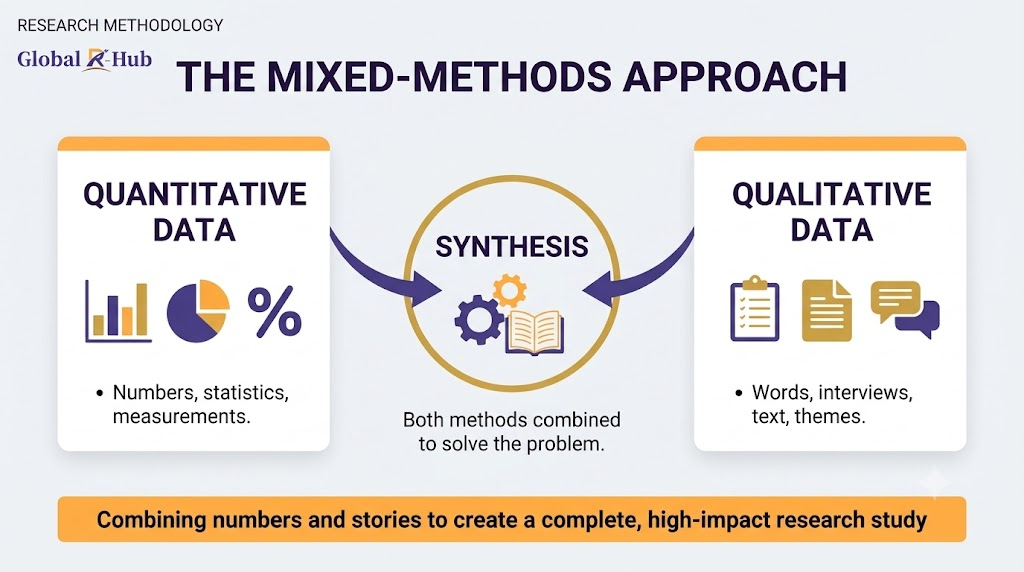
Executing an inter disciplinary project requires a highly structured methodology because you are balancing the evidentiary standards of two different fields. Humanities rely on qualitative analysis (themes, texts, context), while STEM fields rely on quantitative data (numbers, statistical significance).
When writing your methodology section, you must adopt a Mixed-Methods Approach. According to the American Psychological Association (APA), a mixed-methods design intentionally integrates both quantitative and qualitative data to provide a comprehensive analysis.
Define the Dominant Discipline: Decide which field is driving the core question. If you are analyzing the economic impact of a disease, Economics is the dominant discipline (quantitative), and Biology provides the contextual variables.
Justify the Synthesis: Your methodology section must explicitly state why the problem cannot be solved using only one discipline.
Layer the Data: Start with your quantitative data to establish what is happening (e.g., a statistical drop in crop yields). Then, introduce your qualitative data to explain why it is happening (e.g., historical letters documenting a drought).
Mastering a mixed-methods approach is notoriously difficult for high school students working independently. Attempting to balance advanced statistics with rigorous textual analysis often leads to a disjointed paper. The High School Scholar Program pairs students directly with university faculty who guide them step-by-step through designing a cross-disciplinary methodology, ensuring the final paper meets the rigorous standards required by top-tier universities.
An inter disciplinary project only impacts your university admissions profile if it is formally validated by third-party academics. You must format your final findings into a standard 3,000 to 5,000-word academic manuscript and submit it for peer review.
Because your research bridges two fields, you have a strategic advantage when selecting publications. You can submit to:
Field-Specific Journals: If your paper heavily leans toward one discipline (e.g., environmental science), you can target journals dedicated solely to that field.
General Undergraduate Journals: Platforms like the Journal of Student Research or the Columbia Undergraduate Science Journal frequently seek out interdisciplinary papers because they appeal to a broader academic readership.
Navigating the submission process formatting to specific academic styles (APA vs. Chicago), writing an abstract, and handling reviewer revisions is a distinct skill set. You can explore our directory of recommended journals to find vetted publications that accept high school interdisciplinary submissions and understand their specific formatting requirements.
What makes a good inter disciplinary project for high school? A strong project combines two distinct fields (such as computer science and literature, or biology and economics) to answer a specific, testable question. It should move beyond basic conceptual summaries and involve actual data collection, qualitative synthesis, or statistical analysis.
Do universities care about interdisciplinary research? Yes. Admissions officers at highly selective universities actively look for interdisciplinary research because it mirrors the reality of modern academia and industry. Real-world problems like climate change or artificial intelligence ethics are not confined to a single subject, and universities want students who can navigate complex, overlapping fields.
How do I choose two subjects to combine? Look for friction points between your strongest subject and a subject you are naturally curious about. If you excel in mathematics but care deeply about social justice, explore algorithmic bias in the legal system. The best projects occur where a technical skill set meets a complex human problem.