

9 Advanced Robotics Projects for Students
9 Advanced Robotics Projects for Students: From Kits to Published Research
Whether you are aiming for an Ivy League engineering program or preparing for international STEM competitions, building a functional robot is one of the most effective ways to demonstrate technical competence. However, not all robotics projects for students are created equal. Admissions committees and peer-reviewed journals are rarely impressed by pre-packaged kits that simply snap together. To stand out, you must transition from following instruction manuals to designing custom hardware, writing raw code, and solving open-ended engineering problems.
At a Glance: Student Robotics Fundamentals
Core Disciplines: Mechanical engineering (chassis/motors), electrical engineering (wiring/sensors), and computer science (coding/algorithms).
Standard Microcontrollers: Arduino Uno (best for beginners and hardware control) and Raspberry Pi (best for advanced computing and computer vision).
Programming Languages: C++ (for Arduino) and Python (for Raspberry Pi/ROS).
Average Project Cost: $50 to $150 for custom parts; significantly cheaper than commercial $400+ robotics kits.
On this page:
When searching for robotics projects for students, most beginners default to commercial ecosystems like LEGO Mindstorms. While these are excellent educational tools for young learners, they are "closed systems." All the parts are guaranteed to work together, and the programming is often drag-and-drop.
For high school students applying to competitive programs at MIT, Stanford, or Imperial College London, closed systems do not demonstrate problem-solving. True engineering happens when things break, when components have mismatched voltage requirements, or when sensors return noisy data that must be filtered through code.
To build a compelling academic profile, you must build "open system" robots. This means sourcing individual components like DC motors, motor drivers, ultrasonic sensors, and microcontrollers and integrating them yourself. This approach not only saves money but also forces you to learn genuine C++ programming, circuit design, and soldering.
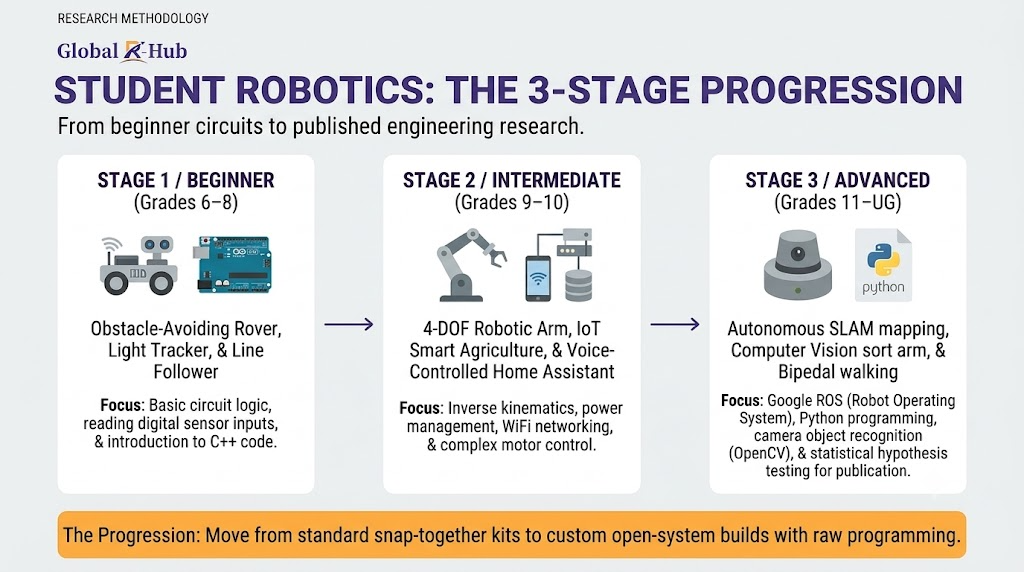
For younger students, the goal is to master the basics of circuits and simple logic loops. These projects utilize the Arduino Uno, the global standard for beginner microcontrollers.
1. The Autonomous Obstacle-Avoiding Rover
The Concept: A two-wheel-drive robot that drives forward until it detects a wall, stops, looks left and right, and turns toward the clear path.
Hardware Required: Arduino Uno, L298N motor driver, HC-SR04 ultrasonic sensor, standard DC gear motors, and a basic chassis.
Skills Learned: Basic C++
if/elsestatements, reading digital sensor data, and controlling motor direction via H-bridge drivers.Research Upgrade: Test how different sensor angles or materials (like glass vs. cardboard) affect the ultrasonic sensor's accuracy.
2. Light-Tracking Solar Panel (Dual-Axis Tracker)
The Concept: A robotic mount that uses photoresistors (light sensors) to track the brightest light source in a room and tilts a small solar panel to face it.
Hardware Required: Arduino, two micro servo motors (for pan and tilt), and four photoresistors.
Skills Learned: Analog-to-digital conversion, mapping sensor values to servo angles, and basic solar energy efficiency metrics.
3. The Line-Following Logistics Bot
The Concept: A classic project where a robot uses infrared (IR) sensors to stay on a black line drawn on a white floor.
Skills Learned: Calibrating IR threshold values and utilizing Proportional-Integral-Derivative (PID) control logic to keep the robot’s movements smooth rather than jerky.
Students building these foundational skills can benefit from structured guidance. The Young Scholar Program (Grades 6–8) helps younger students learn how to document their technical builds and begin asking the scientific questions that lead to formal research.
As students enter high school, robotics projects should move beyond basic movement and introduce complex mathematics, remote connectivity, and environmental interaction.
4. 4-DOF (Degrees of Freedom) Robotic Arm
The Concept: A stationary robotic arm capable of picking up objects and moving them to a designated location, controlled via potentiometers or a joystick.
Hardware Required: Multiple high-torque servos, 3D-printed or laser-cut acrylic arm segments, and an external power supply (microcontrollers cannot power multiple servos directly).
Skills Learned: Inverse kinematics (calculating the joint angles required to position the robotic hand at a specific 3D coordinate) and power management.
5. IoT Smart Agriculture Robot
The Concept: A stationary robotic system that monitors soil moisture, humidity, and temperature, automatically deploying a water pump when the soil is dry, and logging the data to an online dashboard.
Hardware Required: NodeMCU or ESP32 (microcontrollers with built-in Wi-Fi), soil moisture sensors, and a relay module.
Skills Learned: Internet of Things (IoT) networking, API integration, and automated resource management.
6. Voice-Controlled Home Assistant Bot
The Concept: A robot that responds to specific voice commands (e.g., "turn on the lights" or "move forward") by processing audio inputs.
Skills Learned: Bluetooth/Wi-Fi module integration, basic natural language processing (NLP), and interfacing hardware with smartphone applications.
For students aiming to publish academic papers or secure university internships, projects must involve advanced computer science, specifically the integration of the Raspberry Pi and Python-based algorithms.
7. Autonomous SLAM Mapping Robot
The Concept: A robot placed in an unknown maze that drives itself while simultaneously drawing a 2D digital map of the environment using LIDAR (Light Detection and Ranging).
Hardware Required: Raspberry Pi, 2D LIDAR scanner, and encoders on the motors to track distance traveled.
Skills Learned: SLAM (Simultaneous Localization and Mapping) algorithms and utilizing the open-source Robot Operating System (ROS).
8. Computer Vision Sorting Arm
The Concept: A robotic arm equipped with a camera that looks at objects on a conveyor belt, identifies their color or shape, and sorts them into correct bins.
Hardware Required: Raspberry Pi, Raspberry Pi Camera Module, and a robotic arm setup.
Skills Learned: Integrating OpenCV (Open Source Computer Vision Library) with Python to train the robot to recognize pixels, contours, and object profiles.
9. Bipedal Walking Robot
The Concept: A two-legged robot that must balance and walk without falling over, mimicking human gait.
Skills Learned: Advanced center-of-mass calculations, dynamic balancing using gyroscopes and accelerometers (IMU sensors), and complex gait-sequencing algorithms.
If you have a unique engineering concept in mind but need help narrowing it down into a testable hypothesis, exploring a curated list of research project ideas can help you bridge the gap between building a robot and conducting formal academic research.
To execute these projects, students must familiarize themselves with the industry-standard tools used by professional engineers.
Hardware:
Arduino: Best for reading sensors and controlling motors with precise timing.
Raspberry Pi: A microcomputer capable of running a full Linux operating system; required for processing video feeds and heavy algorithmic math.
Sensors: Ultrasonic (distance), Infrared (line tracking), IMU (balance/tilt), and LIDAR (mapping).
Software:
C++ (Arduino IDE): The mandatory language for programming Arduino boards.
Python: The dominant language for machine learning, computer vision, and Raspberry Pi programming.
ROS (Robot Operating System): An open-source framework utilized globally by robotics researchers to write complex robot software. According to the official ROS documentation, it provides the libraries and tools necessary to build complex, scalable robotic behavior across multiple platforms.
Building a robot is an engineering achievement, but to publish a paper, you must conduct research. This means your robot must be used as a tool to answer a scientific question.
For example, simply building a computer vision sorting arm is a project. However, hypothesizing that "Algorithm A will identify and sort recyclable plastics 15% faster and with higher accuracy under low-light conditions than Algorithm B" transforms the project into a formal empirical study. You can collect data on sorting speed, calculate the error rates, and write a methodology detailing your findings.
Transitioning from a hobbyist builder to a published researcher requires strict adherence to academic formatting, statistical analysis, and peer-review standards. The High School Scholar Program (Grades 9–12) pairs driven students directly with university faculty mentors. Your mentor will guide you through the process of formulating a hypothesis, running rigorous trials with your robot, and formatting your final data into a manuscript ready for publication in a vetted STEM journal.
What is the best robotics project for a beginner student? The autonomous obstacle-avoiding rover is universally considered the best starting point. It teaches students how to wire a basic circuit, power DC motors, and write simple C++ logic (e.g., "if the sensor sees a wall closer than 10cm, turn right") using an affordable Arduino Uno.
Do I need to know how to code to build a robot? To build research-grade, custom robots, yes. While some commercial kits offer block-based coding, advancing in robotics requires learning text-based languages. C++ is essential for controlling microcontrollers like Arduino, while Python is the standard for advanced tasks like computer vision and AI integration on a Raspberry Pi.
Can a high school robotics project be published in a journal? Yes, provided the project is framed as empirical research. You cannot publish a paper simply stating "how I built a robot." You must use the robot to test a hypothesis, collect original performance data, analyze that data statistically, and format the findings into a standard academic manuscript.