

Environmental Project Topics for College Students

7 Advanced Environmental Project Topics for College Students
Transitioning from high school science fairs to university-level research requires a massive shift in methodology. You can no longer rely on simple observational experiments or building physical models. To impress international university admissions committees or secure a fellowship, you must design empirical studies that generate original data. Exploring rigorous environmental project topics for college students means learning to utilize geographic information systems (GIS), statistical modeling, and formal life cycle assessments to solve complex ecological problems.
At a Glance: College-Level Environmental Research
The Goal: To generate original, statistically significant data that can be published in a peer-reviewed academic journal.
Core Methodologies: Spatial analysis (GIS), remote sensing, longitudinal field sampling, and Life Cycle Assessments (LCA).
Essential Free Tools: QGIS (for mapping), Google Earth Engine (satellite data), and R or Jamovi (for statistical analysis).
Ideal Timeline: 3 to 6 months from literature review to final manuscript.
On this page:
Many students waste months on projects that universities ultimately view as juvenile. Planting trees, organizing a campus cleanup, or building a miniature solar oven are excellent community service activities, but they are not academic research.
A college-level environmental science project must contain three elements:
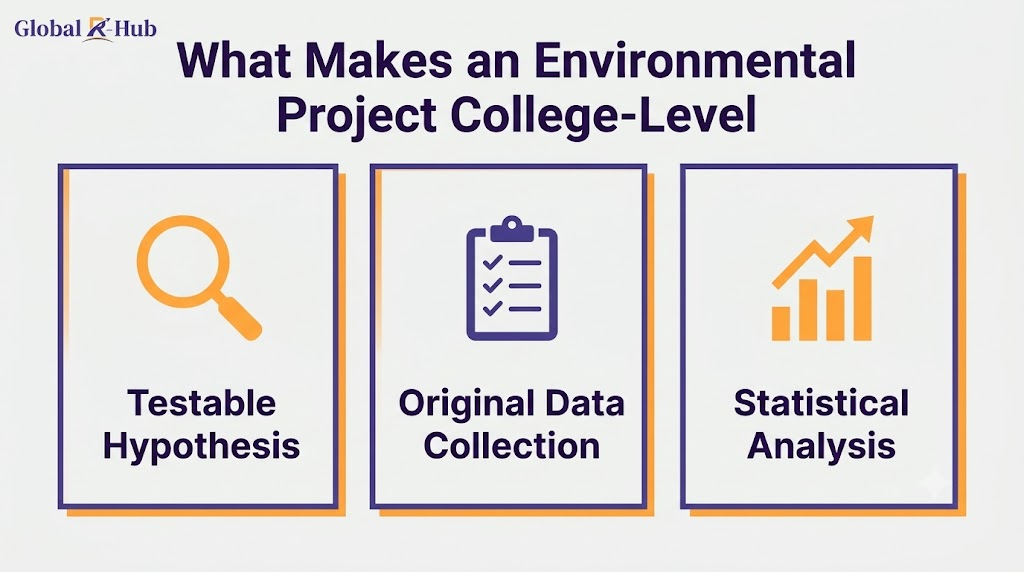
A Testable Hypothesis: You must be trying to prove or disprove a specific relationship between variables, not just demonstrating a known fact.
Original Data Collection: You must either collect primary data from the field/lab or synthesize existing large-scale secondary datasets (like government satellite imagery) in a completely new way.
Statistical Analysis: You cannot just present a chart of averages. You must use inferential statistics (like t-tests or ANOVA) to prove your findings are not the result of random chance.
If you want your research to stand out on a university application or a graduate school resume, bypass the standard "water filtration" experiments. Here are seven rigorous project frameworks that utilize professional methodologies.
1. GIS Mapping of Urban Heat Islands and Income Disparity
The Concept: Urban Heat Islands (UHIs) occur when cities replace natural land cover with dense concentrations of pavement and buildings, which absorb and retain heat.
The Research Question: Is there a statistically significant correlation between a neighborhood's median household income and its localized land surface temperature during peak summer months?
Methodology: Use QGIS (a free, open-source geographic information system) to overlay publicly available thermal satellite imagery (such as Landsat 8 data) with local census income tracts.
Why it works: It crosses environmental science with sociology, demonstrating highly sought-after spatial analysis skills.
2. Microplastic Accumulation Rates in Local Freshwater Bivalves
The Concept: Bivalves (like freshwater mussels or clams) are filter feeders. They process large volumes of water, making them excellent bio-indicators for microplastic pollution.
The Research Question: How does the proximity to municipal wastewater discharge points affect the concentration of microplastics found in the digestive tracts of local bivalve populations?
Methodology: Collect samples at varying distances from a known discharge point. Digest the biological tissue using a potassium hydroxide (KOH) solution in a lab, and quantify the remaining microplastics using a dissecting microscope.
3. Life Cycle Assessment (LCA) of "Sustainable" Fast Fashion Alternatives
The Concept: Clothing brands frequently market alternative fabrics (like bamboo viscose or recycled polyester) as eco-friendly, but the manufacturing processes are often highly chemical-intensive.
The Research Question: When accounting for chemical processing, water usage, and transportation, does bamboo viscose actually possess a lower overall carbon footprint than conventional organic cotton?
Methodology: Conduct a standardized Life Cycle Assessment (LCA) boundary analysis from "cradle to gate" (raw material extraction to factory output) using open-source LCA databases and literature reviews to calculate the total environmental impact.
4. Soil Phytoremediation Efficacy Using Native Flora
The Concept: Phytoremediation is the use of living plants to clean up soil, air, and water contaminated with hazardous contaminants.
The Research Question: Which native grass species demonstrates the highest uptake rate of heavy metals (such as lead or zinc) in soil samples taken from post-industrial urban lots?
Methodology: In a controlled greenhouse or lab setting, grow 3-4 different native plant species in soil spiked with known, safe concentrations of a specific metal. After an 8-week growth cycle, test the plant tissue (roots vs. shoots) to measure the concentration of the extracted metals.
5. Behavioral Economics of Campus Energy Consumption
The Concept: Environmental solutions are often limited by human behavior rather than technology.
The Research Question: Does the implementation of real-time, peer-comparative energy dashboards in university dormitories significantly reduce individual electricity consumption compared to standard monthly billing?
Methodology: Partner with a school or university facility management team. Establish a control group (dorm receiving normal bills) and an experimental group (dorm receiving real-time data comparing their usage to their neighbors). Run a two-sample t-test on the kilowatt-hour usage over three months.
6. Remote Sensing of Deforestation and Local Rainfall Patterns
The Concept: Large-scale deforestation disrupts the local water cycle, potentially altering micro-climates.
The Research Question: How has the 10-year reduction in forest canopy cover in [Specific Region] mathematically correlated with shifts in the region's annual dry-season precipitation?
Methodology: Utilize Google Earth Engine to analyze a decade of satellite vegetation indices (like NDVI) and cross-reference this data with historical rainfall datasets from local meteorological stations.
7. Bio-Acoustic Monitoring of Avian Biodiversity
The Concept: Measuring biodiversity traditionally requires hundreds of hours of manual field observation. Bio-acoustics automates this using sound.
The Research Question: How does acoustic species richness (measured via autonomous audio recorders) differ between a managed urban park and an unmanaged secondary forest edge?
Methodology: Place passive acoustic recorders in two different habitats for two weeks. Use open-source sound analysis software (like Audacity or specialized ornithology AI tools) to process the audio files, identifying the number of distinct species calls (vocalizations) during dawn choruses.
If you have a different environmental interest but need help structuring it into a viable study, browsing a database of research project ideas can help you convert a broad topic into a testable hypothesis.
Once you select your topic, you must write a highly detailed methodology. In college-level environmental science, if another researcher cannot replicate your study perfectly based on your written instructions, your data is considered invalid.
A rigorous environmental methodology must define:
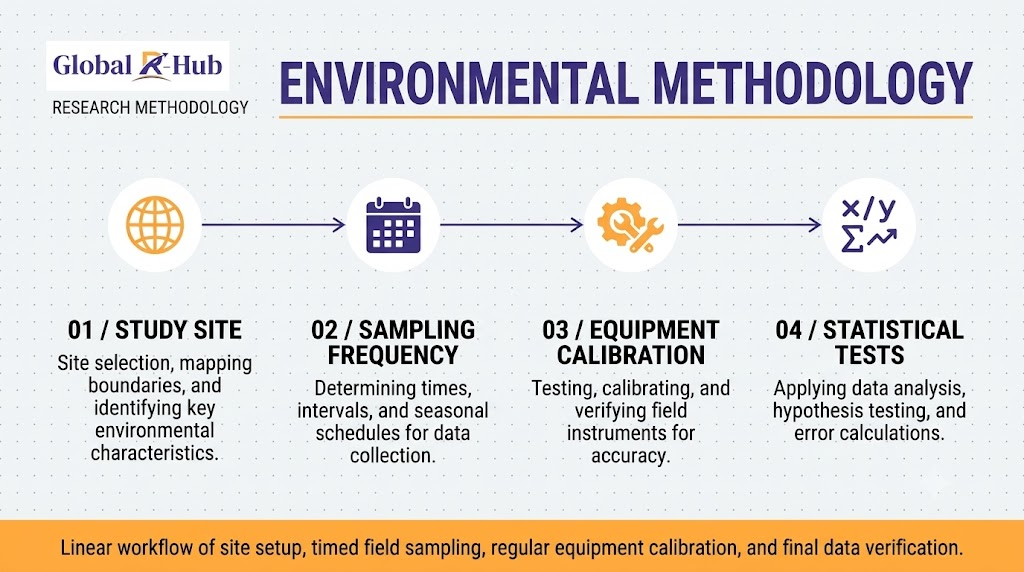
The Study Site: Provide exact GPS coordinates, elevation, and historical context of where you sampled.
Sampling Frequency: State exactly when and how often you collected data. Did you test water quality once a month, or every day for two weeks?
Equipment Calibration: Name the specific brands and models of any sensors or software used (e.g., "pH was measured using a YSI ProDSS multiparameter water quality meter, calibrated daily").
Statistical Tests: Explicitly name the math you used to prove your point. Do not just say, "The data was analyzed." Say, "A one-way ANOVA was conducted to determine the variance between the three soil groups."
Executing this level of empirical rigor independently is notoriously difficult for students transitioning to university standards. The Undergraduate Scholar Program pairs students directly with active university faculty mentors. Your mentor will help you design a flawless methodology, navigate complex statistical software, and ensure your final environmental analysis meets the strict standards of academic peer review.
The final step of a college-level project is publication. Conducting the research is only half the battle; formatting your findings into a 4,000-word manuscript and submitting it to a peer-reviewed journal is what ultimately validates your work to university admissions officers and future employers.
Environmental science is highly interdisciplinary, meaning you have multiple avenues for publication:
Subject-Specific Journals: Look for undergraduate journals that focus strictly on ecology, earth sciences, or sustainability.
General STEM Undergraduate Journals: Platforms like the Journal of Student Research accept rigorous environmental papers alongside biology and physics submissions.
Policy Journals: If your project leans toward human impact (like the urban heat island or behavioral economics topics), social science and public policy journals are excellent targets.
Navigating the submission process requires strict adherence to formatting guidelines (usually APA or CSE style for environmental sciences). You can explore our curated directory of recommended journals to find vetted platforms that actively seek out and publish undergraduate-level empirical research.
What is a good environmental science research topic? A strong topic focuses on a highly specific, localized issue that you can actually measure. Instead of studying "global climate change," study "the impact of road salt runoff on the pH levels of a specific local stream." Localized, measurable topics generate the best data.
Do I need a laboratory to do environmental research? No. While topics like microplastic analysis require a lab setup, many of the most advanced environmental project topics for college students rely entirely on computer-based modeling. Projects using GIS mapping, remote satellite sensing, and Life Cycle Assessments (LCA) only require a laptop, open-source software, and internet access to public databases.
How long should a college environmental research project take? To produce publishable data, expect to spend 3 to 6 months on the project. This timeline includes one month for the initial literature review, one to two months for active data collection or field sampling, and one to two months for statistical analysis and manuscript formatting.

