

Abstract Writing Format: Guide & Examples

How to Master the Abstract Writing Format for Academic Papers
You have spent months conducting experiments, analyzing data, and writing a 4,000-word manuscript. Now, you face the hardest task of the entire process: condensing that exhaustive study into a single paragraph. Mastering the abstract writing format is critical because, for peer reviewers, admissions committees, and database algorithms, the abstract is often the only part of your paper they will ever read. If it fails to communicate your methodology and statistical results clearly, your research will not get published or cited.
At a Glance: Academic Abstract Standards
Standard Word Limit: 150 to 250 words maximum.
Placement: Directly after the title page, before the introduction.
Core Structure: Background, Methods, Results, and Conclusion (mapping to the IMRaD format).
The Golden Rule: Always write your abstract after the rest of your manuscript is 100% finished.
Citations: Never include citations or references in an abstract.
On this page:
Before you open a blank document, you must determine which type of abstract your target journal or competition requires. The two primary categories dictate entirely different writing strategies.
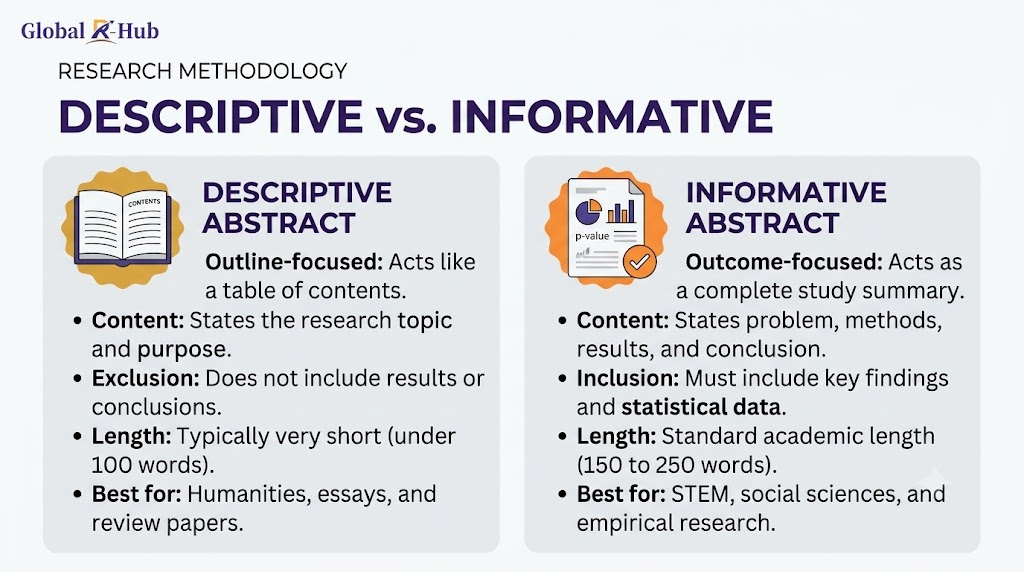
Descriptive Abstracts A descriptive abstract acts like a table of contents in paragraph form. It tells the reader what topics the paper covers, but it does not reveal the actual results or the conclusion. These are typically very short (under 100 words) and are most commonly used in humanities papers, theoretical essays, or review articles.
Informative Abstracts If you are conducting original empirical research in STEM or the social sciences, you must use an informative abstract. This format acts as a complete surrogate for the paper itself. It explicitly states the hypothesis, details the exact methodology, reveals the primary data (including statistical significance), and outlines the final conclusion. When high school or undergraduate students are submitting to scientific journals, they are almost universally required to write informative abstracts.
Once you know you are writing an informative abstract, you must check the author guidelines of your target publication to see if they require a structured or unstructured format.
Feature | Unstructured Abstract | Structured Abstract |
Visual Layout | One continuous, unbroken paragraph. | Divided by bolded subheadings. |
Common Use | Standard APA formatting; most humanities and social science journals. | Medical journals (e.g., The Lancet), clinical psychology, and hard sciences. |
Required Sections | Background, Methods, Results, Conclusion flow naturally into each other. | Explicit headers: Background:, Methods:, Results:, Conclusions:. |
Readability | Requires careful transition sentences to maintain flow. | Easier to scan quickly; prevents authors from accidentally skipping a section. |
If the journal does not explicitly demand a structured abstract, default to the unstructured, single-paragraph format required by the American Psychological Association (APA).
A flawless abstract writing format maps directly to the IMRaD structure (Introduction, Methods, Results, and Discussion) of your main paper. Because you only have roughly 250 words, you must allocate your sentences with extreme precision.
1. Background and Objective (2–3 Sentences)
Do not waste your limited word count on broad historical context or cliché openings. Start by identifying the specific gap in the current academic literature, followed immediately by your research question or hypothesis.
Weak: "Climate change is a big problem in today's world, especially for agriculture."
Strong: "While the impact of drought on wheat yields is well-documented, the localized effect of micro-ice ages on 17th-century European agrarian economies remains under-researched. This study investigates the correlation between paleoclimatology data and agricultural collapse in France between 1640 and 1660."
2. Methodology (2–3 Sentences)
You must explain exactly what you did to answer the question. For empirical research, this requires naming your sample size, your variables, and your specific analytical approach.
Crucial Details: Did you run a randomized controlled trial? Did you distribute a Likert-scale survey to 400 high school students? Did you use Python to scrape text from political speeches? State the exact tools and population used.
3. Results (3–4 Sentences)
This is the most important section of your abstract. Do not simply say, "The results are discussed." You must provide the hard data. If you ran quantitative research, include your primary finding and its statistical significance (e.g., your p-value or confidence interval). If you ran qualitative research, state the dominant theme you uncovered.
Example: "The analysis revealed a statistically significant correlation (p < 0.01) between urban heat islands and localized asthma admission rates, with concrete-dense sectors experiencing a 14% higher admission rate than baseline neighborhoods."
4. Conclusion (1–2 Sentences)
Conclude by answering the "So what?" question. What is the real-world application of your finding? Avoid making sweeping claims that your data cannot support; simply state the direct implication of your results on the specific field of study.
Drafting these 250 words often takes longer than writing a 10-page literature review. If you are struggling to condense complex data into this rigid structure, reviewing established research project ideas and reading the abstracts of the papers associated with them is the best way to internalize the pacing and vocabulary required.
The abstract writing format does not end with the summary paragraph. Directly below the abstract, you must include a list of keywords.
Academic databases (like PubMed, JSTOR, or Google Scholar) use these keywords to index your paper. If you choose the wrong keywords, other researchers will never find your work to cite it.
Rules for Keywords:
Quantity: Provide 3 to 5 keywords or short phrases.
Formatting: In standard APA style, indent the line, italicize the word Keywords:, and then list the words in lowercase, separated by commas (no period at the end).
Selection: Choose specific terms that appear in your paper but ideally do not appear in your title. If your title is "The Impact of Sleep on Teenage Cognition," do not use "Sleep" or "Cognition" as keywords; the search engine already indexes the title. Instead, use terms like "circadian rhythm," "memory consolidation," and "adolescent development."
When journal editors desk-reject a manuscript without sending it to peer review, it is usually because the abstract violates basic academic conventions. Avoid these frequent missteps:
Writing the Abstract First: You cannot summarize results you have not yet finalized. Always write the abstract as the very last step, after your final conclusion is polished.
Including Citations: An abstract must be entirely self-contained. Never cite other authors (e.g., "Smith, 2021") in this section.
Using Acronyms: Unless an acronym is universally understood (like DNA or NASA), write the term out completely.
Copy-Pasting from the Paper: Do not simply lift sentences from your introduction and paste them into the abstract. The abstract requires newly generated text that synthesizes the broader paper.
Mastering this highly specific style of concise, objective writing is a steep learning curve for students accustomed to standard high school essays. Through the High School Scholar Program, students work one-on-one with university faculty who review and critique their abstracts, ensuring the final formatting, methodology reporting, and keyword selection meet the strict standards of peer-reviewed publishing.
Once your abstract and manuscript are polished, you must ensure they match the exact author guidelines of your target publication. Different publishers have distinct rules regarding word limits and structured subheadings. Consult our directory of recommended journals to find platforms that accept student research and carefully review their specific abstract submission requirements.
How long should an abstract be for a research paper? Most academic journals require abstracts to be strictly between 150 and 250 words. You should always check the specific author guidelines of the journal or conference you are applying to, as exceeding the word limit can result in automatic rejection.
What is the difference between an abstract and an introduction? An introduction sets up the background of the problem and ends with your hypothesis, but it does not reveal your findings. An abstract is a complete summary of the entire paper, meaning it must explicitly state your methodology, your final data/results, and your conclusion.
Can I put a graph or table in my abstract? No. Abstracts are strictly text-based. Any charts, graphs, data tables, or visual aids must be placed in the Results or Appendix sections of your full manuscript.
What is APA abstract format? In APA 7th edition formatting, the abstract belongs on its own page (page 2) after the title page. The word "Abstract" is bolded and centered at the top. The text itself is a single paragraph, double-spaced, with no indentation at the beginning. The keywords list is placed below it, indented, with the word Keywords: italicized.