

Avishkar Competition 2026: Complete Winning Guide
Avishkar Competition: Complete Guide to Winning India's Premier Research Contest
For Indian students building a profile for competitive international university admissions, stating that you have an "interest in science" on your application is no longer enough. Admissions officers at top-tier institutions expect verified proof of your ability to conduct independent, rigorous academic work. In India, the Avishkar competition stands as one of the most credible, structured platforms to prove this capability. Originally initiated as a state-level inter-university research convention, Avishkar has become a benchmark for student innovation, demanding empirical research, working models, and rigorous academic defense.
At a Glance: The Avishkar Research Convention
Origin: Initiated in 2006 by the Hon'ble Governor of Maharashtra to foster a research culture among students.
Participant Levels: Undergraduate (UG), Postgraduate (PG), Post-PG (Ph.D.), and Teachers/Faculty.
Structure: Four progressive stages (Intra-College, District, University, and State Level).
Format: Mandatory 1m x 1m poster presentation, followed by a working model exhibition and oral defense (Viva).
Core Focus: Cost-effective, indigenous solutions addressing specific regional, social, or industrial problems in India.
On this page:
The Avishkar competition is a tiered research convention designed to identify and nurture original research talent across Indian educational institutions. While its flagship format is the Maharashtra State Inter-University Research Convention, its framework heavily influences school-level science exhibitions, college tech fests, and regional innovation fairs across the country.
The convention forces students to step away from textbook memorization and engage directly with the scientific method. Participants cannot simply present a literature review of existing knowledge; they must identify a localized problem, formulate a hypothesis, test it, and present a viable solution.
Because the competition spans from the undergraduate level up to Ph.D. scholars, the judging standards are exceptionally high. High school students preparing to enter undergraduate programs, or current first-year undergraduates, must understand that they are entering a pipeline that values applied methodology over flashy, unproven concepts.
Avishkar strictly categorizes projects to ensure judges with the correct domain expertise evaluate each submission. To win, your project must fit cleanly into one of the following six disciplines. Submitting an agricultural tech project under pure engineering often results in immediate point deductions.
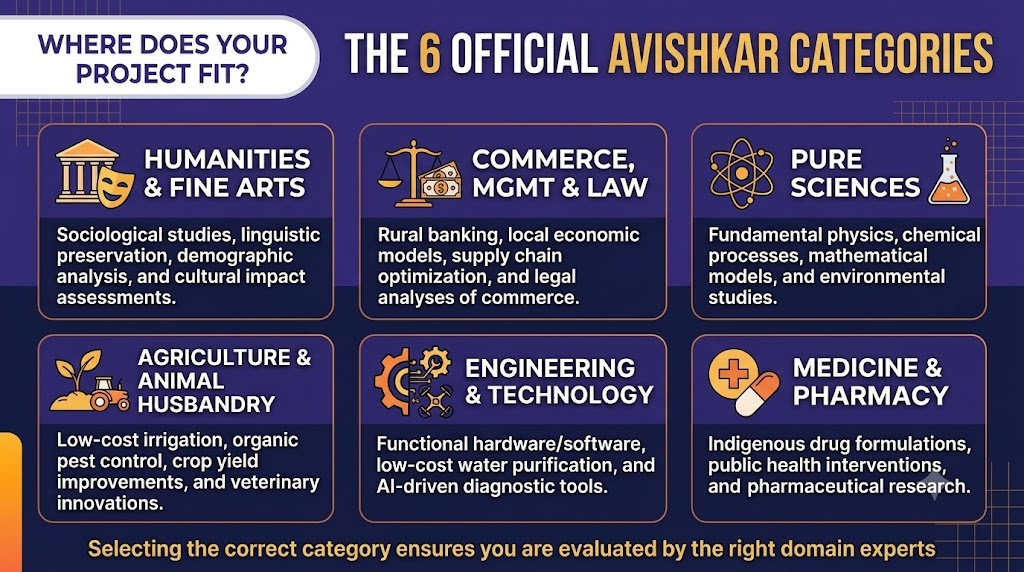
Humanities, Languages, and Fine Arts: Focuses on sociological studies, linguistic preservation, demographic analysis, and cultural impact assessments. Winning projects here often utilize extensive field surveys and statistical demographic data.
Commerce, Management, and Law: Requires research into local economic models, supply chain optimization, rural banking solutions, or analyses of specific legal frameworks impacting Indian commerce.
Pure Sciences: Encompasses physics, chemistry, mathematics, and environmental science. Judges look for fundamental scientific investigations, new material properties, or chemical processes that reduce industrial waste.
Agriculture and Animal Husbandry: Highly competitive and deeply relevant to India. Winning projects usually feature low-cost irrigation techniques, organic pest control formulations, crop yield improvements, or veterinary health innovations.
Engineering and Technology: Demands functional hardware or software models. Theoretical blueprints are rarely enough. You must present a working prototype—whether it is a specialized drone for disaster relief, a low-cost water purification system, or an AI-driven diagnostic tool.
Medicine and Pharmacy: Focuses on indigenous drug formulations, public health interventions, diagnostic devices, and clinical research methodologies.
Students often struggle to find a localized problem that fits these specific academic buckets. Reviewing curated research project ideas can help you bridge the gap between a broad interest (like climate change) and a hyper-specific, category-appropriate Avishkar project (like drought-resistant crop yields in a specific Indian district).
Understanding the rubric is the most critical step in your preparation. Judges at the University and State levels of the Avishkar competition do not score based on how expensive or complex your equipment is. They score based on four primary pillars:
Scientific Principle and Methodology: Did you follow a rigorous, empirical process? Judges will interrogate your sample size, your control variables, and your statistical analysis. If your data is flawed, the project fails.
Originality and Innovation: Are you presenting a genuine innovation, or did you recreate a YouTube tutorial? Your literature review must prove that your specific approach has not been attempted before.
Societal Impact: Does your research solve a real problem for a specific demographic? A highly complex robotics project that has no real-world application will lose to a simple, low-cost mechanical device that solves a daily struggle for local farmers.
Commercial Viability (Scalability): Can your working model be mass-produced cheaply? Projects that rely on exorbitant, imported materials rarely win. The focus is always on indigenous, cost-effective scaling.
Winning requires moving beyond the underlying science and mastering the presentation format. The competition is notoriously strict about its display rules and defense protocols.
Step 1: Solve a Hyper-Local Problem
Do not attempt to solve global warming. Attempt to solve the specific water contamination issue in a named river in your district. Avishkar judges are academics who value precise, scoped research over grandiose, untestable claims. Identify a local issue, consult with affected community members, and build your hypothesis around localized data collection.
Step 2: Master the 1m x 1m Poster
The first filter of the Avishkar competition is the poster presentation. The official rules mandate a poster size of exactly 1 meter by 1 meter.
Avoid dense blocks of text. Use bullet points, flowcharts, and high-contrast graphs.
Your poster must clearly state the Abstract, Hypothesis, Methodology, Results, and Conclusion.
Ensure the font is readable from at least four feet away. Judges will walk past dozens of posters; yours must communicate its core value proposition in under ten seconds.
Step 3: Build a Resilient Working Model
If you are competing in Engineering, Agriculture, or Pure Sciences, a working prototype is usually expected alongside the poster. Ensure your model is durable enough to survive transportation to the regional and state venues, and simple enough to be repaired on-site if a component fails during transit.
Step 4: Prepare for the Viva (Oral Defense)
The poster gets the judges' attention; the Viva wins the medal. Judges will aggressively question your methodology. They will ask what went wrong, why you chose a specific statistical model, and what the limitations of your study are. You must answer confidently without becoming defensive. Acknowledging the limitations of your research shows intellectual maturity, whereas pretending your model is flawless indicates a lack of scientific rigor.
If your project involves complex data sets or requires university-level statistical analysis, independent preparation can be daunting. Engaging in structured mentorship, such as the High School Scholar Program, pairs ambitious students with active academic researchers who can help refine your methodology and practice rigorous oral defense techniques long before the actual competition date.
A common misconception among Indian students is that only international competitions like the ISEF matter for US or UK university admissions. This is false. Top-tier admissions committees understand the prestige and rigor of regional Indian platforms like the Avishkar competition, the KVPY (historically), and the INSPIRE awards.
When updating your Common App activities list, do not simply write "Participated in Avishkar." Frame the achievement using metrics and outcomes. For example: "Gold Medalist, State-Level Avishkar Research Convention. Designed and defended a low-cost hydro-filtration model for rural agriculture, advancing past 4,000 regional competitors. Evaluated by university faculty."
Furthermore, the research you conduct for Avishkar should not end when the competition closes. A winning Avishkar project provides the perfect foundational manuscript to be expanded, formatted into a formal academic paper, and submitted for presentation at global academic symposiums, such as the ICONSTARS conference. Converting a domestic competition win into an international peer-reviewed presentation demonstrates the exact trajectory of intellectual curiosity that elite universities demand.
Who is eligible to participate in the Avishkar Research Convention? Avishkar allows participation across four distinct categories: Undergraduate students (UG), Postgraduate students (PG), Post-PG students (such as M.Phil or Ph.D. scholars), and regular Teachers/Faculty members. High school students typically participate in derivative school-level science fairs modeled on the Avishkar framework before entering the official UG track in college.
What are the poster size requirements for Avishkar? The official regulations mandate that all research posters must be exactly 1 meter by 1 meter (1m x 1m). Flex prints or standard scientific poster paper are permitted, but they must strictly adhere to these dimensions to be mounted on the provided exhibition boards.
Can a team participate, or is it strictly individual? Students can participate individually or in small teams, but specific rules regarding team size vary slightly depending on the university hosting the state-level finals that year. Generally, only one or two presenting authors are permitted to stand with the poster and defend the project during the official Viva rounds.
Is theoretical research allowed in Avishkar? Yes, primarily in the Humanities, Languages, and Fine Arts category, or Commerce and Law. However, for Engineering, Agriculture, and Pure Sciences, judges strongly prefer and actively reward applied research that includes a physical working model, a software prototype, or empirical, field-tested data.